

The late afternoon sun, a gentle cascade of amber through my window, often finds me scrolling.
A quiet hum of information overload, a flicker of fleeting delights.
Lately, however, instead of the endless feed, I have found myself leaning into a different kind of digital engagement.
There is a particular calm in creating something intentional, something that answers a deeper curiosity.
It started with a simple thought: what if I could truly learn what I wanted, without the rigidity of formal education or the distraction of the internet’s endless rabbit holes?
It turns out, AI is not just for business strategy or content generation; it is a surprisingly powerful ally in crafting a deeply personal journey of lifelong learning.
You can use AI, specifically tools like ChatGPT, to develop your own personalized fall learning curriculum.
By feeding it your interests and refining its suggestions, you can create structured monthly modules that foster intentional, fun, and flexible self-learning, transforming idle curiosity into focused knowledge exploration.
Why This Matters Now: Beyond the Scroll
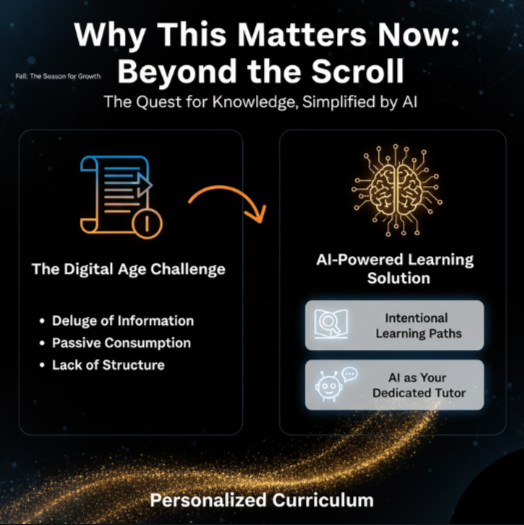
The digital age often presents a deluge of information, making deep engagement challenging.
However, a growing number of individuals recognize learning as a continuous journey, seeking greater agency over their intellectual growth.
This pursuit involves replacing passive consumption with intentional, themed exploration, rediscovering the joy of learning for its own sake.
As fall invites introspection and new routines, it presents an ideal season to cultivate such enriching practices, fostering a personalized curriculum.
The Quest for Knowledge, Simplified by AI
The core problem for many aspiring self-learners is not a lack of interest, but a lack of structure.
How do you transform a vague fascination into a tangible learning path?
The sheer volume of available information can be paralyzing.
Here is a counterintuitive insight: the very technology often blamed for our scattered attention can become our greatest organizer.
Artificial intelligence, particularly sophisticated language models like ChatGPT, offers a dynamic solution, capable of distilling vast amounts of information into coherent, personalized learning frameworks.
It is like having a dedicated, patient tutor at your fingertips, ready to help you chart a course through your curiosities with AI learning.
My Journey: From Vague Interests to Defined Modules
My own path to a personalized curriculum began, as many good journeys do, with a question to ChatGPT.
I was curious about self-learning and how to structure a syllabus.
The AI provided a helpful overview, but I knew my learning needed to be fluid, fun, and flexible—and most importantly, aligned with my current curiosities.
I liked the idea of monthly themes, a mix of theoretical and practical tasks, and perhaps a seasonal tie-in for my fall curriculum.
Initially, ChatGPT’s suggestions were a bit abstract and too focused on traditional fall themes, like tree and leaf observation.
While lovely, they did not resonate with my specific, deeply personal context.
I am currently trying to conceive, and my personal themes are simplicity and ease.
The initial AI output, based on its general knowledge, missed this nuance.
In a follow-up prompt, I explicitly told ChatGPT to forget about the fall season and focus purely on my interests.
We got closer, but its suggestions still leaned on previous prompts or general personal development ideas, like practice networking with intention by hosting monthly dinners, which it had picked up from an earlier, unrelated goal I had mentioned.
This highlighted a crucial aspect of working with AI: it is a brilliant assistant, but it needs clear, precise guidance, especially when delving into the deeply personal.
Eventually, through several iterations, I landed on three topics that genuinely ignited my curiosity: reading ancient spiritual texts, exploring birth work, and understanding the art of sourdough baking.
You likely already have an instinctive grasp of what you would like to learn.
But sometimes, articulating it to an AI can spark an unexpected connection or crystallize a nascent idea.
Once you have those core fascinations, ChatGPT becomes your personal curriculum designer, ready to build out structured plans, activities, and assignments.
Lessons from the AI Lab: Guiding Your Digital Co-Pilot
While AI offers immense potential for personalized learning, my experience highlights a few key takeaways for effective collaboration.
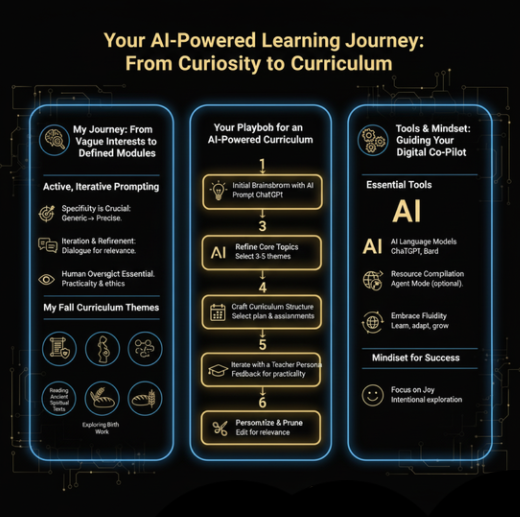
It is not about passively accepting its first output; it is about active, iterative prompting.
Specificity is crucial.
Generic prompts lead to generic results.
The more precisely you articulate your interests, learning style, and desired outcome, the better the AI can serve you.
For instance, instead of asking to learn about spirituality, specify reading ancient spiritual texts and even which spiritualities interest you.
Iteration and refinement are key.
Expect to engage in a dialogue with the AI.
My initial curriculum draft from ChatGPT was a mix of hits and misses.
Instead of simply accepting it, I provided feedback, prompting it to think more like a teacher and come up with more practical learning ideas.
This dramatic shift in perspective for the AI led to a far more relevant and structured plan.
Human oversight is essential.
ChatGPT might suggest a task like reaching out to a clinic in week 3.
While well-intentioned, this was not practical or desirable for my context.
A more suitable end-of-month assignment, after learning about birth work, would be to decide if, after everything learned, a doula course would be a next step.
Always review the AI’s suggestions through your own lens of practicality, relevance, and personal comfort.
Your Playbook for an AI-Powered Curriculum
Ready to embark on your own self-learning adventure?
Here is a playbook to guide you:
- First, unearth your fascinations.
Begin by identifying your current curiosities.
What topics have you always wanted to learn but never found the time for?
What sends you down delightful rabbit holes?
Do not censor yourself; jot down everything.
- Next, conduct an initial brainstorm with AI.
Open ChatGPT and ask it about personalized learning or developing a learning plan.
Share your raw list of interests.
Prompt it to suggest potential monthly themes or topics, reminding it to keep the suggestions fun, fluid, and flexible.
- Refine your core topics.
Review ChatGPT’s initial output.
Does anything resonate deeply?
Do you need to steer it away from seasonal clichés, as my experience showed?
Select three to five learning topics that genuinely excite you for your seasonal curriculum.
- Craft the curriculum structure.
With your chosen topics, prompt ChatGPT to create a learning curriculum for each topic, with an assignment or activity at the end of each month.
This lays out the foundational learning path.
- Iterate with a teacher persona.
This is where the magic happens.
Provide specific feedback, telling ChatGPT to think more like a teacher or provide more practical learning ideas.
Guide it towards specific subtopics or learning styles that appeal to you.
- Personalize and prune.
Go through each weekly suggestion and end-of-month assignment.
Ask yourself if it is realistic, relevant, and inspiring.
Do not hesitate to edit, delete, or refine.
For example, ensure learning lists are short, relevant, and achievable within your life.
- Resource Compilation, while optional, is recommended.
If you have a paid ChatGPT plan, explore its agent mode.
Prompt it to find all of the most important resources for a beginner learning about your chosen topic.
This can save hours of searching.
Risks, Trade-offs, and Ethical Considerations
While the utility of AI in personal learning is undeniable, it is crucial to approach it with a discerning eye.
Bias and Accuracy are important considerations.
AI models learn from vast datasets, which can carry inherent biases or present incomplete or even incorrect information.
Always cross-reference critical details, especially for sensitive topics.
Your human judgment remains paramount.
The Black Box problem can arise.
Sometimes, AI suggestions might feel disconnected or abstract, as experienced with initial fall-themed ideas.
This highlights the need for continuous, iterative prompting and explicit guidance to align the AI with your unique needs.
Avoid over-reliance.
The goal is not to outsource your learning entirely to AI, but to use it as an accelerator.
The critical thinking, synthesis of information, and real-world application still fall squarely on your shoulders.
Be mindful of data usage and privacy.
While personalized learning benefits from context, be aware of how your data might be used by AI tools.
Tools, Metrics, and Your Learning Cadence
For tools,
For tools, your primary curriculum design assistant will be ChatGPT or a similar large language model.
The paid version often offers more advanced features like agent mode for resource compilation.
Additionally, use Notion, Evernote, or a simple notebook for jotting down ideas, organizing your curriculum, and tracking your progress.
For metrics,
For metrics, since this is highly personalized self-learning, success is not measured by grades.
Instead, consider personal satisfaction, assessing how much joy you derive from the learning process.
Evaluate engagement consistency by tracking how regularly you engage with your chosen topics.
Gauge perceived mastery by asking if you feel you are gaining a deeper understanding or practical skill in the areas you are exploring.
Finally, consider application: are you able to apply what you are learning in real-world scenarios, like baking sourdough or discussing ancient texts?
For your learning cadence,
For your learning cadence, establish a monthly review.
At the end of each month, assess your progress: what did you learn, what worked well, and what adjustments are needed for the next module?
Additionally, conduct a seasonal reflection before starting a new season’s curriculum.
Take time to reflect on the past three months, considering if your interests evolved or if there are new personal development areas you want to explore.
FAQ
To get started creating your own AI learning curriculum, begin by listing everything you are curious about.
Then, use an AI tool like ChatGPT to brainstorm potential topics and structure them into monthly modules, guiding the AI with specific prompts about your interests and desired learning style.
If the AI’s initial suggestions are not helpful for your personalized curriculum, do not worry; this is common.
Refine your prompts by being more specific about your interests, your learning goals, and even asking the AI to think like a teacher or focus on practical application.
It is an iterative process.
Absolutely, AI can genuinely help with lifelong learning.
AI can act as a powerful assistant, helping you organize your educational AI journey, suggest resources, and structure your knowledge management so that personal growth and continuous learning become more accessible and enjoyable.
The best types of topics to choose for microlearning are those that genuinely fascinate you and align with your current curiosities.
Whether theoretical or practical, choose subjects that make hobby exploration feel less like a chore and more like a joy.
Conclusion: The Human Heart of AI Learning
The notion of a fall curriculum might conjure images of rigid textbooks and stern teachers.
But my experience with AI-powered self-learning has been anything but.
It has been a deeply human process, revealing how technology, when wielded with intention, can amplify our innate drive to explore and understand.
From the simple joy of shaping a sourdough loaf to the profound insights from ancient texts, this intentional, AI-assisted path offers a refreshing antidote to the passive consumption of information.
The cool thing about your personalized curriculum is that there are no rules.
Learn in whatever way feels fun for you, and lean on AI tools to make the process more productive.
So, as the days shorten and the world outside invites coziness, perhaps it is time to light a different kind of fire: the spark of tailored, human-first learning, designed by you, with a little help from your digital friend.
What will you discover this season?