
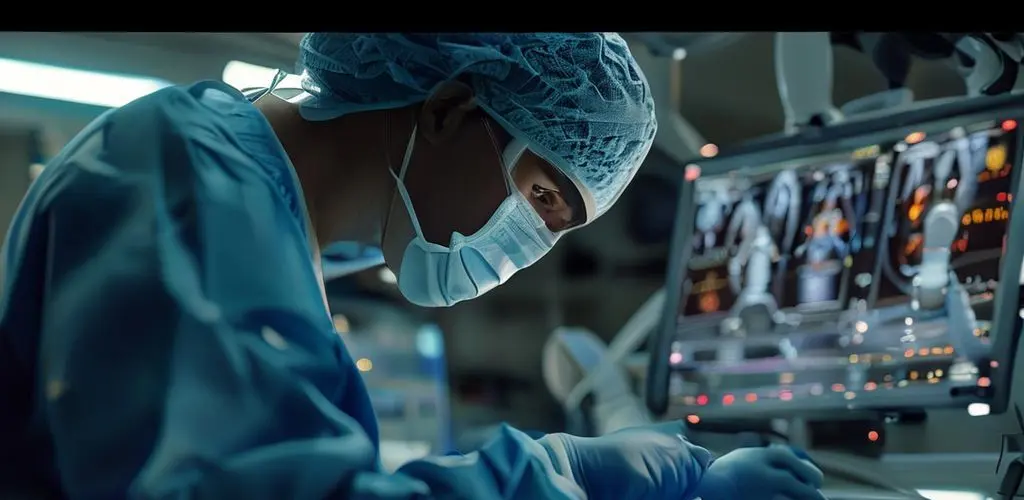
Telesurgery Tips: Building the Future of Remote Surgical Robotics, Human First
Dr. Anya Sharma, her brow furrowed, moved her hands with practiced precision.
Yet, her mind often wandered to remote patients for whom specialized surgery was a distant dream.
She imagined a world where her expertise could bridge miles, where life-saving procedures were dictated by possibility, not geography.
This vision of telesurgery is a future on the cusp of reality.
In short: Telesurgery is closer than ever, but technology is not the biggest barrier.
Sovato CEO Cynthia Perazzo advises device developers to prioritize regulatory navigation, patient-centric workflows, and latency management to unlock remote surgical robotics’ full potential.
Why Beyond the Code Matters Now
Dr. Sharma’s quiet reflection is not unique.
Telesurgery promises improved access to specialized care, reduced travel burdens, and optimized surgical talent.
Medical device development pushes technical boundaries in surgical robotics.
However, as Sovato Health CEO Cynthia Perazzo points out, the biggest obstacle is not technological prowess.
It is the intricate web of human systems, regulatory processes, and financial incentives that dictates adoption.
Perazzo emphasized to MDO in 2023 that technology is not the barrier.
Instead, she cited operating models, reimbursement structures, and incentives as the real challenges.
This shifts the focus from building better machines to integrating them seamlessly into healthcare’s complex ecosystem.
For device developers, understanding these non-technical challenges is as critical as mastering hardware and software.
Widespread telesurgery adoption depends on navigating vital non-technical hurdles.
These include securing patient consent, establishing robust credentialing and training for clinicians, and developing clear standards and protocols within health systems, as MDO reported in 2023.
Without these foundations, advanced surgical robotics will struggle to move from aspiration to common practice.
Insights from the Forefront
Cynthia Perazzo’s experience with Sovato offers key insights for medical device development, grounded in real-world challenges.
First, anticipate remote use from day one.
Perazzo emphasizes building surgical robotics systems expecting surgeons to operate from anywhere.
This means integrating IP protocols into software and communications.
She advised developers in MDO in 2023 to embed remote-ready architecture from the start to simplify network transmission.
Second, design for the entire patient journey.
While the FDA focuses on human factors during surgery, Perazzo notes healthcare workflows extend beyond the operating table.
She explained to MDO in 2023 that diverse daily routines, such as surgeons working across multiple operating rooms, demand thoughtful device integration.
A device’s true value stems from its usability across the entire patient care continuum.
Finally, do not overlook latency.
This critical technical consideration involves the robot’s compute power for video compression, encoding, and decoding.
High latency in video processing or inherent robot latency can degrade physician experience and limit practical telesurgery distance, as MDO reported in 2023.
Every millisecond counts for safety and surgeon confidence, a concern increasingly flagged by the FDA.
Developers must minimize latency.
Playbook for Tomorrow’s Operating Room
For medical device development teams, integrating Perazzo’s wisdom can future-proof innovations.
Here is a concise playbook:
- Engage Early with Regulatory Bodies.
- Architect for Network-First.
- Map the Holistic Patient Journey.
- Prioritize Latency Management.
- Innovate on Reimbursement Models.
- Embrace Modularity and Portability.
Risks Trade-offs and Ethics The Human Element in Remote Care
Telesurgery’s promise is immense, but its implementation carries inherent risks.
Patient safety is paramount; technical glitches or network disruptions could have severe consequences.
Robust redundancy and fail-safes are non-negotiable.
Data security and patient privacy are critical, demanding stringent encryption and regulatory compliance.
The trade-off often lies between speed to market and comprehensive integration.
Rushing a device without addressing regulatory complexities or workflow fit can delay widespread adoption.
Ethically, ensuring equitable access is vital.
There is a risk of exacerbating healthcare disparities if access is limited by broadband or socioeconomic factors.
Developers, partnering with health systems, have a moral responsibility to design solutions fostering dignity and making advanced care accessible to all.
This requires transparent discussions around patient consent.
Tools Metrics and Cadence Sustaining the Vision
To navigate the evolving telesurgery landscape, developers need robust systems for planning, tracking, and optimizing.
Tool Stacks
Project Management: JIRA, Asana.
Collaboration: Secure platforms like Microsoft Teams, Slack.
Simulation & Testing: Advanced software, hardware-in-the-loop environments.
Workflow Mapping: Digital tools like Lucidchart, Miro.
Performance Indicators
Track regulatory approval timelines.
Measure workflow integration satisfaction.
Monitor end-to-end system latency, targeting under 150 milliseconds.
Achieve 100 percent provider training.
Target over 75 percent pilot program adoption.
Review Cadence
Weekly: Internal technical and project reviews.
Monthly: Cross-functional meetings.
Quarterly: Feedback sessions with early adopters.
Bi-annually: Strategic reviews with payer organizations.
Frequently Asked Questions
What is the biggest hurdle for telesurgery adoption currently
According to Cynthia Perazzo, the biggest hurdles are regulatory processes, developing standards and protocols within health systems, and establishing viable operating models, reimbursement structures, and incentives.
Technology is not the primary barrier.
How can device developers future-proof their robotics systems for telesurgery
Developers should anticipate remote use by building software and communications on IP protocols.
They must also consider how their device fits into new, evolving workflows across the entire patient journey.
What commonly overlooked technical aspects can cause headaches for device developers
Key overlooked technical aspects include the robot’s compute power for video compression encoding decoding and managing the inherent latency of the robot itself.
Both are crucial for maintaining physician experience and extending the effective range of telesurgery systems, as noted by Perazzo in response to FDA inquiries.
Conclusion Bridging Miles Connecting Care
Dr. Anya Sharma’s vision, once a quiet whisper, is now a surging current pushing the boundaries of medical possibility.
The future of telesurgery is not just about advanced machines; it is about seamlessly integrating those machines into the human ecosystem of care.
Cynthia Perazzo’s insights from Sovato Health serve as a beacon for medical device development, reminding us that innovation thrives when technical brilliance is paired with a deep understanding of human needs, regulatory landscapes, and operational realities.
By embracing a holistic approach—designing for connectivity, optimizing workflows, managing latency, and navigating incentives—we can empower surgeons to bridge miles and deliver exceptional care.
Build with people first, and the technology will follow.
References
MDO Min-Vasive Medtech.
Telesurgery tips for device developers from Sovato’s Cynthia Perazzo.
2023.