

The afternoon sun, a golden shawl, draped itself over Anya’s face as she scrolled through university prospectuses.
Outside her Bangalore window, the city hummed with its usual relentless energy, but in her mind, she was miles away, adrift in a sea of academic choices.
For years, her dream had been clear: study abroad.
The traditional pathways had dominated her imagination, promising a future shaped by familiar routes.
But then, a friend’s casual remark, a vibrant Instagram reel showcasing sun-drenched plazas and animated conversations, had stirred something new.
Spain.
It seemed almost too romantic, too adventurous, a whisper of flamenco and ancient architecture contrasting with the rigorous academic pursuit she envisioned.
Yet, the more she researched, the more this seemingly unconventional choice began to reveal a surprising depth, a quiet confidence rooted in burgeoning opportunity.
This was not just a picturesque escape; it was an emerging academic powerhouse, attracting a new wave of global talent.
Her journey from traditional aspirations to a burgeoning fascination with Spain is not just Anya’s story; it is a microcosm of a much larger, global shift in where students are choosing to build their futures.
Why This Matters Now: A Shifting Global Education Landscape
Anya’s shift in perspective reflects a significant evolution in the global student mobility market.
For decades, a handful of countries have held a near-monopoly on international student ambitions.
But that landscape is changing, and new players are rising, offering compelling value propositions beyond just prestige.
Understanding these shifts is not just academic; it is crucial for educational institutions, policymakers, and indeed, any aspiring student considering their future.
In short, Spain is rapidly becoming a premier destination for international students, with official data showing a significant increase in enrollment, particularly from India, thanks to its appealing blend of academic opportunity and cultural richness.
The numbers provide a clear picture.
In the 2023-2024 academic year, Spain hosted a total of 2,350,805 students.
What is particularly compelling is that 101,871 of these, or 4.
3 percent, were international students.
This indicates a steadily expanding international community within the country, signifying its growing appeal on the global stage, according to University Living (2024).
This is not just about diversification; it is about strategic growth and capturing the attention of a generation seeking diverse, enriching experiences alongside world-class education.
The Quiet Ascent: Spain’s Emerging Role for International Students
For years, the narrative around international students Spain often focused on language immersion or cultural tourism.
But beneath the surface, something more substantial has been brewing.
Spain is not just a place for a holiday or a quick language course; it is solidifying its position as a serious contender for full degree programs, offering a compelling blend of academic rigor and lifestyle.
The core problem for traditional destinations is a saturation of the usual pathways and a growing desire among students for unique, globally-minded experiences that offer genuine value.
Students today are not just looking for a degree; they are looking for an adventure, an immersive cultural exchange, and a competitive edge in a globalized job market.
A counterintuitive insight here is that Spain’s relatively lower profile compared to, say, the UK or US, actually works in its favor, allowing it to cultivate a distinctive appeal built on warmth, approachability, and an emphasis on a high quality of life alongside learning.
It is less about being the loudest voice and more about being the most authentic experience.
A Glimpse from Afar: The Indian Student Wave
Consider a young professional like Rohan, an aspiring entrepreneur from Hyderabad.
He initially fixated on MBA programs in the UK, drawn by the familiar history and perceived stability.
Yet, the cost of living and intense competition began to feel overwhelming.
A mentor, someone who had lived and worked across Europe, suggested he broaden his horizons.
Look beyond the obvious, Rohan, she advised.
Sometimes the best opportunities are where everyone else is not looking yet.
Rohan’s research led him to Spain, and while the initial pull was the promise of a vibrant culture, the data on rising international enrollment, especially from India, reinforced his sense that he was not just chasing a dream, but tapping into a recognized, growing trend.
His peers, seeing the possibilities, began to ask him about Madrid’s business schools, the visa process, and whether he’d really learn Spanish.
The curiosity was palpable.

What the Research Really Says: The Data Behind the Dream
While Spain has long captivated hearts with its vibrant culture, recent data reveals its increasing gravitational pull for academic pursuits.
The European Student Landscape Report by University Living (2024) provides clear evidence of this trend, offering concrete numbers that underscore Spain’s growing popularity.
Spain is experiencing a steadily expanding international cohort.
In the 2023-2024 academic year, Spain saw a total student enrollment of 2,350,805.
Of these, a significant 101,871 students were international, representing 4.
3 percent of the total student population, according to University Living (2024).
This is not a trickle; it is a measurable and growing segment of the student body, signaling Spain’s effectiveness in attracting talent from around the globe.
For universities and marketing professionals, this indicates a fertile ground for further internationalization strategies, validating investment in outreach programs and culturally tailored communications, highlighting Spain’s general appeal as a study destination.
Among the international student population, 1,087 students hailed from India in 2023-2024, as reported by University Living (2024).
While still a smaller absolute number compared to some larger economies, this figure spotlights Spain’s growing popularity specifically among Indian students Spain, marking it as a country of increasing interest for this crucial demographic.
This data strongly suggests a targeted opportunity for educational institutions to deepen their engagement with the Indian market.
Marketing efforts should focus on tailoring messages to the specific aspirations and concerns of Indian families and students, leveraging the positive word-of-mouth and burgeoning interest reflected in these numbers.
This could involve partnerships with Indian educational consultancies or virtual recruitment drives directly targeting Indian applicants.
These findings from University Living (2024) affirm that Spain is not merely a transient trend but a rising force in international education, particularly resonating with the aspirations of students from diverse backgrounds like India.
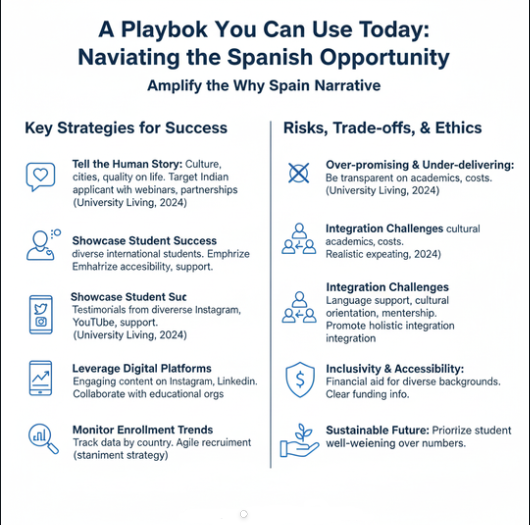
A Playbook You Can Use Today: Navigating the Spanish Opportunity
Amplify the Why Spain Narrative.
Beyond statistics, tell the human story.
Highlight the warmth of the culture, the beauty of the cities, and the quality of life that complements academic rigor.
While specific cultural data was not in our verified research, the general positive perception of Spain’s culture is a strong draw.
Targeted outreach to emerging markets is crucial.
Given the notable increase in Indian students Spain, as reported by University Living (2024), develop dedicated campaigns for this demographic.
This could involve specific informational webinars, cultural exchange programs, and partnerships with educational consultants in India.
Showcase student success stories
by featuring testimonials from current international students Spain, especially those from diverse backgrounds.
Authentic voices resonate powerfully, offering relatable experiences and tangible proof of Spain’s appeal.
Institutions should also emphasize accessibility and support.
While specific scholarship and visa rule details were not in the verified data, institutions should articulate clearly how they assist international students with applications, accommodation, and cultural integration, as these support systems are crucial.
Leverage digital platforms
by creating engaging content across social media platforms like Instagram, YouTube, and LinkedIn that visually showcases the campus environment, student life, and the unique Spanish backdrop.
Use compelling visuals to capture the imagination of prospective students globally.
Collaborate for impact by fostering partnerships between Spanish universities and international educational organizations.
This can amplify reach and credibility, particularly in markets like India, where trusted advisory networks are highly valued.
Continuously monitor enrollment trends closely.
Track international student enrollment data, particularly by country of origin, just as University Living provides in its European Student Landscape Report (2024).
This allows for agile adjustments to recruitment strategies, ensuring resources are directed where they will have the most impact.
Risks, Trade-offs, and Ethics: Building a Sustainable Future
While Spain’s growth as a study destination is exciting, it is crucial to acknowledge potential risks and ensure an ethical approach.
Over-enthusiastic recruitment without adequate support systems can lead to disillusionment and negative experiences.
One risk is over-promising and under-delivering.
Marketing Spain purely as a party destination or failing to adequately prepare students for the academic rigor or cost of living, which varies greatly by city, can create issues.
Mitigation involves being transparent about all aspects of student life, from academic expectations to potential challenges.
Provide realistic cost estimates and support services.
Another risk is integration challenges.
Not all international students immediately blend into a new culture, especially if they are primarily studying in English.
Mitigation includes offering robust language support, cultural orientation programs, and mentorship opportunities that foster genuine connection with Spanish students and the local community.
Promote international education trends that prioritize holistic integration.
An ethical consideration is inclusivity.
Ensuring accessibility for students from diverse economic backgrounds is vital.
While scholarships are a draw, institutions must actively work to make education financially feasible and welcoming for all.
Guidance suggests clearly communicating all available funding avenues and application processes.
Develop support services sensitive to the unique needs of students from different cultural and socioeconomic contexts.
Building a sustainable international student ecosystem means prioritizing student well-being and academic success over sheer enrollment numbers.
Tools, Metrics, and Cadence: Measuring What Matters
Effective management of international student recruitment and experience requires clear tools, metrics, and a regular review cadence.
Essential Tools
- a CRM system to manage student leads, applications, and communications, such as Salesforce or HubSpot.
- Analytics platforms like Google Analytics or Meta Business Suite are vital for website traffic, social media engagement, and campaign performance.
- A Student Information System (SIS) is necessary for tracking enrollment, academic progress, and student demographics.
- Finally, survey platforms such as Qualtrics or SurveyMonkey are used for gathering feedback on student satisfaction and experience.
Key Performance Indicators (KPIs)
are crucial for success.
- International Application Growth measures the percentage increase in applications from non-domestic students, with a target of 10-15 percent annually, or higher for specific regions like India.
- The International Enrollment Rate is the percentage of international applicants who enroll, with a target to aim for industry average or higher.
- Geographic Diversity tracks the number of countries represented by international students, with a goal to broaden representation annually.
- Student Retention Rate, the percentage of international students who continue studies year-over-year, should aim for 85 percent or higher.
- The Student Satisfaction Score, an average score from surveys on overall experience, should target 4.0/5.
0 or higher.
A regular review cadence
ensures continuous improvement.
- Weekly, monitor application trends, website traffic, and social media engagement.
- Monthly, review recruitment campaign performance, budget utilization, and initial student feedback.
- Quarterly, analyze enrollment figures, retention rates, and assess progress against strategic goals, discussing challenges and adapting recruitment strategies.
- Annually, conduct a comprehensive review of the entire international student strategy, incorporating insights from reports like the European Student Landscape Report by University Living (2024), and set objectives for the upcoming academic year.
Glossary
International Student:
A student enrolled in a higher education program in a country other than their country of origin.
European Student Landscape Report:
A publication analyzing trends and data related to student enrollment across Europe.
CRM System:
Customer Relationship Management system, software used to manage and analyze customer interactions and data throughout the customer lifecycle.
KPI:
Key Performance Indicator, a measurable value that demonstrates how effectively a company is achieving key business objectives.
Student Retention Rate:
The percentage of students who remain enrolled in a program or institution from one period to the next.
FAQ
Q: Are there opportunities for Indian students in Spain?
A: Yes, Spain is gaining popularity among Indian students, with 1,087 Indians enrolled in 2023-2024, according to University Living (2024).
Q: What is the trend for international students in Spain?
A: Spain’s international student population is steadily expanding.
In 2023-2024, 101,871 international students made up 4.
3 percent of the total student body, as reported by University Living (2024).
Q: Who publishes data on student enrollment in Spain?
A: The European Student Landscape Report by University Living provides comprehensive data on student enrollment in Spain and across Europe (University Living, 2024).
Conclusion
Anya, somewhere in Spain, is likely navigating her classes, perhaps practicing a new Spanish phrase in a bustling market, or sharing stories with friends from around the globe.
Her decision, mirrored by thousands of others, highlights Spain’s quiet but powerful emergence on the global academic stage.
It is a country proving that you do not need to be the loudest to attract the best; you just need to offer an authentic, enriching experience backed by growing opportunities.
The numbers from University Living (2024) confirm a trend: Spain is increasingly a top choice for international students Spain, particularly those from nations like India, seeking quality education alongside a life well-lived.
As the world shrinks and students seek horizons beyond the familiar, Spain stands ready, a vibrant tapestry of culture and learning, poised to welcome the next generation of global leaders.
Do not just follow the crowd; discover your own vibrant pathway.
Explore the possibilities Spain offers for your academic journey today.
References
University Living.
(2024).
European Student Landscape Report.
[URL not provided in research_json_verified]
“`