
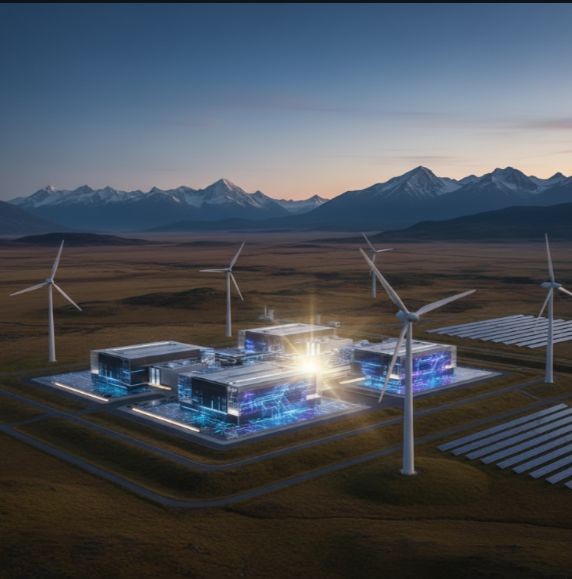
The wind, a constant companion in Patagonia, whispers tales of ancient glaciers and endless horizons.
It shapes the iconic landscapes, carves the mountains, and fuels the very spirit of the land.
For generations, this untamed region, stretching across southern Argentina, has been defined by its stark beauty, its vast open spaces, and the powerful, clean energy it holds in its natural elements.
Imagine, then, a new whisper on that wind – not of the past, but of a future being built, brick by digital brick, in a place seemingly at the edge of the world.
This isn’t just about silicon and servers; it’s about a confluence of bold vision, strategic incentives, and the relentless demand for the unseen force powering our modern world: artificial intelligence.
The news of OpenAI’s partnership with Sur Energy to construct a colossal US$25 billion AI data centre, Stargate Argentina, in Patagonia is a landmark event.
It signals a profound shift, transforming this remote region into a pivotal nexus for global innovation.
This initiative isn’t merely an investment in infrastructure; it’s a profound declaration that the future of AI is intrinsically linked to places with untapped potential and a commitment to sustainable growth.
In short: OpenAI is partnering with Sur Energy to build a US$25 billion AI data centre, Stargate Argentina, in Patagonia, driven by Argentina’s investment incentives and aiming to make Argentina an artificial intelligence hub for Latin America.
Why This Matters Now: The Global Race for Computing Power
Our world is hungrier for computing power than ever before.
Every new AI model, every nuanced query to a large language model, every innovative application demands more computational muscle.
This isn’t a fleeting trend; it’s a fundamental reality shaping our digital destiny.
Fidji Simo, OpenAI’s number two, noted in an interview with AFP that this represents a massive investment in computing power at a time when there is a desperate shortage of it for many desired applications.
She emphasized that the world will fundamentally shift and recognize computing power as its most strategic resource.
This desperate shortage, highlighted by OpenAI, is what’s driving monumental investments like the Stargate Argentina project.
It’s a clear signal to businesses and nations alike: securing and scaling computing capacity is paramount for future relevance and growth.
The New Gold Rush: Strategic Infrastructure for an AI-First World
The core challenge facing the artificial intelligence industry isn’t just about algorithms; it’s about the physical foundations necessary to run them.
We are in the midst of a silent, yet fierce, global competition for computing power, and it’s dictating where the next generation of digital infrastructure will be built.
The counterintuitive insight here is that geographical remoteness, traditionally a barrier, can now be a strategic asset, particularly when paired with abundant, sustainable energy resources.
This isn’t merely about constructing a building; it’s about forging the very heart of the next digital era.
The Stargate Argentina data centre is designed to host the next generation of AI computing, aiming for a staggering capacity of up to 500 MW, according to Argentina’s government.
To put that into perspective, 500 megawatts could power hundreds of thousands of homes.
For an AI data centre, it represents an immense engine for processing vast datasets, training complex models, and running sophisticated AI applications at an unprecedented scale for Latin America.
Argentina’s Magnetic Appeal: The RIGI Advantage
Why Argentina?
President Javier Milei’s administration has played a masterful hand with its Régimen de Incentivos para Grandes Inversiones (RIGI) scheme.
This isn’t just a friendly handshake; it’s a robust, long-term commitment, offering 30-year fiscal and customs benefits, as confirmed by Argentina’s government.
For an investment of US$25 billion, that kind of stability and foresight is incredibly appealing.
It’s a powerful testament to how clear, long-term incentive policies can transform a nation’s attractiveness for significant foreign direct investment, especially in strategic sectors like AI computing infrastructure.
As Sam Altman himself noted to OpenAI, President Milei’s vision for how artificial intelligence can drive Argentina’s growth and creativity was unmistakable and strong.
This project will help bring that vision to life.

Pillars of a New Digital Frontier
The Stargate Argentina project isn’t an isolated event; it’s a microcosm of larger global trends and strategic shifts.
Several key findings underscore its significance.
Argentina’s RIGI scheme proves highly effective in attracting significant foreign direct investment for strategic sectors, as reported by Argentina’s government.
This demonstrates that nations offering clear, long-term incentive policies become competitive hubs for emerging technologies, fostering economic growth and innovation.
Businesses aiming to scale AI operations globally should consider locations with robust governmental support.
OpenAI’s global Stargate initiative represents an estimated US$500 billion in worldwide investments, as stated by OpenAI.
This ambitious plan aims to develop a network of next-generation data centres, underscoring that AI expansion relies fundamentally on physical infrastructure, not just software.
Cloud, energy, and construction sectors should anticipate unprecedented demand for data centre development, particularly in regions with reliable, sustainable energy and favorable investment climates.
Furthermore, a desperate shortage of computing power for many AI applications positions it as a critical strategic resource, a point highlighted by AFP and OpenAI’s Fidji Simo.
For AI operations and business leaders, securing access to computing capacity will become a defining competitive advantage.
This necessitates exploring strategies like co-location, cloud partnerships, or equity stakes in infrastructure providers to ensure sustained access, as computing power increasingly rivals resources like oil or rare earth minerals in strategic importance.
A Playbook for the AI Era: Building the Future, Sustainably
For businesses, governments, and innovators looking to capitalize on the next wave of AI-driven growth, the Stargate Argentina project offers a potent playbook.
- First, identify and leverage unique regional advantages.Argentina, for instance, is capitalizing on its unique renewable energy potential, as noted by Sur Energy.
Businesses should assess their own regions for abundant, sustainable resources—such as hydro, wind, or solar—that can power future-forward AI computing infrastructure, aligning with the project’s goal of secure, efficient, and sustainable energy sources.
- Second, forge strategic, vision-aligned partnerships.The collaboration between OpenAI, a tech leader, and Sur Energy, an energy and infrastructure leader, serves as a powerful model.
Seeking partners with complementary core competencies can create synergistic joint ventures capable of tackling monumental projects.
- Third, invest in foundational infrastructure with scalability in mind.The Stargate Argentina data centre aims for 500 MW capacity, built to host next generation AI computing, according to Argentina’s government.
Any infrastructure investment today must anticipate exponential growth and future technological shifts, building not just for now, but for what’s next.
- Fourth, prioritize human-centric AI adoption.OpenAI’s OpenAI for Countries initiative, starting with government agencies, aims to expand access and help public employees streamline work and improve services.
For businesses, this means focusing not just on tech deployment, but on comprehensive adoption programs, training, and integration that empowers employees and enhances public services, creating tangible social benefits.
- Fifth, advocate for long-term policy incentives.Argentina’s 30-year fiscal and customs benefits under RIGI were crucial, as highlighted by Argentina’s government.
Engaging with policymakers to champion stable, long-term incentive schemes can de-risk major capital investments and attract global players, signaling a clear path for sustained growth.
- Finally, embrace the new reality of computing as a strategic asset.Recognize that computing power is now a strategic resource, not merely a utility.
Just as you secure supply chains for raw materials, strategize for guaranteed access to high-capacity, low-latency compute resources.
This necessitates long-term planning and potentially significant capital allocation.
Risks, Trade-offs, and Ethics: Navigating the AI Frontier
Every grand vision carries inherent risks and ethical considerations.
While the Stargate Argentina project promises immense benefits, it is crucial to consider potential trade-offs.
One concern is the environmental footprint.
Even with renewable energy, data centres are massive consumers of resources.
The sheer scale of 500 MW requires careful management of energy transmission, water for cooling, and waste.
Mitigation strategies must include continuous innovation in energy efficiency, responsible material sourcing, and robust environmental impact assessments.
Another challenge is addressing the digital divide and ensuring equitable access.
While the OpenAI for Countries initiative aims to expand access, truly extending the benefits of an AI hub to all people across Argentina and Latin America requires more than just infrastructure.
It demands digital literacy programs, affordable access, and a focus on local problem-solving.
The risk lies in creating pockets of hyper-advanced technology without broader societal uplift.
A significant foreign investment, while beneficial, can also create a degree of economic or technological dependency.
Argentina will need to foster local talent, cultivate its own AI ecosystem, and ensure knowledge transfer to build resilience and self-sufficiency in the long run.
Lastly, as AI becomes more powerful, the ethical implications—fairness, bias, privacy, job displacement—become more pronounced.
Argentina, as an emerging AI hub, will need robust regulatory frameworks and ethical guidelines to ensure AI development aligns with societal values and human-first principles.
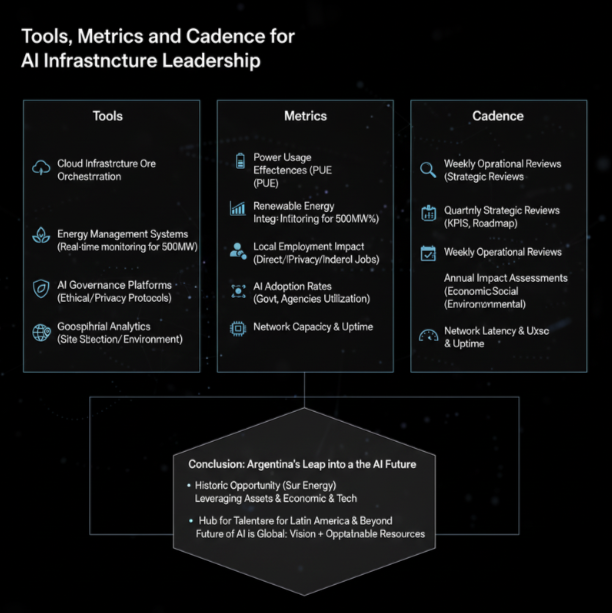
Tools, Metrics, and Cadence for AI Infrastructure Leadership
To effectively manage and measure the impact of such a monumental undertaking, a strategic framework of tools, metrics, and review cadence is essential.
Tools
- Specialized platforms are crucial for cloud infrastructure orchestration, managing hybrid environments, and optimizing compute resource allocation.
- Energy Management Systems offer real-time monitoring and optimization of power consumption, vital for a 500 MW facility powered by renewable sources.
- AI Governance Platforms establish ethical guidelines, data privacy protocols, and model transparency, while geospatial analytics aids site selection, environmental monitoring, and logistical planning in a region like Patagonia.
Metrics
- Key Performance Indicators track progress, including Power Usage Effectiveness (PUE) to measure energy efficiency, renewable energy integration percentages, and the local employment impact, such as the number of direct and indirect jobs created for local communities.
- AI adoption rates within government agencies, compute capacity utilization, and network latency and uptime figures are also critical.
Cadence
- Regular reviews ensure accountability and adaptation: weekly operational reviews focus on energy consumption, system performance, and immediate operational issues.
- Quarterly strategic reviews assess progress against KPIs, re-evaluate infrastructure roadmaps, and analyze market demand shifts.
- Annual impact assessments provide a comprehensive review of economic, social, and environmental contributions, stakeholder engagement, and compliance with ethical guidelines.
Conclusion: Argentina’s Leap into the AI Future
Standing on the vast plains of Patagonia, one can almost hear the hum of a future yet to be fully realized.
This US$25 billion investment by OpenAI and Sur Energy is more than just a financial figure; it represents a profound belief in Argentina’s potential and a strategic play in the global race for AI dominance.
Emiliano Kargieman of Sur Energy rightly stated that this project represents a historic opportunity for the country.
It’s about leveraging natural assets, embracing bold economic policy, and creating a hub where talent, creativity, and transformative technology can converge.
Argentina isn’t just building a Patagonia AI data center; it’s building a bridge to the future, positioning itself as an artificial intelligence powerhouse for Latin America and beyond.
For businesses and nations navigating this rapidly evolving landscape, the lesson is clear: the future of AI isn’t confined to established tech capitals.
It’s emerging wherever vision meets opportunity, wherever sustainable resources can fuel groundbreaking innovation, and wherever people are ready to embrace the promise of a digital dawn.
The time to think big, think sustainably, and think globally is now.
What will your next strategic leap be?
References
- AFP. Interview with AFP (OpenAI’s Fidji Simo).
- Argentina’s government. Argentina’s Government Statement on Stargate Argentina Project.
- Argentina’s government. Argentina’s government.
- OpenAI. OpenAI Chief Executive Sam Altman Video Message.
- Sur Energy. Sur Energy Press Release on Stargate Argentina.