

The sun climbed high over Varanasi, painting the ancient ghats in hues of gold and ochre.
Inside a bustling, sun-dappled co-working space, young Meera leaned forward, her eyes fixed on a screen displaying complex agricultural data.
Her startup, KhetConnect, aimed to provide local farmers with predictive insights – when to plant, how to irrigate, what crops were best suited for the changing climate.
The current AI models she used were powerful, yes, but often felt distant.
Their recommendations, based on global datasets, sometimes missed the subtle nuances of India’s diverse soils, micro-climates, and centuries-old farming practices.
She yearned for an intelligence that truly understood her land, her language, her people.
An intelligence that felt like it was born from the very earth she sought to serve.
This yearning for a truly indigenous, culturally attuned AI is not just Meera’s; it’s a silent aspiration echoed across the nation, now on the cusp of becoming a vibrant reality.
India is rapidly developing its own sovereign AI model, aiming for launch by the India AI Summit in February.
This initiative includes deploying an impressive 38,000 GPUs, significantly exceeding its initial targets, to build robust compute infrastructure and foster entirely Indian foundational AI models.
Why This Matters Now: A Nation’s Digital Destiny
Meera’s challenge, multiplied by a billion stories, underscores a profound truth: in the age of Artificial Intelligence, true sovereignty isn’t just about borders or currency; it’s about data, algorithms, and the very intelligence that will shape our future.
India, recognizing this, is making a monumental strategic move to secure its digital destiny.
The nation is aggressively pursuing the development of its own sovereign AI model, a commitment underlined by the rapid scaling of its compute infrastructure.
According to Electronics and IT Secretary S Krishnan (Meity, 2024), India has already deployed 38,000 Graphics Processing Units (GPUs) against an initial target of 10,000 units.
This isn’t just a technical achievement; it’s a statement of intent, positioning India to build and deploy its own foundational and sovereign AI models sooner than many might have anticipated.
The Quest for Indigenous Intelligence: More Than Just Code
The core problem, or rather, the grand challenge India is embracing, is to create an Artificial Intelligence that isn’t just used in India, but is of India.
Imagine an AI that inherently understands the rhythm of an Indian festival, the nuances of regional dialects, or the complexities of the informal economy, because it was built on that very bedrock.
This goes beyond mere language translation; it’s about cultural context, ethical frameworks, and socio-economic relevance.
India’s strategic vision allows it to craft a more intentional and robust AI strategy from the ground up, learning from global developments.
Building From the Ground Up: A Vision for Foundational Models
To understand the depth of this ambition, consider the foundational elements.
A foundational model is the bedrock upon which specific AI applications are built – a vast, pre-trained AI that learns patterns from immense datasets.
India’s commitment is to develop its own such models, not merely adapt existing ones.
This ensures that the underlying intelligence reflects Indian values, addresses local problems, and is free from biases or data gaps inherent in foreign-trained systems.
It’s akin to building your own powerhouse before plugging in the appliances, ensuring a steady, reliable, and tailored energy supply for all your needs.
What the Research Really Says: Milestones and Momentum
The roadmap for India’s AI journey is clear and ambitious, as articulated by S Krishnan (Meity, 2024).
The nation is not just talking about AI; it’s building it with tangible targets and accelerated progress.
India anticipates having its first entirely Indian foundational model ready before the close of the current year.
This is a crucial step towards AI self-reliance, meaning the core AI intelligence will be developed indigenously.
This paves the way for applications across sectors – from healthcare to education – to be powered by AI that natively understands Indian contexts.
For businesses, this implies a future where AI solutions are more culturally relevant and effective, reducing the need for extensive localization of global models.
Following swiftly, India expects to launch its full sovereign AI model by the India AI Summit, slated for February.
This marks the culmination of their efforts, signifying national control over critical AI infrastructure and capabilities.
The practical implication for AI operations is profound: organizations can leverage a national AI framework that guarantees data security, privacy aligned with Indian regulations, and strategic autonomy, fostering trust and innovation within the country’s digital ecosystem.
To power these ambitious models, India has not just met but dramatically exceeded its compute infrastructure targets.
S Krishnan (Meity, 2024) highlighted the deployment of 38,000 Graphics Processing Units (GPUs), significantly surpassing the initial goal of 10,000 units.
Robust compute power is the oxygen for large-scale AI development.
This rapid scaling demonstrates an accelerated commitment to AI infrastructure, positioning India strongly for rapid development and deployment.
For technology leaders, this signals a fertile ground for AI innovation, with the necessary hardware backbone to support complex AI projects and research within the country.
A Playbook You Can Use Today: Navigating India’s AI Horizon
For businesses, innovators, and policymakers, India’s sovereign AI journey presents both opportunities and a call for strategic adaptation.
Consider aligning with national AI priorities by understanding the government’s vision for India AI and identifying how your organization’s goals can synergize.
The focus on national control and data sovereignty (S Krishnan, Meity, 2024) means prioritizing secure, in-country data handling and ethical AI practices.
- Invest in local talent and data by fostering AI talent within India and prioritizing the collection and utilization of diverse, high-quality Indian datasets.This will ensure your AI initiatives are genuinely relevant and effective for the Indian market, reflecting the foundational model’s indigenous nature.
- Prioritize data sovereignty and security, as strict adherence to national data protection laws will be paramount.Implement robust cybersecurity measures and ensure compliance with emerging AI governance frameworks.
- Explore foundational model applications by conceptualizing how an entirely Indian foundational model could transform your industry.Think about localized content generation, specialized analytics for regional markets, or AI-powered solutions that understand unique social dynamics.
- Collaborate with the ecosystem by engaging with research institutions, startups, and government bodies involved in India’s AI mission.Participating in pilot programs or contributing to open-source initiatives can offer early insights and influence development.
- Develop AI for inclusivity, designing solutions with India’s diverse linguistic, cultural, and socio-economic landscape in mind.The goal of sovereign AI is to serve all of India, emphasizing accessibility and equitable access.
- Future-proof your compute strategy; while India scales its GPU deployment (S Krishnan, Meity, 2024), businesses should assess their own compute needs and consider hybrid cloud strategies that leverage national infrastructure while maintaining operational flexibility.
Risks, Trade-offs, and Ethics: The Path Less Travelled
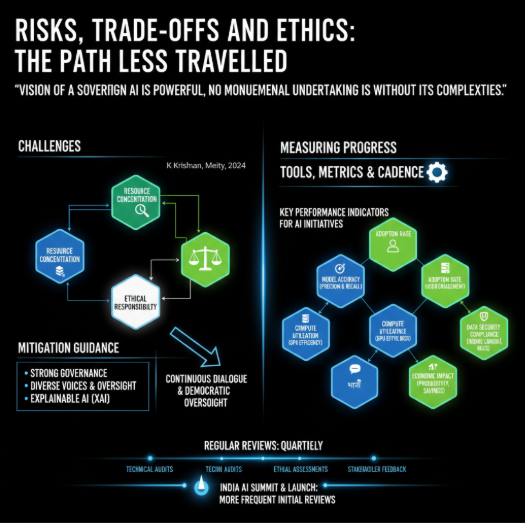
While the vision of a sovereign AI is powerful, no monumental undertaking is without its complexities.
One significant risk is the potential for resource concentration; focusing too heavily on a national model could inadvertently centralize power and innovation, potentially hindering the agility of smaller, independent AI research groups.
There’s also the trade-off between speed and comprehensiveness; rapid deployment targets (S Krishnan, Meity, 2024) demand intense focus, which might lead to initial gaps in niche applications or diverse language support.
Ethically, the responsibility is immense.
A national AI model must be built with an unwavering commitment to fairness, transparency, and accountability.
Mitigation guidance involves establishing strong governance frameworks from the outset, ensuring diverse voices are included in the development and ethical oversight committees, and prioritizing explainable AI (XAI) to build public trust.
Ensuring that the sovereign AI is truly for the people, and not just for the state, requires continuous dialogue and democratic oversight.
Tools, Metrics, and Cadence: Measuring Progress in a New AI Era
Implementing an AI strategy in this evolving landscape requires a pragmatic approach to tools, metrics, and review cycles.
While specific brands might vary, the focus should be on scalable, secure, and India-compliant technologies.
Key Performance Indicators for AI Initiatives
- model accuracy (precision and recall of AI models, particularly for India-specific datasets),
- adoption rate (percentage of target users engaging with AI-powered solutions),
- compute utilization (efficiency of GPU and infrastructure usage),
- data security compliance (adherence to national data protection and privacy regulations),
- localization effectiveness (AI model’s ability to understand and perform in diverse Indian languages and contexts), and
- economic impact (measurable contributions to productivity, cost savings, or new revenue streams).
Regular, ideally quarterly, reviews of AI strategy and performance are crucial.
This should include technical audits, ethical assessments, and stakeholder feedback sessions.
As the India AI Summit approaches and the sovereign model launches, more frequent initial reviews might be necessary to fine-tune operations and address any emerging challenges.
Conclusion: An AI Future Rooted in India
Back in Varanasi, Meera looked up from her screen, a thoughtful smile playing on her lips.
The news of India’s sovereign AI model wasn’t just another headline; it was a promise.
A promise that the intelligence she sought for KhetConnect would soon speak her farmers’ dialects, understand their challenges with an innate cultural wisdom, and truly thrive on the rich, diverse data of India.
This national endeavor is more than a technological sprint; it is an affirmation of self-reliance, a commitment to building a digital future that is authentically Indian, shaped by its people, and for its people.
As the India AI Summit approaches, the nation stands on the precipice of a new dawn, ready to unleash an intelligence that will not just compete globally but will uniquely serve the heartbeat of Bharat.