
India’s AI Gold Rush: The Rs 38 Crore Monkey and Our Digital Future
I remember a time, not so long ago, when Sunday evenings in our home were a sacred ritual around the television.
Antennas adjusted, channels flipped, searching for that one Bollywood classic or a cricket match that brought everyone together.
Today, that familiar hum of the TV is often replaced by the glow of a smartphone or tablet.
Kids giggle, parents are engrossed, all glued to YouTube.
The kitchen might have a recipe playing, the living room a travel vlog.
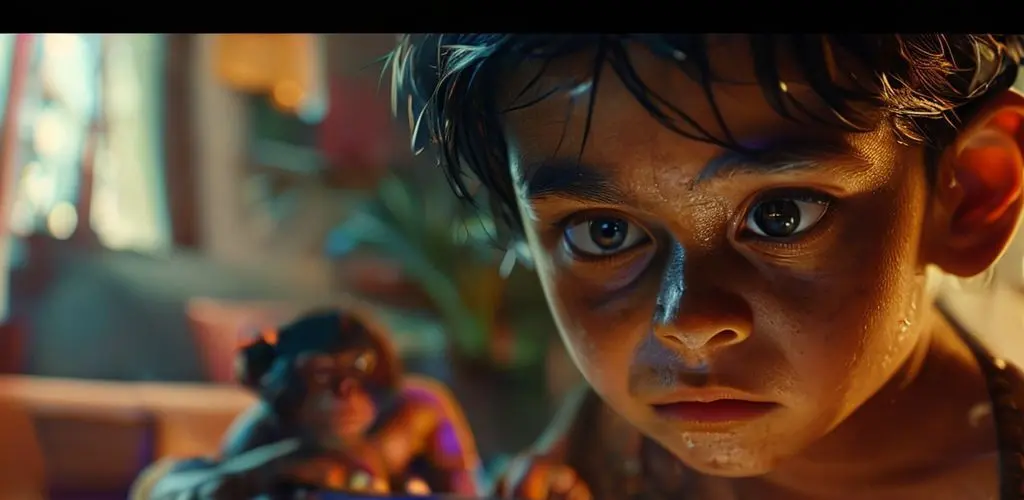
My seven-year-old nephew, a bright-eyed boy, has his favorites.
One afternoon, I watched him transfixed by vibrant, animated clips, utterly captivated, his tiny fingerprint on the screen marking engagement.
It made me wonder: what truly drives this new era of digital storytelling, when even the most unlikely content finds a billion-strong audience?
Why This Matters Now
This shift is not just about entertainment; it is a profound recalibration of our digital economy.
India is rapidly emerging as a creator nation, a term YouTube CEO Neal Mohan used when announcing significant investments (YouTube, 2025).
YouTube already reaches a staggering 462 million users in India in early 2024, according to Google’s ad data, making it a critical market for digital engagement.
In this vibrant landscape, an unexpected player has emerged: AI-generated content.
My nephew’s monkey videos are part of a phenomenon.
The channel he watches, Bandar Apna Dost, is estimated to be earning an astonishing Rs. 38 crores (4.25 million USD) annually, as reported by Kapwing in 2024.
This is not just a niche success; it is a seismic shift, signaling a new era of AI-generated content and its immense potential for content monetization.
In short: India’s YouTube landscape, with 462 million users, is witnessing an AI-driven content revolution.
Channels like Bandar Apna Dost are earning Rs. 38 crores annually through AI-generated videos, highlighting the immense financial potential and ethical considerations for the booming creator economy.
The Unconventional Logic of AI Content
We have long held that successful content demands intricate plots, compelling dialogue, and profound human creativity.
Yet, what happens when content, seemingly devoid of these traditional elements, generates billions of views and millions in revenue?
This is the core challenge presented by the rise of AI YouTube channels.
The Bandar Apna Dost channel, for example, defies conventional understanding of value, forcing us to re-evaluate how we define engagement, quality, and even creativity.
The counterintuitive insight here is that sometimes, less traditional human complexity can translate directly into broader, more accessible appeal.
Mini Case: Bandar Apna Dost’s Billion-View Formula
Bandar Apna Dost serves as a striking example of this new content paradigm.
Identified by Kapwing as the most-viewed AI channel in its category (Kapwing, 2024), it thrives on short, animated clips.
Its success is not about narrative depth but instant, visceral engagement.
Its broad appeal transcends language barriers, and its frenetic pace suits modern scroll and watch habits.
The estimated annual income of Rs. 38 crores (Kapwing, 2024) proves that AI-generated content does not need to be profound to be profoundly profitable.
This demonstrates how AI can unlock unprecedented content monetization on a massive scale.
What the Research Really Says
The data paints a clear picture of an emerging digital frontier, one shaped by artificial intelligence and an insatiable global appetite for video content.
-
First, AI’s Financial Prowess is undeniable.
The Bandar Apna Dost channel, for example, pulls an estimated Rs. 38 crores (4.25 million USD) annually, according to Kapwing in 2024.
This highlights that AI-generated content offers substantial financial returns, implying that businesses and digital creators should explore AI tools for rapid content production and diverse content monetization avenues.
-
Second, the Scale of AI Slop is significant.
A Kapwing study in 2024 classified 278 channels as pure AI slop.
These channels collectively garnered over 63 billion views and 221 million subscribers (Kapwing, 2024).
This indicates that a significant and growing segment of YouTube is now AI-driven.
Marketers must therefore understand this category’s reach and audience to assess competitive landscapes and potential engagement strategies.
-
Third, India’s Digital Dominance is a key factor.
Google’s ad data revealed YouTube reached 462 million users in India in early 2024.
YouTube CEO Neal Mohan declared India a creator nation (YouTube, 2025), committing Rs. 850 crore over two years to support Indian creators (YouTube, 2025).
This means India is a crucial, high-growth market for video content, both for consumption and creation.
Content strategies need to be India-centric, leveraging local insights and trends, possibly integrating AI for scaled localization within Digital India.
Playbook for Modern Content Strategy
Navigating this AI-powered landscape requires a deliberate, strategic approach for AI content creation.
-
First, prioritize the Audience.
Even with AI, understanding what resonates with your target demographic is paramount.
Analyze existing viral content in your niche.
-
Second, Experiment with AI Tools.
Explore AI tools for script generation, animation, and video editing to accelerate your YouTube earnings.
This leverages the efficiency highlighted by the Kapwing report (Kapwing, 2024).
-
Third, Focus on Low-Barrier Engagement.
Content transcending language or complex narratives, like Bandar Apna Dost, has global appeal.
Consider visuals-first, emotionally-driven content.
-
Fourth, Embrace Niche Diversification.
Human-first creators can use AI to research and quickly produce content for underserved niches, building loyal communities.
-
Fifth, Strategize for India’s Growth.
Given India’s massive user base (Google, 2024) and YouTube’s investment (YouTube, 2025), tailor content for Indian audiences.
-
Sixth, Adopt Hybrid Creativity.
Do not replace human creativity; augment it.
Use AI for repetitive tasks, allowing your team to focus on strategic oversight, unique concepts, and ethical considerations.
Risks, Trade-offs, and Ethics
The rise of AI YouTube channels is not without its shadows.
The primary risk lies in a race to the bottom, where sheer volume trumps quality and authenticity.
The term AI slop itself hints at content perceived as low-effort or even manipulative.
There is potential for misinformation, as AI can generate convincing but fabricated content at scale, eroding trust.
Ethical concerns arise around copyright, intellectual property, and fair use, which become murkier when AI generates content based on existing works.
A fear exists that AI might devalue human artistic contributions, leading to creator displacement.
Furthermore, a flood of AI-generated content could lead to content saturation, making it harder for genuinely creative, human-led channels to stand out.
Mitigation involves transparent labeling of AI-generated content, adhering to platform guidelines, prioritizing ethical AI development, and focusing on unique value propositions that only human creativity can deliver.
For Digital India creators, building genuine connection and community remains a powerful differentiator.
Tools, Metrics, and Cadence for AI Content
To navigate this new terrain effectively, a robust operational framework for content monetization is essential.
Recommended Tool Stacks
-
AI Video Generators for text-to-video or simple animation
-
AI Writing Assistants for script outlines, titles, and descriptions
-
Analytics Platforms like YouTube Studio for native insights, alongside third-party tools for competitor analysis and keyword research for viral content
-
Project Management tools are also vital for managing AI content pipelines.
Key Performance Indicators (KPIs)
-
Engagement Rate (likes, comments, shares per video)
-
Watch Time (overall and average view duration)
-
Subscriber Growth (net new subscribers)
-
Revenue Per View/Subscriber (direct YouTube earnings metrics)
-
Content Production Velocity (number of videos published per week/month, a key advantage of AI).
Review Cadence
-
Weekly for performance review of new content, A/B testing, and trend analysis.
-
Monthly reviews should involve a deeper dive into channel growth, subscriber demographics, and strategic adjustments.
-
Quarterly planning should encompass comprehensive market analysis, AI tool evaluation, ethical review, and long-term strategy planning for Digital India.
Conclusion
That afternoon, watching my nephew laugh at the frantic antics of Bandar Apna Dost, I saw not just a child entertained, but a glimpse into a future already here.
It is a future where the lines between human creation and machine generation blur, where a cartoon monkey can earn more than many established production houses.
This rapid evolution, fueled by India’s immense digital population and YouTube’s strategic investments, is a potent mix.
As marketers and strategists, our task is not to resist this tide but to understand its currents.
We must leverage AI’s efficiencies for AI-generated content while fiercely protecting the human element—the empathy, the insight, the authentic connection no algorithm can truly replicate.
The challenge is to find that sweet spot where technology empowers, rather than diminishes, our inherent creativity.
Let us learn from the Rs. 38 crore monkey, but build a legacy with a human heart.
References
-
Kapwing (2024). Kapwing’s report on AI-Generated Content Channels.
-
Kapwing (2024). Kapwing Study on YouTube Channels.
-
Google (2024). Google’s ad data on YouTube users in India.
-
YouTube (2025). YouTube CEO Neal Mohan’s announcement on India investment.