
Humanoid Robots Take Center Stage at CES 2026: A Human-First Look
I remember, not so long ago, watching my niece try to teach her new robot dog to fetch.
It was a brightly colored, clunky thing that mostly just bumped into furniture, its pre-programmed barks sounding more like a digital hiccup than genuine enthusiasm.
She’d coo encouragement, even when its fetch attempts consisted of nudging a ball with its nose before wandering off to sniff imaginary corners.
It was endearing, yes, but also a stark reminder of the vast chasm between our sci-fi dreams and the mechanical realities of the day.
The potential was always there, a flicker in our collective imagination, but the technology felt distant.
Fast forward to CES 2026 in Las Vegas, and that chasm seems to be shrinking at warp speed.
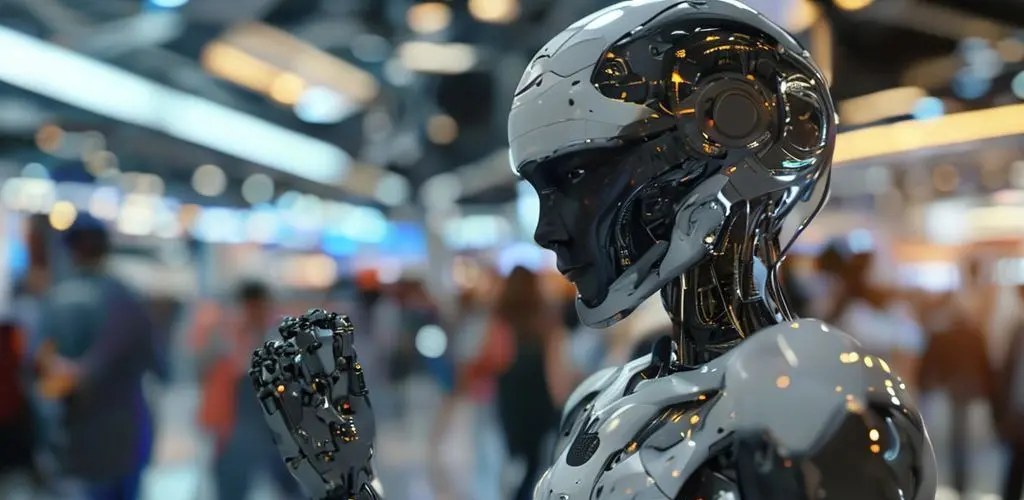
The halls of the city buzzed not just with the usual cacophony of innovation, but with the distinct, almost unsettling presence of humanoid robots.
They were everywhere: dancing with fluid movements, even performing mundane tasks like folding laundry.
It was not just a spectacle; it was a promise whispered in silicon and code.
As I observed the crowds, a thought settled: these are not just machines; they are reflections of our deepest desires for connection, for assistance, and perhaps, for a glimpse of what it means to create life itself.
In short: Humanoid robots powered by generative AI dominated CES 2026, showcasing advanced capabilities from vision language models to complex physical tasks.
While industry giants like Nvidia position themselves as key enablers, significant challenges remain in bridging the gap from impressive demos to safe, practical, and widespread commercial implementation.
Why This Matters Now
The spectacle at CES was not merely for show; it signaled a profound shift.
Historically, humanoid robots have struggled with the intelligence and flexibility required for true usefulness, a challenge that has long stumped engineers (CNBC, 2026).
However, the arrival of generative AI, particularly the deep learning technology behind OpenAI’s ChatGPT in late 2022, changed the game.
This breakthrough technology can now teach robots to walk, use their hands, or even fold laundry, marking a significant leap toward sophisticated physical AI (CNBC, 2026).
This is not just about flashy new gadgets; it is about reshaping industries from logistics to healthcare and profoundly altering the way we live and work.
From Dreams to Algorithms: The Generative AI Leap
For decades, the idea of a helpful, human-like robot felt confined to the silver screen or the pages of a novel.
Yet, in our labs, prototypes often stumbled, struggled with simple grasps, or required meticulous, labor-intensive programming for every single action.
The core problem was not necessarily the hardware—though that too had its limitations—but the brain.
How do you imbue a machine with the intuition to navigate a messy room, the dexterity to pick up a dropped key, or the common sense to understand a nuanced command?
The counterintuitive insight here is that the form factor of the humanoid is almost secondary to the intelligence driving it.
While their human shape captivates us, it is the invisible, deep learning algorithms that are truly revolutionary.
These new models allow robots to learn from massive datasets, enabling them to interpret sensory input and translate it into complex physical actions.
Early industrial robots, for example, were magnificent and precise but utterly blind and deaf outside their pre-programmed parameters, excelling only at repetitive, predictable tasks.
Asking one to tidy up a workshop was an impossible command.
Now, with generative AI, that scenario begins to change.
Nvidia CEO Jensen Huang noted at CES that the humanoid industry is riding on the work of the AI factories we are building for other AI stuff (CNBC, 2026), indicating that foundational AI research and infrastructure developed for large language models are directly benefiting robotics.
Robots are no longer just executing commands; they are beginning to understand, reason, and adapt.
What the Research Really Says About Physical AI
The buzz from CES 2026 was grounded in significant technological advancements, albeit with a healthy dose of reality check.
Nvidia is aggressively positioning itself not just as a chip provider but as a complete ecosystem builder for the robotics industry.
Companies looking to integrate robotics should consider partners offering comprehensive software and hardware solutions.
Nvidia, for example, unveiled Gr00t for robot body control and Cosmos for reasoning and planning, aiming to be a one-stop shop for robot development (CNBC, 2026).
This suggests a future where foundational AI models become as critical as the physical hardware itself.
The generative AI breakthrough is real, with the same deep learning technology powering ChatGPT now directly enabling robots to learn complex physical tasks.
Businesses should explore how vision language models (VLMs) can transform their operations, allowing robots to pair sensor data with traditional AI for reasoning, such as navigating a cluttered floor (CNBC, 2026).
This opens doors for intelligent automation in complex, previously un-automatable environments.
However, commercial implementation faces significant hurdles.
Despite impressive demonstrations, widespread practical adoption of humanoid robots, especially in unstructured environments like homes, is a very, very long way off.
Companies should temper expectations with the reality of high costs, slow operational speeds for common tasks, and crucial safety concerns (CNBC, 2026).
The focus should be on controlled, industrial environments first, where variables are more manageable.
A Playbook for Navigating the Robot Revolution
For businesses eyeing the potential of physical AI, the path forward requires careful planning and a human-centric approach.
Clearly articulate the specific problem you are trying to solve—such as repetitive labor, hazardous tasks, or a need for precision—to prioritize practical applications over mere novelty.
It is vital to invest in the AI foundation first, focusing on intelligence over form.
As Jensen Huang implied, the AI factories are driving this forward (CNBC, 2026), making robust AI models and software ecosystems essential.
Prioritize safety and ethical frameworks, especially for consumer-facing or human-adjacent robotics.
Jeff Burnstein of the Association for Advancing Automation cautions that planning for unforeseen interactions, like a child running into a robot or a robot running over a pet, is a critical challenge (CNBC, 2026).
Develop clear guidelines and fail-safes.
Pilot projects should begin in controlled, predictable spaces for iterative learning and refinement.
Focus on value, not just flash, seeking solutions that offer tangible improvements in efficiency, accuracy, or safety.
Finally, foster human-robot collaboration, designing systems that augment human capabilities rather than simply replacing them.
Risks, Trade-offs, and Ethics in the Age of Physical AI
The allure of humanoid robots is undeniable, but their rapid advancement introduces complex risks and ethical considerations.
The primary trade-off is often between perceived intelligence and real-world safety, especially when moving from controlled demonstration floors to dynamic environments.
A significant risk lies in safety, particularly in domestic or public spaces.
Home is very unstructured, warns Jeff Burnstein (CNBC, 2026), highlighting the unpredictability of human environments.
This unpredictability, from a child’s sudden movement to an unexpected obstacle, poses immense challenges for robots designed for precision, and even minor accidents can erode public trust.
Mitigation for these risks involves rigorous testing, clear human-robot interaction protocols, privacy by design, and transparency in robot capabilities.
The journey to widespread physical AI necessitates a balanced approach, where innovation is tempered by responsibility, and ambition is guided by a strong moral compass.
Tools, Metrics, and a Human-Centric Cadence for Robotics
Implementing AI-powered robotics requires a structured approach to tools, performance measurement, and review cycles, moving beyond simply buying off-the-shelf robots to integrating intelligent systems into existing workflows.
This includes leveraging tools like the Robotics Operating System (ROS) and cloud-based AI/ML platforms for vision language models, alongside simulation software and data annotation tools.
Key Performance Indicators (KPIs) like task completion rate, error rate, operational efficiency, safety incidents, and human-robot interaction scores are crucial for tracking progress.
A disciplined review cadence, involving daily monitoring and weekly, monthly, and quarterly analyses, ensures continuous optimization for performance, safety, and human well-being.
Conclusion
The gleaming, dancing humanoids at CES 2026 were more than just technological marvels; they were a mirror reflecting our complex relationship with progress.
They whisper of a future where mundane tasks are handled with effortless precision, where companionship might take a new form, and where the boundaries between human and machine continue to blur.
It is a far cry from the clunky robot dog of my niece’s childhood, whose limited movements were met with such boundless human patience.
Nvidia CEO Jensen Huang proclaimed that robots are having their ChatGPT moment (CNBC, 2026), and Modar Alaoui, general partner at ALM Ventures, suggests that the next generation is just going to grow up with these machines whether we accept it or not (CNBC, 2026).
This is not just about innovation; it is about a profound shift in our lived experience.
As we stand on the precipice of this new era, the real question is not whether these machines will arrive, but how thoughtfully and ethically we will invite them into our world.
The future of AI and humanity is not a distant dream; it is being built, byte by byte, with every step these new robots take.
References
CNBC.
Humanoid robots take over CES in Las Vegas as tech industry touts future of AI.
2026.