
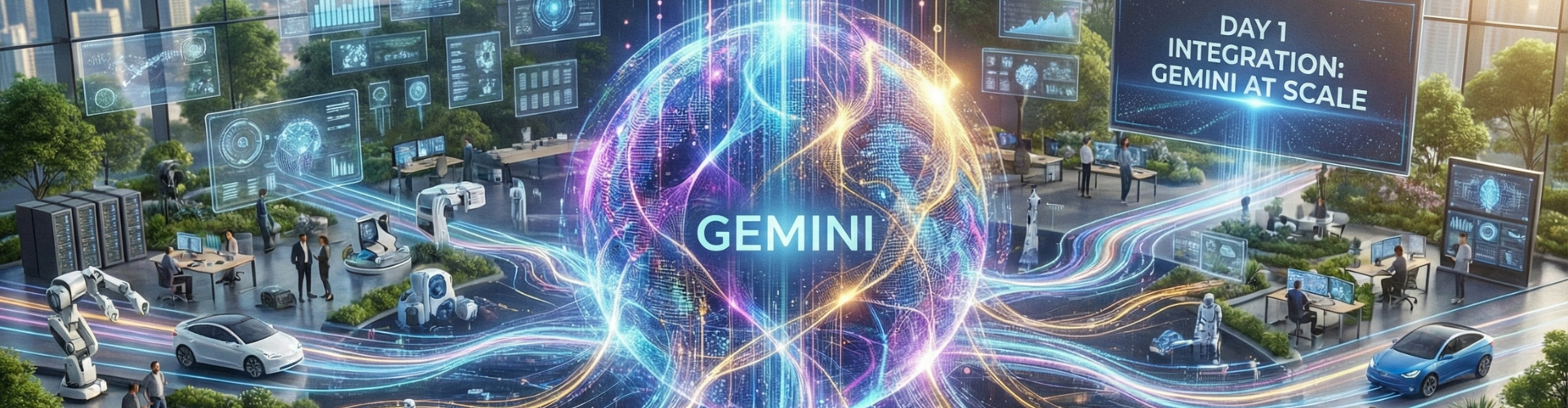
Innovation at Scale: What Sundar Pichai Loved About Gemini 3.0
The hum of a server rack, the quiet click of a keyboard late into the night – these are the subtle soundtracks of innovation.
For every grand product launch, there’s a deeper, often unseen effort: the intricate dance of integration, of making complex technology simply work in the messy reality of diverse systems.
We’ve all seen dazzling demos, only to watch new tech gather dust because getting it to play nice with existing infrastructure felt like wrestling an octopus in a phone booth.
Yet, sometimes, something truly remarkable happens: a new technology isn’t just unveiled; it seamlessly weaves itself into the fabric of the digital world almost instantly.
This immediate, widespread embrace isn’t just a technical achievement.
It is a testament to thoughtful design, strategic vision, and a deep understanding of what developers truly need.
This profound, almost effortless integration caught the eye of Google CEO Sundar Pichai, becoming his defining takeaway from the recent Gemini 3.0 launch.
What he loved was not just the AI itself, but its immediate, tangible impact across an interconnected ecosystem.
Google CEO Sundar Pichai’s key takeaway from the Gemini 3.0 launch was the unprecedented speed and scale of its integration across diverse products, both within Google and across the broader tech ecosystem, right from day one.
This immediate, widespread adoption highlighted ‘innovation at scale,’ affirming Google’s decade-long AI-first strategy and signaling a future focus on efficiency with Gemini 3.0 Flash.
Why This Matters Now: The Ripple Effect of Real-World AI
When a tech giant like Google launches a flagship AI model, the world pays attention.
But when its CEO pinpoints “Day 1” integration as the most thrilling success, it shifts the conversation from raw power to practical utility.
This is not merely about impressive algorithms.
It is about how quickly and effectively these algorithms can be woven into the everyday applications we use.
This focus on immediate, tangible impact sends a clear signal to the market: the era of theoretical AI is giving way to pervasive, applied AI.
The financial markets certainly understood the message.
Days after its unveiling, the Gemini 3.0 AI model was noted for sending Alphabet’s stock prices soaring (The Times of India, 2024).
This market reaction is not just hype.
It underscores the perceived importance and potential impact of Google’s latest AI.
For businesses and developers, it is a powerful validation of a strategy rooted in integration and efficiency.
The demand for AI that can deliver immediate, scalable improvements is no longer a future aspiration; it is the current market reality.
The Integration Conundrum: Making AI Work in the Real World
The biggest challenge facing any groundbreaking technology is not always its creation, but its adoption.
We have all seen brilliant solutions that languish in obscurity because they were too complex to implement, too resource-intensive, or simply did not fit into existing workflows.
This is the integration conundrum: bridging the gap between innovative potential and practical application.
The counterintuitive truth here is that the true measure of an AI’s power is not just its raw intelligence or processing capability; it is its integrability.
How easily can developers leverage it?
How quickly can it enhance user experiences without demanding a complete overhaul of existing systems?
An AI model, no matter how advanced, is only as impactful as its ability to be seamlessly woven into the digital fabric.
From Lab to Living Room: The Day 1 Magic of Gemini 3.0
Imagine the anticipation.
Developers, product managers, and even rival companies eagerly awaiting access to Google’s newest AI powerhouse, Gemini 3.0.
In the past, such a launch might entail months of coding, debugging, and framework adjustments to get even a basic integration off the ground.
But with Gemini 3.0, something different happened.
Sundar Pichai himself remarked, “What I loved about the launch of Gemini 3 last week was seeing so many products (from Google and others in the ecosystem) improve their experience with it on Day 1, truly innovation at scale,” (Sundar Pichai, Release Notes podcast, 2024).
This immediate, widespread improvement across an entire tech ecosystem is not just a happy accident.
It reflects a deep understanding of developer needs and an architectural design that prioritizes accessibility and ease of use.
It means that the value of advanced AI is not locked behind layers of complexity, but is readily available to enhance everything from search results to creative tools, almost instantly.
The Pillars of Google’s AI Ambition: Scale, Efficiency, and Vision
Pichai’s reflections offer a clear lens into Google’s long-term AI strategy, built on three critical pillars: massive scale, relentless efficiency, and a unified vision.
First, the rapid integration of Gemini 3.0 across products signals robust developer adoption and Google’s impressive ability to scale AI.
The immediate improvements seen across numerous applications indicate a healthy and active ecosystem ready to embrace new AI capabilities.
This suggests a powerful accelerator for AI innovation, pushing enhanced features to end-users at an unprecedented pace, thereby driving widespread product enhancements.
Second, Google is already prioritizing efficiency with the upcoming Gemini 3.0 Flash model.
While the initial Gemini 3.0 impresses with its scale, the strategic announcement of Flash points to a future where AI is not just powerful but also practical and cost-effective.
Pichai noted, “Gemini 3.0 Flash is coming, and it’s likely our best model yet because it helps developers serve more users efficiently,” (Sundar Pichai, The Times of India, 2024).
This strategic shift aims to help developers serve more users cost-effectively, potentially broadening AI accessibility and application across a wider range of services and industries.
Finally, at its core, Gemini is central to Google’s entire portfolio.
Pichai articulated this vision clearly: “Gemini is a manifestation of our decade long AI first strategy, I see it as a through line for everything – from Search to YouTube to Cloud to Waymo etc,” (Sundar Pichai, Release Notes podcast, 2024).
This means AI is not just a collection of features; it is the foundational technology underpinning Google’s diverse offerings.
This indicates a deep, holistic integration strategy, ensuring a unified and consistent AI experience across all Google services, from basic searches to autonomous driving.
Building Your Own ‘Day 1’ Impact Strategy
- Embrace an ‘AI-First’ Mindset: Mirror Google’s decade-long commitment.This is not about adding AI as an afterthought, but embedding it at the core of your product development and business strategy from the outset.
Your entire team, from engineering to marketing, should see AI as fundamental, not incidental (Pichai, Release Notes podcast, 2024).
- Prioritize Seamless Integration: Focus on developing or adopting AI tools that allow for rapid, “Day 1” improvements.This means robust APIs, clear documentation, and a developer-friendly approach that minimizes friction for integrating new AI capabilities into existing systems.
The goal is to make AI adoption feel less like an overhaul and more like a natural enhancement.
- Optimize for Efficiency, Not Just Power: As Google shifts focus to Gemini 3.0 Flash, consider that raw AI power is not always the most important factor.For widespread adoption and cost-effectiveness, particularly in high-volume applications, prioritizing efficient models can help developers serve more users affordably.
This broadens your reach and democratizes access to advanced AI features within your own ecosystem (Pichai, The Times of India, 2024).
- Foster an Ecosystem Approach: Think beyond individual products.How can AI serve as a common backbone, connecting and enhancing various services across your business or even external partnerships?
A unified AI infrastructure allows for consistency, synergy, and accelerated innovation across your entire portfolio, much like Gemini connects Google’s diverse offerings (Pichai, Release Notes podcast, 2024).
- Look Beyond Today’s Models: The pace of AI innovation is relentless.Google’s internal teams are already “pre-training the next generation, with constant innovation pushing the full stack into 2026” (Sundar Pichai).
Stay agile, invest in continuous learning, and build your AI strategy with an eye toward future iterations and advancements.
Navigating the AI Frontier: Challenges and Responsibilities
While the promise of AI is vast, every powerful tool comes with inherent risks and trade-offs.
The widespread integration of AI, while thrilling, demands a careful consideration of potential pitfalls.
Over-reliance on AI without human oversight can lead to unexpected errors or biases.
Data privacy and security become paramount concerns as AI models process ever-larger datasets.
Ethical considerations, such as fairness, transparency, and accountability, must be woven into the fabric of AI development, not bolted on as an afterthought.
Mitigation starts with robust testing and validation processes, ensuring AI models perform as expected across diverse scenarios.
Maintaining human-in-the-loop oversight for critical decisions and establishing clear ethical guidelines from development to deployment are crucial.
Regularly auditing AI systems for bias, ensuring data anonymization where possible, and building mechanisms for user feedback can help navigate these complexities responsibly.
Equipping Your AI Integration Journey: Tools, Metrics, and Cadence
To effectively integrate AI, businesses need a practical framework.
This includes the right tools, measurable metrics, and a consistent review cadence.
For tools, consider robust AI development platforms that offer comprehensive APIs for easy integration.
Cloud-based AI services, MLOps (Machine Learning Operations) platforms for managing the AI lifecycle, and tools for data governance and security are essential.
Key Performance Indicators (KPIs) should track both the adoption and impact of your AI initiatives.
- User Engagement: How are users interacting with AI-powered features (e.g., feature usage rate, time spent)?
- Developer Adoption Rate: How quickly are internal or external developers leveraging new AI APIs or models (e.g., number of integrations, API call volume)?
- Efficiency Gains: What tangible cost or time savings are realized (e.g., reduced computation cost per user with models like Flash, faster task completion)?
- Feature Velocity: How quickly can new AI-enhanced features be brought to market?
For cadence, an agile approach is critical.
Implement continuous integration and deployment for AI models, allowing for rapid iteration and improvement.
Quarterly AI strategy reviews, involving both technical and business stakeholders, ensure alignment with broader organizational goals and facilitate proactive ethical oversight.
FAQ
Q.1 What did Sundar Pichai love most about the Gemini 3.0 launch?
Pichai loved seeing the rapid integration of Gemini 3.0 across many Google and third-party products on Day 1, calling it ‘innovation at scale,’ as stated on the Release Notes podcast (Sundar Pichai, Release Notes podcast, 2024).
Q.2 What is Gemini 3.0 Flash?
Gemini 3.0 Flash is a forthcoming Google AI model designed for enhanced efficiency, specifically developed to help developers serve more users effectively, as confirmed by Sundar Pichai (Sundar Pichai, The Times of India, 2024).
Q3. What is Google’s ‘AI-first strategy’?
Google’s ‘AI-first strategy’ is a decade-long commitment to making AI the core technological backbone for all its products, from Search to YouTube to Waymo, with Gemini being its manifestation, according to Pichai (Sundar Pichai, Release Notes podcast, 2024).
Q.4 When is the next generation of Gemini expected?
Pichai indicated that Google’s internal teams are already pre-training the next generation, with constant innovation pushing the full stack into 2026 (Sundar Pichai).
Conclusion
The story of Gemini 3.0 is not just about another powerful AI; it is a narrative about the practical magic of integration.
It is about how a CEO found thrill not in abstract power, but in the immediate, tangible improvements felt by developers and users across an entire ecosystem, right from day one.
This focus on “innovation at scale” and the subsequent pivot towards “efficiency” with Gemini 3.0 Flash paints a clear picture: the future is not just about building smarter AI; it is about making smarter AI work for everyone, everywhere.
For businesses and innovators, Google’s journey offers profound lessons.
The ability to integrate AI seamlessly, efficiently, and with a long-term, unified vision will define success in the coming years.
It is a call to move beyond the hype and truly embed AI as a foundational element, creating a future where technology does not just promise, but truly delivers, from the very first day.
Ready to harness this innovation for your business? Let us explore how.
References
- Google.(2024).
Release Notes podcast with Logan Kilpatrick.
Retrieved from: (URL not provided in source data)
- TOI Tech Desk.(2024).
Google CEO Sundar Pichai tells what he ‘loved about the launch of Gemini 3’.
The Times of India.
Retrieved from: (URL not provided in source data)