

The fluorescent lights of the simulation lab hummed, casting a sterile glow on Maya’s face as she practiced breaking difficult news to a robotic patient.
Her voice, usually so steady, faltered as the AI-driven system provided an optimal script, devoid of the warmth she instinctively knew was needed.
She could feel the mechanical precision, the cold logic, but where was the space for a gentle hand on a shoulder, the quiet understanding in a shared glance?
It was in that moment, wrestling with the pre-programmed perfection, that Maya realized the profound chasm between data-driven efficiency and the messy, vital art of human connection.
The faint antiseptic scent of the ward, usually comforting, suddenly felt like a barrier between her and true healing.
In a world racing towards the widespread adoption of AI, what happens to the quiet, vital hum of human empathy?
Why This Matters Now
The integration of artificial intelligence into healthcare is no longer a futuristic concept; it is a present reality.
From clinical decision support systems used for over two decades to modern large language models, AI promises to streamline tasks, predict outcomes, and potentially alleviate physician burnout.
Yet, beneath this tide of technological advancement lies a simmering concern: what is AI’s true impact on the bedrock of medicine – the doctor-patient relationship?
A recent single-institution study, involving a survey of medical students, highlighted this tension with a 12.14% response rate from future physicians (Loyola University Chicago Stritch School of Medicine, 2025).
Understanding their perspective is crucial as we navigate this transformative era.
In short: A study from Loyola University Chicago Stritch School of Medicine (2025) found that medical students who received formal emotional intelligence training were significantly more cautious about AI’s potential to improve the doctor-patient relationship, highlighting concerns about preserving human connection in healthcare.
The Invisible Thread: Why AI Challenges the Doctor-Patient Relationship
At the heart of the debate isn’t whether AI is good or bad, but how it redefines the very essence of care.
For decades, the empathetic bond between a physician and their patient has been recognized as inherently therapeutic.
This bond isn’t built on algorithms; it is forged in shared vulnerability, trust, and the nuanced understanding that only human emotional intelligence can provide.
Dr. Daniel Goleman, in his seminal 1995 work Emotional Intelligence: Why It Can Matter More Than IQ, broadly defined EI as a person’s ability to perceive the emotions of themselves and others while expressing and regulating their own (Bantam Books).
He underscored its critical role in interpersonal relationships, efficiency, and well-being – all non-negotiables in healthcare.
The counterintuitive insight emerging from recent research is that those specifically trained in emotional intelligence are more likely to view AI with apprehension, especially regarding its relational impact.
It is not a rejection of progress, but a deeply informed safeguarding of what cannot be automated.
The Human Element: When a Machine Cannot Coach Compassion
Imagine a physician who has just delivered devastating news to a family.
The words are medically accurate, the prognosis clear, but the pain in the room is palpable.
Could an AI system coach this physician on how to be more empathetic?
Could it advise them on how to genuinely broach sensitive topics, not just verbally, but through presence, tone, and shared humanity?
While AI can mimic speech patterns and suggest empathetic phrases, many believe it inherently lacks the lived experience and consciousness for true emotional understanding and connection.
The study by Loyola University Chicago Stritch School of Medicine (2025) touched on similar concerns.
While not statistically significant for every related question, Emotional Intelligence and Resilience (EIR) trained students generally showed greater apprehension about AI’s role in guiding physician-patient interactions.
This subtle yet telling distinction suggests that those immersed in the nuances of EI might instinctively grasp the limitations of a machine in such profoundly human scenarios.
They understand that empathy isn’t a script; it is a spontaneous, learned, and deeply human response.
Cultivating Caution: EI Training and AI Perception
The data from the Loyola University Chicago Stritch School of Medicine (2025) study offers a compelling narrative: formal training in emotional intelligence significantly shapes a future physician’s perspective on AI in healthcare.
This isn’t about Luddism; it’s about discernment and a human-first approach to innovation.
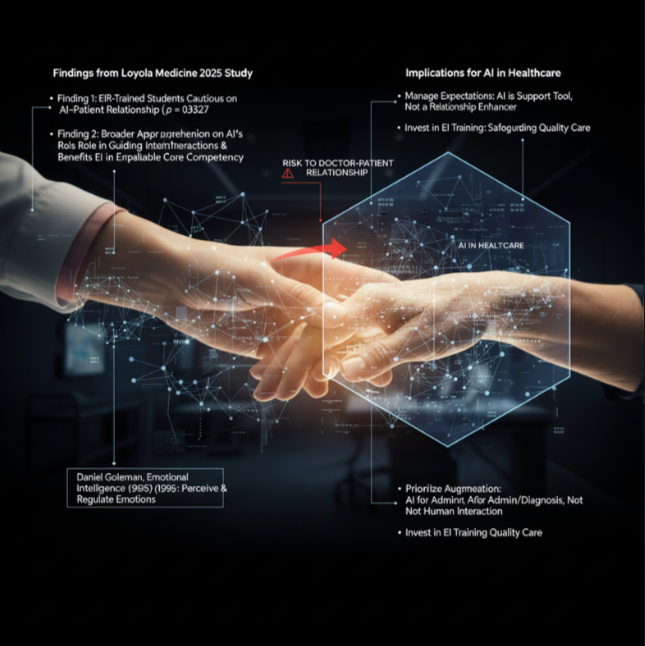
Finding 1: EIR-trained students showed statistically significant disagreement with AI improving the doctor-patient relationship.
Medical students who had completed the Emotional Intelligence and Resilience (EIR+) elective indicated statistically significantly greater disagreement with the statement, I believe AI technology will improve the doctor-patient relationship, compared to their untrained peers (EIR-) (mean 3.0 vs. 3.5; p = 0.0327) (Loyola University Chicago Stritch School of Medicine, 2025).
This finding suggests that a deeper understanding of emotional intelligence cultivates a more critical and cautious view of AI’s capacity to enhance interpersonal medical care.
For organizations implementing AI in healthcare, this highlights the need to manage expectations and avoid overstating AI’s relational benefits.
Marketing and communications should focus on AI as a support tool for physicians, rather than a direct enhancer of patient relationships, preserving the perception of genuine human connection.
Finding 2: Broader apprehension about AI’s role in guiding interactions and overall benefits.
While not statistically significant, EIR+ students also reported a similar magnitude of greater disagreement with AI has a place in guiding physicians on how to better interact with their patients and colleagues (p = 0.0701) and Overall, I think adopting the use of AI in healthcare will be beneficial (p = 0.0521) (Loyola University Chicago Stritch School of Medicine, 2025).
This indicates a more holistic apprehension among EIR-trained individuals, suggesting that their EI education leads to a broader skepticism regarding AI’s ability to truly benefit complex human interactions and its overall positive impact when measured against relational integrity.
AI development and deployment strategies in healthcare should prioritize applications that augment human capacity (e.g., administrative tasks, diagnostic support) rather than attempt to replace or guide human-to-human interaction.
Emphasize AI’s role in freeing up physician time for more empathetic care, rather than suggesting it can directly facilitate such care.
Finding 3: The enduring importance of Emotional Intelligence.
Reinforcing these perspectives, Dr. Daniel Goleman’s 1995 work established emotional intelligence as the ability to perceive and regulate emotions in oneself and others (Bantam Books).
In healthcare, EI is vital for building strong doctor-patient relationships, reducing physician burnout, and fostering empathetic care (Bantam Books, 1995).
This reinforces that EI remains an irreplaceable, core competency for healthcare professionals, independent of technological advancements.
Medical education curricula must continue to prioritize and integrate robust emotional intelligence and resilience training.
For healthcare organizations, investing in ongoing EI development for current staff isn’t just about professional growth; it’s a strategic imperative for safeguarding the quality of patient care in an increasingly AI-driven environment.
Integrating AI with Empathy: A Human-First Framework
Navigating the future of AI in healthcare demands a deliberate, human-centric approach.
Here’s a playbook for integrating AI as a powerful tool without undermining the irreplaceable human element.
Prioritizing emotional intelligence and resilience training must be a cornerstone of medical education and ongoing professional development.
This equips practitioners to understand the unique value of human connection and where AI’s capabilities end, fostering a healthy physician apprehension that balances innovation with patient well-being (Loyola University Chicago Stritch School of Medicine, 2025).
As Dr. Daniel Goleman established, EI is crucial for empathetic care (Bantam Books, 1995).
Defining AI’s ethical boundaries clearly is essential.
Establish clear guidelines for where AI should and should not operate in patient interactions.
AI should handle data, analysis, and administrative tasks, but not dictate emotional responses or replace personal judgment in sensitive patient communications.
Fostering critical dialogue and openness among medical professionals, students, and patients about AI’s benefits and limitations helps refine implementation strategies and addresses concerns around the doctor-patient relationship proactively, informed by insights from EIR-trained students.
Designing human-centered AI interfaces means AI tools should be intuitive aids that complement a physician’s workflow.
The goal is to free up time for more direct patient engagement, allowing for richer, more empathetic care.
As the study authors conclude, AI is merely a tool that should be used to complement a physician’s assessment of the entire clinical picture (Loyola University Chicago Stritch School of Medicine, 2025).
Measuring human-centric outcomes, beyond just efficiency, is vital.
Track patient satisfaction with human interaction, physician burnout rates, and the perceived quality of the doctor-patient relationship.
These key performance indicators ensure that technology serves humanity, not the other way around.
Navigating the Ethical Maze of AI in Clinical Practice
Risks and Trade-offs
The primary concern articulated by medical students, especially those with EI training, centers on the erosion of the doctor-patient relationship.
Over-reliance on AI could lead to a decline in critical human skills, creating a generation of physicians who are technically proficient but relationally distant.
There is also the risk of algorithmic bias, where AI replicates or even amplifies societal inequities present in its training data, leading to unequal care.
Furthermore, the perceived infallibility of AI might lead to a diminished sense of accountability, both for the AI system and the human practitioner.
Mitigation Guidance
To safeguard against these risks, robust ethical frameworks must be in place.
This includes transparent AI development, clear lines of responsibility for AI-driven decisions, and continuous medical education on the limitations and appropriate use of these tools.
Physicians must remain the ultimate arbiters of care, using AI as an intelligent assistant rather than a decision-maker.
Regular audits of AI systems for bias and efficacy are essential, alongside a strong emphasis on maintaining human oversight.
Equipping the Human Healer for the AI Era
Tools and Technologies
Practical tools and technologies can support this human-first approach.
Clinical Decision Support (CDS) Systems, which have been in hospitals for over 20 years, offer treatment recommendations based on real-time clinical metrics (Loyola University Chicago Stritch School of Medicine, 2025).
These augment diagnostic capabilities without directly interfering with the emotional aspects of care.
Communication Training Platforms leveraging virtual reality or AI simulations can also hone empathetic care skills in a safe environment, reinforcing human interaction without replacing it.
Regularly evaluating and providing feedback on EI skills through Emotional Intelligence Assessment Tools helps individuals track their development and reinforces the importance of this human competency.
Metrics and KPIs
Instead of solely focusing on AI’s output, measure its impact on the human side of healthcare.
Key metrics should include patient trust scores, gauging patient confidence in their physician and the healthcare system.
Physician well-being and burnout rates should be monitored to ensure AI genuinely reduces administrative burden, not adds to moral injury or workload.
The quality of doctor-patient interactions can be assessed through qualitative feedback and observations.
Furthermore, tracking improvement in emotional intelligence among practitioners who undergo specific training can be achieved through EI competency scores.
Review Cadence
Implementing a regular review cycle for AI integration is crucial.
Quarterly reviews can assess operational efficiencies and immediate impacts, while annual strategic reviews, involving all stakeholders (physicians, patients, ethicists, AI developers), should evaluate AI’s broader effects on the doctor-patient relationship and ethical considerations.
For clarity, these are common definitions:
Emotional Intelligence (EI) is the ability to perceive, understand, manage, and use emotions effectively, both one’s own and those of others.
Artificial Intelligence (AI) refers to computer systems designed to perform tasks that typically require human intelligence, such as learning, problem-solving, and decision-making.
The doctor-patient relationship is the therapeutic bond and professional interaction between a healthcare provider and a patient.
Resilience training involves programs designed to help individuals develop coping mechanisms and adapt to stress, adversity, or change.
Clinical Decision Support (CDS) refers to AI systems that provide clinicians with evidence-based recommendations at the point of care.
Physician apprehension describes a cautious or anxious feeling among doctors regarding new technologies or practices, particularly their potential impact on patient care.
Frequently Asked Questions
Emotional intelligence is the ability to perceive and manage one’s own emotions and those of others.
In healthcare, it’s vital for building strong doctor-patient relationships, reducing physician burnout, and fostering empathetic care (Dr. Daniel Goleman, Bantam Books, 1995).
A recent study indicates that medical students who received formal Emotional Intelligence and Resilience (EIR) training are more apprehensive about AI’s potential to improve the doctor-patient relationship, suggesting a greater understanding of EI’s unique human value (Loyola University Chicago Stritch School of Medicine, 2025).
While AI can augment certain tasks, formal emotional intelligence training suggests future physicians are cautious about AI’s ability to genuinely enhance the doctor-patient relationship.
They anticipate that true empathy, rooted in human experience, remains a uniquely human attribute (Loyola University Chicago Stritch School of Medicine, 2025; Dr. Daniel Goleman, Bantam Books, 1995).
Medical education should focus on integrating emotional intelligence and resilience training to help future doctors navigate AI.
This prepares them to leverage AI as a tool while preserving and prioritizing essential human skills like empathy, communication, and listening (Loyola University Chicago Stritch School of Medicine, 2025).
Conclusion
The hum of technology grows louder each day, promising efficiency and progress.
But as Maya learned in that simulation lab, the most profound healing often happens in the quiet spaces between the data points—in the human touch, the understanding nod, the shared silence.
The study from Loyola University Chicago Stritch School of Medicine (2025) serves as a potent reminder: our future physicians, especially those steeped in emotional intelligence, are signaling a need for caution.
They are not rejecting AI, but rather championing the irreplaceable human core of medicine.
The future of medicine isn’t about replacing the heart, but fortifying it with wisdom, ensuring that technology serves humanity’s highest calling.
Let’s commit to a future where AI serves, but never supplants, the human art of healing.
References
- Bantam Books. Emotional Intelligence: Why It Can Matter More Than IQ. 1995.
- Loyola University Chicago Stritch School of Medicine. Emotional Intelligence Training Correlates With Medical Students’ Apprehension of AI in Healthcare: A Single-Institution, Observational Study. 2025.