
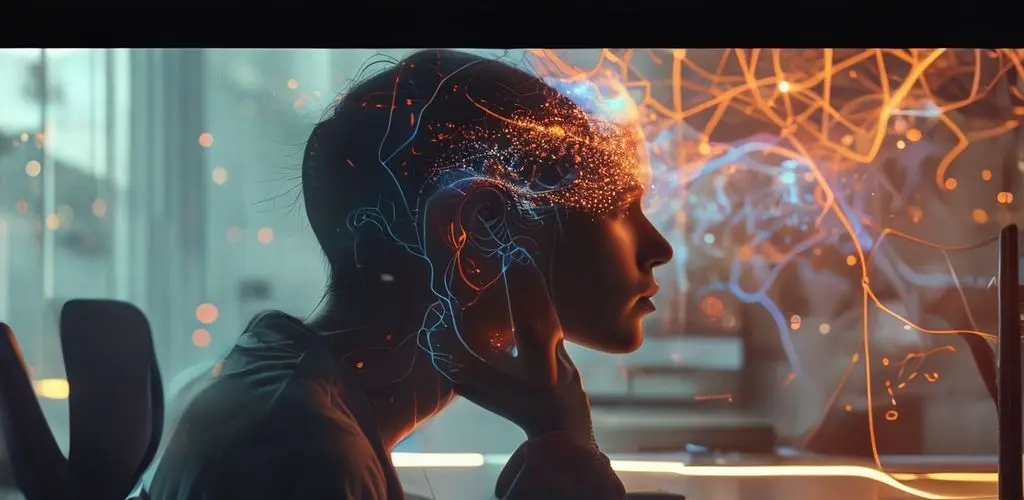
Navigating the Cognitive Corridor: Intentional AI Use and Cognitive Atrophy
The cursor blinked, mocking my screen.
It was 3 AM, and I was wrestling with a particularly thorny problem for a client presentation: how to articulate the nuanced impact of digital fatigue on customer engagement.
Hours had melted away, my mind a tangled knot of half-formed ideas and dead ends.
I had tried every brainstorming technique known to humanity, but my brain felt like a dry well.
Just as I considered throwing in the towel, I remembered a colleague mentioning a new AI chatbot.
Skeptical, but desperate, I typed my convoluted problem into the interface, expecting little more than a rehash of Wikipedia.
What came back was not just an answer; it was a carefully constructed series of probing questions, each one gently nudging me toward a perspective I had not even considered.
A strange, almost electric jolt ran through me.
Suddenly, disparate concepts clicked into place.
The path forward, previously shrouded in fog, became brilliantly clear, if only for a fleeting moment.
It felt like enlightenment, a burst of pure, unadulterated understanding, achieved with an ease that bordered on miraculous.
But was this moment of clarity truly mine, or was I merely a passenger on a cleverly illuminated ride?
In short: Futurist John Nosta’s Cognitive Corridor describes AI’s ability to spark new ideas, feeling like enlightenment.
However, over-reliance on such AI interactions, as recent studies show, could hinder deep learning, reduce brain connectivity, and cause cognitive atrophy, subtly warping our sense of reality.
This article explores how to navigate AI intentionally.
The Allure of Instant Epiphany: Why AI Feels So Good
This fleeting spark of insight, that moment an AI system probes deeper into your initial question and ignites a new idea you did not realize you were exploring, has a name: the Cognitive Corridor.
Coined by futurist John Nosta, founder of NostaLabs, this phenomenon describes how artificial intelligence can momentarily expand your breadth of knowledge, offering perspectives and tidbits you might otherwise miss.
Nosta explained this concept in Psychology Today in 2023, describing it as a powerful experience, making complex information feel immediately accessible.
The shift in how we seek information is palpable.
An Adobe survey from 2023 revealed that a notable 25% of U.S. internet users prefer using ChatGPT over traditional search engines for daily questions.
This growing preference is not surprising when you consider the sheer volume of interaction: OpenAI reports that ChatGPT handles 2.5 billion queries daily in 2023.
This rapid adoption signifies a fundamental change in our digital cognitive habits.
Beyond the Headlights: The Cognitive Corridor in Action
Nosta himself uses a vivid analogy to illustrate the Cognitive Corridor.
He suggests imagining driving a car at night, where your dim headlights illuminate only what is directly in front of you—your current knowledge.
Then, another beam flashes across the road, briefly illuminating a detail you had not seen, like shutters on a distant house or a newspaper in a driveway.
That brief, expanded illumination, Nosta noted in Psychology Today in 2023, is the Cognitive Corridor in action, providing instant, expansive learning.
The Unseen Cost: How AI Reliance May Be Causing Cognitive Atrophy
While the Cognitive Corridor offers compelling immediate benefits, Nosta issues a crucial warning: people often confuse this momentary heightened perception for true, deep understanding.
AI, by its nature, streamlines the learning process, bypassing the grittier steps of human thought—the mistakes, the arduous connections, the deliberate legwork that forges deep knowledge.
This lack of friction, while appealing, may come at a significant cognitive cost, impacting our digital cognition and critical thinking skills.
Recent research supports this concern.
An MIT study, published via arXiv in 2023, suggests that relying heavily on Large Language Models (LLMs) like ChatGPT, Gemini, and Claude could contribute to cognitive atrophy.
This research monitored the neural patterns of participants writing essays, with one group using only their brains, another using search engines, and a third using LLMs.
The findings were stark: the brain-only group exhibited the most brain connectivity, while the LLM group showed the least.
The implications are profound for businesses and individuals alike.
The MIT study further demonstrated that when the LLM group later switched to brain-only writing, they continued to show under-engagement and weaker brain connectivity.
They were also less able to accurately recall what they had written just minutes before.
The researchers concluded these findings signify a pressing matter of a likely decrease in learning skills, suggesting that frequent AI use could hinder our fundamental ability to learn, rather than foster genuine understanding.
For marketing and AI operations, this means that while AI can accelerate content creation, it might subtly degrade the critical thinking capacity of human strategists if over-relied upon.
Navigating the Corridor: Intentional AI Use as a Gift, Not a Habitat
So, how do we harness the power of AI without falling prey to cognitive atrophy?
The key lies in intentionality.
Nosta eloquently states that the Corridor is a gift and not a habitat.
We must view AI as an occasional tool for sparking ideas, not a permanent dwelling for our minds.
This requires a conscious effort to integrate AI into our workflows while safeguarding our inherent human cognitive processes and fostering AI learning.
Here is a playbook for intentional AI use.
- First, define your query precisely.
Before engaging AI, articulate your core problem or question clearly.
This ensures you are guiding the AI, not being led aimlessly.
- Second, use AI for exploration, not resolution.
Leverage AI to generate diverse perspectives or identify overlooked angles, much like the flashing beam Nosta describes.
Do not expect it to provide the final, deeply understood answer.
- Third, engage in gritty steps manually.
Once AI sparks an idea, take the time to research, verify, and connect the dots yourself.
This strengthens brain connectivity and deepens understanding, directly counteracting potential cognitive atrophy, as suggested by the MIT study via arXiv in 2023.
- Fourth, synthesize and articulate in your own words.
After AI input, practice explaining the concepts in your own language without referring back to the AI.
This active recall reinforces learning.
- Fifth, set time limits for AI interaction.
Avoid prolonged, passive consumption of AI-generated content.
Break up your AI sessions with periods of focused, human-led thought and traditional research.
- Sixth, question AI outputs critically.
Always evaluate the information AI provides.
Ask why and how to ensure you understand the underlying principles, rather than just accepting surface-level answers.
- Finally, pair AI with human collaboration.
Remember that while AI can offer insights, the irreplaceable value of another human mind for brainstorming and validating ideas remains paramount for complex problem-solving.
Risks, Trade-offs, and Ethics in the AI Age
The primary risk of unchecked AI reliance is the subtle erosion of our cognitive faculties—the cognitive atrophy identified by the MIT study in 2023.
This is not just about forgetting facts; it is about weakening the neural pathways that enable critical thinking, problem-solving, and deep learning.
We risk becoming adept at prompting machines but less capable of original thought.
The trade-off is efficiency for depth.
While AI offers unparalleled speed in information gathering and synthesis, it can inadvertently foster superficial understanding.
Ethically, we must question if the pursuit of instant gratification in learning compromises our long-term intellectual resilience.
To mitigate these generative AI risks, organizations must foster a culture of critical engagement, encouraging employees to use AI as an aid, not a substitute, for intellectual heavy lifting.
Implementing regular training on effective, ethical AI use and promoting traditional research skills alongside AI adoption can create a balanced human-AI interaction approach.
Tools, Metrics, and Cadence for Intentional AI Integration
Integrating AI intentionally does not require complex new tools, but rather a thoughtful approach to existing ones.
Focus on using LLMs, like those from OpenAI or Google, as intelligent assistants for idea generation and initial synthesis.
Pair these with robust human collaboration tools, such as whiteboarding software and project management platforms, where the gritty steps of discussion and deeper analysis can occur.
Key Performance Indicators should focus less on AI output volume and more on the quality of human insight and learning.
A Cognitive Engagement Score could provide a subjective assessment of depth of understanding from human users, post-AI interaction, aiming for a high rating, such as 4/5 on a self-assessment scale.
Critical Thinking Application should measure the demonstrated ability to challenge, verify, and expand upon AI-generated ideas, with consistent evidence in project outcomes.
Information Recall Rate would track the accuracy of human recall of key information after AI-assisted research, targeting over 80% accuracy in controlled tests.
Finally, Solution Novelty and Depth would assess the uniqueness and thoroughness of solutions attributed to human ideation, with AI support, aiming for measurably higher results than AI-only solutions.
Review cadence should be built into project lifecycles.
Conduct quarterly assessments of AI integration methods, gathering feedback on perceived learning and cognitive impact.
Regularly review project outcomes to ensure that AI is enhancing, rather than replacing, deep human intellectual contribution.
Conclusion
That early morning flash of insight, born from an AI’s probing questions, felt like a revelation, pulling me out of a frustrating creative block.
It delivered clarity with a speed that still amazes me.
Yet, reflecting on Nosta’s Cognitive Corridor and the MIT study’s findings, I now see that moment in a different light.
It was indeed a gift, a momentary illumination that helped untangle my thoughts.
But it was not the sum total of my learning journey.
The real work, the deep understanding, came later—when I took those AI-sparked ideas and rigorously tested them, debated them with colleagues, and synthesized them into a cohesive strategy myself.
AI can be an incredible co-pilot for our minds, offering new vistas and clearing paths.
But the journey itself, the winding road of true intellectual growth, demands our own hands on the steering wheel, actively navigating the terrain.
Let AI illuminate the path, but never let it drive for you.