
China’s AI Storytelling Revolution: From Script to Screen
The soft hum of the server filled a quiet post-production studio in Dongyang, a world away from the clamor of an epic battle scene.
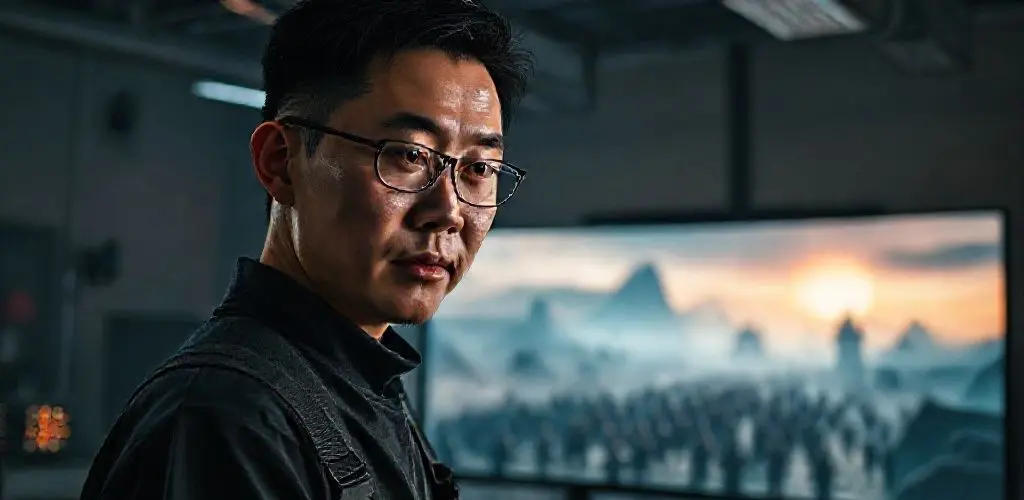
Zhang Shiyu, a post-production technician, watched as an army of digital performers swelled across his screen, rendered with breathtaking realism.
Moments before, this grand vision was merely a few lines in a script, a daunting challenge for a micro-short drama with a modest budget and tight timeline.
Now, with a few precise prompts, artificial intelligence had summoned an entire legion.
Their movements were fluid, their armor gleamed, and they seamlessly integrated into live-action footage.
This scene is not a futuristic dream, but Zhang’s lived reality, a testament to how AI is fundamentally reshaping storytelling in China.
According to Xinhua in 2023, Zhang shared that the leap in AI large language models this year has made the process smoother, more precise, and strikingly efficient.
What once consumed long days can now be delivered by AI in mere minutes with even greater continuity and realism.
It is a quiet revolution unfolding screen by screen, where human ingenuity meets machine efficiency, opening new vistas for creative expression in AI filmmaking in China.
The AI Transformation in China’s Storytelling
AI is revolutionizing China’s film and television industry, enhancing everything from visual effects and post-production to scriptwriting and project evaluation.
This transformation significantly boosts efficiency and creativity for storytelling AI.
Zhang Shiyu’s experience is a microcosm of a broader, systemic shift within China’s dynamic film and television industry.
The drive for efficiency, combined with an insatiable demand for fresh content, has made AI an indispensable partner.
Across the industry, from bustling studios to innovative tech firms, there is a tangible push to integrate technology at every level.
Dongyang Yuanying Technology Co., for instance, launched operations in Hengdian in October 2023 and participated in the production of over 20 micro-short dramas within just a few months, Xinhua reported in 2023.
This rapid adoption underscores a clear signal: the future of film production AI is intertwined with artificial intelligence, empowering creators to tell stories once prohibitively expensive or complex.
Unleashing Creativity and Efficiency
For decades, filmmaking has wrestled with inherent limitations: time, budget, and the sheer logistical complexity of bringing grand visions to life.
An aspiring director, imagining sweeping historical sagas or intricate fantasy worlds, often found ambitions curtailed by practical realities.
This core problem often meant compromising on visual scale, reducing cast sizes, or sacrificing intricate world-building elements due to resource constraints.
The counterintuitive insight here is that AI is not just a cost-cutting measure; it is a powerful tool for unblocking creative AI, allowing filmmakers to push past these traditional barriers.
China’s Hollywood, Hengdian World Studios, recognizes this profoundly.
Lu Pingping, deputy director of the Hengdian Film and Television Cultural Industry Development Service Center, stated to Xinhua in 2023 that Hengdian has prioritized integrating technology with film and television, powering the industry’s growth.
This strategic embrace means that what once required armies of extras, elaborate sets, or months of painstaking animation can now be conjured and refined with startling speed and precision, letting filmmakers focus on the story, not just the logistics.
AI Across the Production Workflow
The integration of AI into China’s storytelling ecosystem is multifaceted, extending far beyond visual wizardry in post-production.
It is a comprehensive transformation that touches every stage of the creative process.
As Zhang Shiyu demonstrated, AI’s capability to generate high-quality visuals and seamlessly integrate them into live-action footage is a game-changer.
Lu Caijian, chairman of Dongyang Gewuzhizhi Culture Media, confirmed to Xinhua in 2023 that AI plays a crucial role in every step of post-production.
AI enables faster, more realistic visual effects, significantly reducing production time and cost while elevating visual quality for media technology in China.
This means increased output and the ability to compete in a rapidly evolving content market.
Beyond the screen, AI is moving upstream, into the very genesis of a story.
Hangzhou-based Huace Group, a major Chinese media company, developed an in-house AI model for script summarization, evaluation, and creation.
This model, trained on 50,000 hours of film and television copyright assets and data accumulated over 30 years, can evaluate novels up to 1.2 million words in one or two hours, a task that previously took a human team 10 to 14 days, according to Xinhua in 2023.
This dramatically increases efficiency for identifying viable projects and optimizing scripts.
Businesses can accelerate development pipelines, make data-driven decisions on greenlighting projects, and ensure creative resources are focused on high-potential stories.
The impact of AI filmmaking China transcends mere efficiency.
Li Zhenlin, dean of the College of Film at the Shanghai Theatre Academy, succinctly put it to Xinhua in 2023 that AI is expanding the boundaries of visual expression, likely giving rise to entirely new cinematic styles and narrative methods unimaginable today.
This implies an explosion of new creative possibilities, fostering innovation and pushing the art form forward.
For marketing and AI operations, this implies a need to stay agile, experiment with new narrative formats, and understand the evolving language of visual storytelling.
Furthermore, the strategic integration seen at hubs like Hengdian, coupled with AI’s ability to lower barriers to entry, is fostering a robust industrial ecosystem.
Fu Binxing, president of Huace Group, noted to Xinhua in 2023 that for new directors, AI lowers the barriers to entry into the industry, allowing them to translate their creative vision into visual presentations for investors and potential collaborators.
This dynamic environment encourages competition and fosters a rich creative landscape, beneficial for talent development and market expansion alike.
Practical Steps for AI Integration
Integrating AI into storytelling and content creation is a strategic move for any entity involved in media, marketing, or creative production.
First, automate labor-intensive post-production.
Identify areas in visual effects, editing, or digital asset creation where AI can generate or enhance content.
Technicians like Zhang Shiyu show AI can summon complex visuals in mere minutes, freeing human artists for refinement and conceptual design, Xinhua reported in 2023.
Second, pilot AI for content evaluation.
Explore AI models for rapid assessment of scripts, manuscripts, or content ideas.
Huace Group’s model, which reduces evaluation time from 10 to 14 days to one or two hours, offers a clear efficiency benchmark according to Xinhua in 2023.
This speeds up decision-making and project prioritization.
Third, invest in human-AI collaboration training.
Recognize that AI is a tool, not a replacement.
Lin Ju, operations manager at Yuanying, emphasized to Xinhua in 2023 that the core of creation is still people, and what matters is the ability to harness AI.
Train teams to leverage AI for routine tasks, allowing them to focus on true innovation, as Fu Binxing noted, Xinhua also reported.
Fourth, experiment with generative AI for early-stage scripting.
Use large language models to assist with script summarization, character development, or initial story outlines.
While human oversight is paramount, this can inspire creators and optimize early drafts, as Huace Group’s model inspires creators by optimizing scripts, according to Fu Binxing.
Fifth, develop a strategic AI integration roadmap.
For organizations like Hengdian, prioritizing integrating technology with film and television is a growth driver, as Lu Pingping stated, Xinhua reported.
Assess your current production pipeline and identify where AI can create new efficiencies or open new creative avenues.
Finally, explore AI for genre-specific content.
Consider how AI can enhance niche genres like science fiction and fantasy, where visual effects AI are critical.
Lin Ju noted to Xinhua in 2023 that AI is currently being used to create grand scenes, science fiction, and fantasy genres, making these ambitious projects more feasible.
Navigating Risks and Ethical Considerations
While AI promises boundless efficiency and creativity for Hengdian Studios AI, its integration is not without ethical considerations and trade-offs.
The primary concern often revolves around the potential for job displacement or the dilution of human creativity.
However, industry leaders in China largely frame AI as an enabler, not a replacement.
As Lin Ju of Yuanying clearly stated to Xinhua in 2023, AI is not meant to replace humans, but has altered certain production processes.
In the short term, the core of creation is still people.
The real risk lies in over-reliance, where the pursuit of efficiency overshadows artistic integrity.
If creators delegate too much creative control to algorithms, stories could become homogenized or lack the unique human perspective that truly resonates.
The trade-off is often speed versus nuance, and the balance must be carefully maintained.
Mitigation requires robust human oversight at every stage, emphasizing that AI is a powerful assistant, not the primary author.
Directors and screenwriters must still need to control the visual language and final presentation of each shot, ensuring that the emotional core and unique vision remain distinctly human, Lin Ju concluded in 2023.
Measuring AI’s Impact in Media
To truly harness the power of AI in storytelling, it is vital to adopt a structured approach to tools, metrics, and review cadences.
While specific brand names for AI tools are not provided in the research, think in terms of categories: large language models for script analysis and generation, specialized visual effects software with AI integration for rendering and texture mapping, and AI-powered project management platforms.
Key Performance Indicators for AI integration include production efficiency, measured as a percentage reduction in time for tasks like script evaluation or VFX.
Huace Group, for example, saw an efficiency increase of over 50 percent, and could evaluate projects with about 90 percent accuracy.
Content velocity, measured by the number of completed projects or content pieces per quarter, shows Dongyang Yuanying Technology Co. participating in over 20 micro-dramas in months.
Creative exploration tracks the number of unique visual styles or narrative methods prototyped, and project success rate measures the percentage of AI-identified or optimized projects that meet targets.
Implement monthly check-ins for operational teams to assess AI tool performance and user feedback, quarterly reviews for strategic adjustments to AI integration, and annual deep dives to evaluate the overall impact on creative output, efficiency, and market positioning.
This iterative process ensures continuous improvement and adaptation in the rapidly evolving AI landscape.
The Symbiotic Future of Storytelling
The story of Zhang Shiyu, crafting digital armies with a few lines of code, is more than an anecdote; it is a profound metaphor for the future of storytelling.
The age-old craft of weaving narratives, once bound by formidable logistical and financial constraints, is now being liberated by the intelligent hand of AI.
From the vast, cinematic landscapes of Hengdian to the innovative offices of Huace, China is charting a course where human creativity is amplified, not diminished, by technology.
AI is extensively used across the workflow, from post-production for generating high-quality visuals, creating grand scenes, and adding special effects, to script summarization, evaluation, and creation.
Industry experts largely agree that AI is not intended to replace humans in the short term, but rather handles routine tasks while the core of creation remains with people.
Screenwriters and directors still control the visual language and final presentation of each shot.
The key benefits include dramatically enhanced production efficiency, a reduction of complex tasks from days to hours, expanded boundaries of visual expression, and lower barriers to entry for new directors.
This is not just about faster production or cheaper visual effects; it is about expanding the very canvas of imagination.
It is about empowering every filmmaker, every storyteller, to bring their most ambitious visions to life with unprecedented realism and efficiency.
The greatest stories, after all, have always been born from a blend of human insight and the tools available.
In China, that blend is now powered by AI, proving that when humans and machines truly collaborate, the narratives we create can be richer, more diverse, and more captivating than ever before.
How might AI empower your next great story?
References
- Xinhua. (2023). China Focus: AI’s growing role in storytelling, from script to screen.