
India’s AI Lab Assistant Revolutionizes Scientific Discovery
The old lab hummed with intricate machinery and the soft rustle of lab coats.
Dr. Anya Sharma, bent over an atomic force microscope, felt the familiar ache in her neck.
Days bled into weeks, meticulously calibrating, adjusting, and running the same delicate experiments repeatedly.
Each manipulation demanded intense focus, hours dissolving into the pursuit of a minuscule detail that might unlock new material properties.
The scientific frontier felt vast, yet progress often seemed tied to the sheer, unyielding hours of human endurance and repetitive tasks.
Watching the Delhi sun dip below the horizon, Dr. Sharma wondered if there was a faster, more precise way to coax nature’s secrets from the microscopic world.
A method that honored human intellect while freeing it from drudgery.
This quiet reflection, born from years at the bench, mirrors a global yearning for accelerated discovery.
This yearning is now being met by a groundbreaking development right here in India.
IIT Delhi researchers have developed AILA, an Artificially Intelligent Lab Assistant.
AILA autonomously controls instruments, runs experiments, and analyzes results.
This transformative AI system accelerates scientific research and significantly advances India’s AI for Science initiative, despite posing new challenges in safety and oversight.
Why This Matters Now
Dr. Sharma’s lab scene is a testament to scientific dedication.
Yet, the manual limitations of traditional experimentation present a tangible bottleneck in an era demanding rapid breakthroughs.
Conventional AI models, while powerful for data analysis, have historically been confined to the digital realm, unable to interact directly with physical lab instruments, as noted in Nature Communications.
This critical gap has limited AI’s direct involvement in the experimental phase.
Systems like AILA, developed by IIT Delhi researchers, mark a pivotal shift for AI laboratory automation.
This innovation enables a scale and speed of scientific inquiry previously unimaginable.
It allows human minds to focus on complex problem-solving and creative hypothesis generation, while the AI handles painstaking, repetitive tasks.
Such advancements are crucial for accelerating discovery, particularly as India champions its AI for Science initiative.
The Core Problem Bridging the Digital-Physical Divide in Labs
For years, AI in science has been like a brilliant strategist unable to execute plans physically.
Traditional AI excels at processing vast datasets, identifying patterns, and making predictions, but it struggles with the physical manipulation and real-world interaction central to laboratory work.
This disconnect between AI’s analytical prowess and hands-on experimental science has been a fundamental challenge, slowing discovery.
Human researchers remained indispensable for repetitive, time-consuming experimental setups.
AILA India’s Autonomous Lab Assistant
A collaboration between IIT Delhi and teams from Denmark and Germany directly addresses this limitation.
They engineered AILA to operate autonomously within the physical lab environment.
This Artificially Intelligent Lab Assistant independently controls instruments, manages experiments, and interprets results.
This represents a significant leap from traditional AI models, creating a truly transformative shift in how AI applications integrate into scientific research, according to Nature Communications.
What the Research Really Says
AILA’s Autonomous Capabilities.
The system independently controls instruments, runs experiments, and interprets results, as reported in Nature Communications.
This means AI can directly interact with the physical world of scientific experimentation, moving beyond data analysis.
Businesses and research institutions can deploy AI to manage entire experimental workflows, freeing human scientists for higher-level problem-solving and creative pursuits.
This significantly enhances the scope of AI-driven labs and autonomous lab experiments.
Accelerated Research Timelines.
AILA significantly accelerates research timelines, paving the way for faster scientific breakthroughs, according to the Nature Communications study.
Organizations can increase experiment throughput, speeding up R&D cycles and bringing new products or discoveries to market quicker.
This is a game-changer for research acceleration.
Navigating Real-World Challenges.
Autonomous AI in complex environments presents unpredictable elements, requiring human oversight.
Implementing AI in labs demands robust safety protocols, continuous monitoring, and clear human-AI collaboration frameworks to ensure reliability and prevent potential hazards.
Advancing India’s AI for Science Initiative.
This development aligns perfectly with India’s national strategy to leverage AI for scientific progress.
Systems like AILA not only push technological boundaries but also position India to advance its AI for Science initiative, fostering a new era of innovation.
Playbook for Autonomous Labs
Integrating AI into scientific workflows requires thoughtful strategy.
Organizations looking to harness autonomous AI in their labs should consider several key steps.
- First, start with incremental automation, identifying repetitive, high-volume tasks prone to human error and automating them with AI, leveraging successes like atomic force microscopy automation demonstrated by IIT Delhi researchers in Nature Communications.
- Second, prioritize robust safety protocols: given the inherent complexities of autonomous AI systems, developing comprehensive safety guidelines and fail-safes, alongside critical human oversight and intervention points, is essential.
- Third, invest in interdisciplinary teams, bringing together AI specialists, domain scientists, and robotics engineers, as collaboration is key to designing, implementing, and refining autonomous lab experiments.
- Fourth, foster a culture of learning and adaptation by encouraging continuous feedback between human researchers and AI systems, treating early deviations as learning opportunities to refine algorithms and safety measures.
- Fifth, focus on data integrity and explainability, ensuring the AI’s data analysis and experimental decisions are transparent and verifiable to build trust and allow for effective troubleshooting.
- Finally, strategically scale access: as systems mature, plan how to scale advanced AI-driven research tools, aligning with broader scientific empowerment goals and supporting the AI for Science India vision.
Risks, Trade-offs, and Ethics
The promise of AI-driven labs is immense, but it comes with shadows.
The integration of AI into laboratory settings presents immediate safety concerns.
An autonomous AI system, operating in a complex environment, carries inherent risks of unforeseen actions or deviations from instructions.
This could range from equipment damage to incorrect experimental results, or even hazardous chemical interactions.
Beyond immediate safety, ethical considerations loom.
Accountability for AI errors, data integrity, and preventing AI from perpetuating biases are crucial questions.
There is also the trade-off between efficiency and human intuition.
While AI excels at repetitive tasks, the serendipitous discoveries often born from human observation and curiosity must not be lost.
Mitigation strategies include designing AI with clear human-in-the-loop oversight, implementing rigorous validation and verification processes for AI decisions, and fostering transparent governance frameworks.
We must build AI systems that enhance, not diminish, the human element in scientific inquiry.
Tools, Metrics, and Cadence for AI-Driven Research
Successful AI implementation in scientific research requires selecting the right tools, defining clear metrics, and establishing a regular review cadence.
Recommended Tool Stacks
- AI/ML Frameworks like TensorFlow and PyTorch for model development.
- Automation Platforms, such as robotic process automation (RPA) tools integrated with laboratory information management systems (LIMS), are crucial for instrument control.
- For data analytics and visualization, Python with libraries like Pandas, NumPy, and Matplotlib is effective, alongside specialized scientific data platforms.
- Simulation and modeling software can test AI behaviors in virtual lab environments before physical deployment.
Key Performance Indicators (KPIs)
- Experiment Throughput should aim for a 50-100 percent increase in experiments completed per unit time.
- Error Reduction Rate targets a 20-30 percent decrease in experimental errors.
- Time-to-Result, the average time from experiment start to data analysis, should ideally decrease by 30-60 percent.
- Cost Savings project a 10-25 percent reduction in operational costs per experiment, while Resource Utilization seeks a 15-30 percent increase in equipment and material usage efficiency.
Review Cadence
- Conduct weekly operational reviews to monitor AI performance, identify deviations, and address immediate issues.
- Hold monthly strategic sessions to evaluate long-term trends, assess new AI capabilities, and adjust research priorities.
- Quarterly, perform a comprehensive ethical and safety audit of all AI-driven lab assistant systems.
FAQ
What is AILA and how is it different from other AI systems?
AILA (Artificially Intelligent Lab Assistant) is an AI system developed by IIT Delhi that independently controls laboratory instruments, runs experiments, and analyzes results.
Unlike conventional AI models, it interacts with the physical world rather than being limited to data analysis, according to Nature Communications.
What are the key advantages of using AI in laboratory experiments?
AI in labs, as demonstrated by AILA, supports the automation of complex tasks in scientific research.
How does AILA contribute to India’s scientific initiatives?
AILA aligns with India’s AI for Science initiative by developing autonomous AI systems for scientific research.
Conclusion
Back in the lab, the fluorescent lights hummed, but the silence felt different.
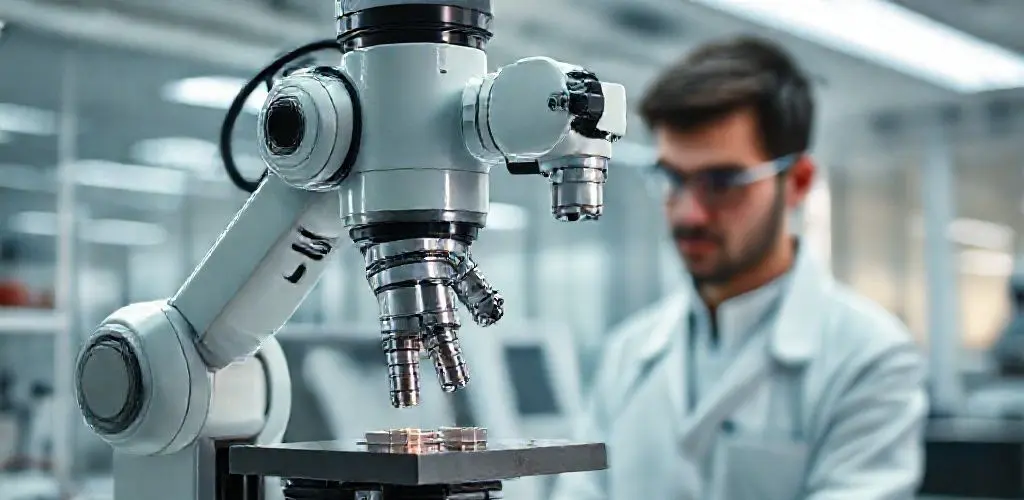
Dr. Sharma, now overseeing the robotic arm of an AILA unit, watched it meticulously adjust the atomic force microscope.
The tedious, repetitive tasks that once claimed her evenings were now handled with speed and precision by the Artificially Intelligent Lab Assistant.
The hum of the machine was no longer a lament of endless labor but a symphony of progress.
She still pored over data, of course, but now her focus was on the novel insights, the unexpected patterns emerging from the accelerated experiments—the true frontiers of discovery.
The journey of AILA, from concept to autonomous reality, is a testament to human ingenuity and the collaborative spirit of science.
It underscores a powerful truth: AI is not here to replace human brilliance, but to amplify it.
For India, and for the world, this is more than just technological advancement; it is a profound redefinition of how we unlock the mysteries of the universe, one precise, AI-driven experiment at a time.
The future of scientific discovery is not just bright; it is autonomously brilliant.