
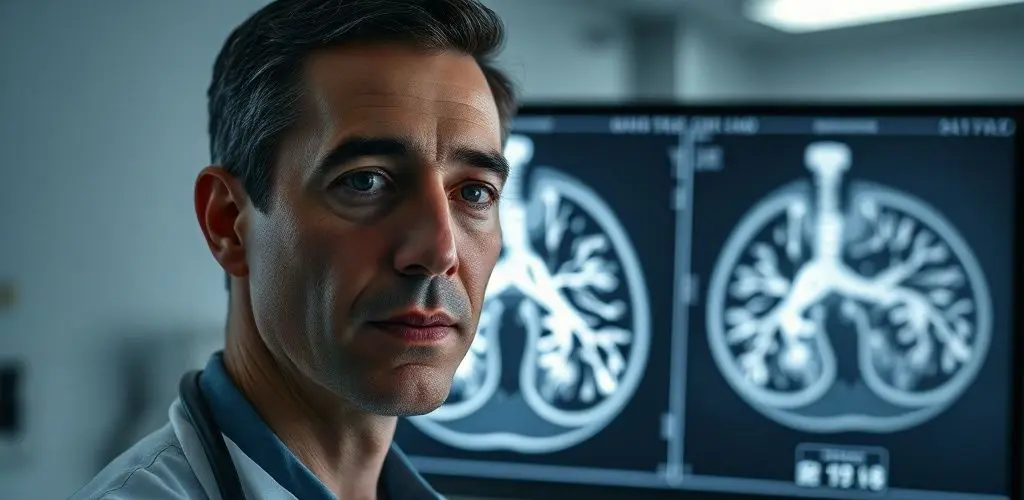
Rewriting the Lung Map: AI Transforms Emphysema Diagnosis
The silence of a radiologist’s reading room often belies the quiet drama unfolding on screen. I recall a hushed conversation with a friend, a pulmonologist, describing the challenge of patients whose lungs told a story of decline, but in a language too subtle for traditional diagnostics to fully grasp.
He spoke of emphysema, a chronic lung disease, not as a single enemy, but a multitude. He would trace the hazy outlines on a standard CT scan, lamenting, “It is like having a map with only major highways, when what we truly need is every backroad, every alleyway.”
This longing for a more granular understanding, a rewriting of the lung map, is precisely where AI in medical imaging is making its profound mark today. Professor Elsa Angelini’s team uses AI to analyze vast lung CT scan data, identifying new emphysema subtypes, promising more precise COPD diagnosis.
Breakthroughs in AI analysis of vast CT datasets are identifying new emphysema subtypes, allowing us to move from generalized care to truly personalized medicine for COPD patients.
Why This Matters Now
The aspiration for detailed diagnostic maps is a critical bridge between human suffering and technological promise. COPD affects hundreds of millions globally. Historically, clinicians suspected subtypes, but lacked rigorous quantification, leading to less tailored treatments.
The ability to peer into the human body with unprecedented detail, to discern patterns invisible to the unaided eye, is not just a scientific marvel—it is an ethical imperative. It promises to transform how we approach conditions like COPD, moving from educated guesses to precise strategies.
The Unseen World: Angelini’s Research
Professor Elsa Angelini, a specialist at Telecom Paris and Columbia University, dedicated a decade to this mystery. Her team leveraged massive longitudinal cohorts like MESA and SPIROMICS. The counterintuitive insight? The sheer scale of data, once a barrier, became the raw material for discovery when paired with AI.
What the Research Really Says
AI is fundamentally reshaping our understanding of complex lung diseases through these key breakthroughs.
Insight 01
AI Uncovers New SubtypesAI-powered analysis of long-term cohorts allowed Angelini’s team to identify previously unseen emphysema subtypes. This moves us beyond generic diagnosis to a highly specific understanding of disease manifestations.
Insight 02
Clinical CorrelationThese new categories correlate meaningfully with lung function and symptom severity. They are not just academic distinctions; they have real-world prognostic and therapeutic implications for patient care.
Insight 03
Evolution to Full AIThe field has rapidly transitioned from classical computer vision to fully deep learning models. This exponential expansion enables complex analysis like domain transfer and super-resolution.
Playbook You Can Use Today
Harnessing the power of AI in biomedical imaging requires a clear strategy, blending innovation with responsible implementation.
Move beyond classical image processing. Invest in experts in deep learning and generative models to uncover hidden patterns, matching the industry’s evolution.
Establish robust protocols for standardizing medical image data across centers. High-quality, harmonized datasets are the bedrock for effective AI training.
AI makes errors. Implement XAI systems that allow medical professionals to understand the “why” behind a diagnosis, building trust and enabling critical oversight.
Recognize scanner variability. Fine-tune models for different machine families to maintain accuracy across diverse clinical environments.
Combine imaging data with radiology reports and biomarkers. This holistic approach creates richer patient profiles and enhances predictive power.
While promising for missing sequences, deploy generative AI only in tightly constrained use cases under expert guidance to avoid the high risk of hallucinations.
Risks and Ethical Foundations
The excitement must be tempered with vigilance. The most critical risk is AI hallucinations—producing plausible but incorrect data. Mitigating this requires rigorous validation against ground truth. Furthermore, protecting patient privacy through robust anonymization and addressing potential bias in training data is paramount.
Tools, Metrics & Cadence
Operationalizing AI-driven imaging requires specialized tools and disciplined reviews.
Recommended Tool Stacks
- MONAI Framework – For medical imaging-specific AI development components.
- Cloud AI Platforms – Scalable compute and specialized medical imaging APIs.
- Annotation Workflows – Robust human-in-the-loop systems for ground truth.
Key Performance Indicators
- Diagnostic Accuracy – % of correctly identified subtypes.
- Patient Stratification – Precision in assigning treatment pathways.
- Workflow Optimization – Time saved on routine analysis.
Review Cadence
- Weekly: Team stand-ups for troubleshooting.
- Monthly: Model performance and drift reviews.
- Quarterly: Clinical feedback sessions with radiologists.
Frequently Asked Questions
How has AI changed diagnosis?
What are the risks of generative AI?
Why is human expertise critical?
Conclusion
The journey from a hazy CT scan to a crisply defined map of chronic lung disease is a testament to the transformative power of AI. My friend, the pulmonologist, is no longer just navigating highways; he is exploring every backroad of his patient’s lungs.
Professor Angelini’s work illuminates the promise of AI in refining diagnosis, but also the ethical grounding required. This is more than just science; it is a commitment to giving every breath a better chance.