
AI customer segmentation uses Artificial Intelligence (AI) to group customers into highly specific categories based on their data. For Direct-to-Consumer (D2C) brands, this means deeply understanding each customer, predicting their needs, and offering truly personalized experiences. This advanced approach moves beyond basic demographics, enabling D2C brands to connect more effectively with Indian customers and scale their business efficiently.
Why This Matters Now:- India and Global Trends
The D2C market in India is experiencing rapid growth, projected to reach US$100 billion by 2025, up from US$44.6 billion in 2022 (Statista / India Brand Equity Foundation (IBEF), 2024). This substantial expansion means increased competition, making sophisticated strategies like AI customer segmentation critical for D2C brands to stand out.
Globally, AI’s role in personalization is undeniable. A Deloitte Insights survey (2023) found that 60% of marketing leaders consider AI “very important” or “extremely important” for personalization, with 45% reporting over a 10% improvement in customer engagement metrics due to AI. This underscores AI’s proven ability to deliver tangible results. Sucharita Kodali, a Principal Analyst at Forrester (2024), emphasizes that D2C brands failing to invest in advanced AI for segmentation and personalization will struggle to compete, as consumers expect brands to “know” them, a feat only scalable with AI.
Key Insights and Proof :-
1. AI Outperforms Traditional Methods:– Academic research highlights that AI-driven segmentation, particularly using unsupervised machine learning algorithms like K-means and DBSCAN on transactional and behavioral data, significantly outperforms traditional demographic or RFM analysis (Journal of Retailing and Consumer Services, 2023). These advanced models identify nuanced customer clusters, revealing distinct purchasing patterns and preferences that enable hyper-personalized marketing.
2. Predictive Analytics Prevents Customer Churn:– An IIM Ahmedabad study (2024) focusing on the Indian e-commerce sector found that integrating AI for predictive analytics allows D2C brands to identify customers at high risk of churn with 80-85% accuracy. By segmenting customers based on purchase frequency, value, and recent engagement processed by AI, brands can deploy targeted retention strategies, significantly reducing customer attrition in the competitive Indian market.
3. Explainable AI Builds Trust and Strategy:– While complex AI models offer superior segmentation, the importance of Explainable AI (XAI) in marketing is growing (IEEE Transactions on Neural Networks and Learning Systems, 2023). XAI enables marketers to understand *why* a customer falls into a particular segment, providing actionable insights into underlying motivations. This transparency fosters trust in AI recommendations and leads to more strategic, rather than merely automated, marketing decisions.
4. Customers Expect Personalization:– Modern consumers expect brands to understand their needs. Salesforce Research (2024) reported that 80% of customers expect consistent interactions and are more likely to make a repeat purchase after a personalized experience. This expectation is highly relevant to India’s digitally native population, making AI segmentation essential for fostering loyalty and repeat business.
India Focus: Market Reality
The Indian D2C market’s projected growth to US$100 billion by 2025 underscores the intense competition and the critical need for effective customer understanding (Statista / India Brand Equity Foundation (IBEF), 2024). AI is also a strategic national priority; NITI Aayog (2023) highlights AI as a critical enabler for India’s economic growth, projecting it could add US$90 billion to the economy by 2035. This favorable environment encourages D2C brands to invest in AI solutions.
Vartika Gupta, Head of Digital Marketing at Nykaa (2024), an Indian D2C leader, confirms, “In the D2C space, customer data is gold. AI-powered segmentation allows us to move beyond basic demographics to understand true intent and preference.” She notes this directly impacts conversion and customer loyalty in India’s diverse market. Dr. Anand Srinivasan, Professor of Marketing at IIM Bangalore (2023), adds that AI’s strength lies in its ability to process vast, disparate data — from social media sentiment to clickstream data — and identify latent patterns humans would miss. This yields truly predictive segments, allowing brands to anticipate customer needs proactively.
Case Study Highlights
Indian D2C Success: An Indian D2C beauty brand leveraged AI to analyze social media interactions, website navigation, and purchase data (NASSCOM, 2024). They identified distinct segments like ‘eco-conscious’ and ‘premium-seeker’ customers. By tailoring product recommendations and content, the brand achieved a 25% increase in repeat purchases from these segments and a 15% uplift in average order value (AOV) within six months. This demonstrates AI’s power in understanding local consumer nuances and driving measurable business outcomes in India.
Global D2C Efficiency: A global D2C apparel brand, in collaboration with McKinsey Digital (2023), transitioned from 5 broad customer segments to over 50 dynamic micro-segments based on browsing behavior, purchase history, and product preferences. This granular approach led to a 15-20% increase in conversion rates for segmented email campaigns and a 10% reduction in marketing spend due to more efficient targeting.
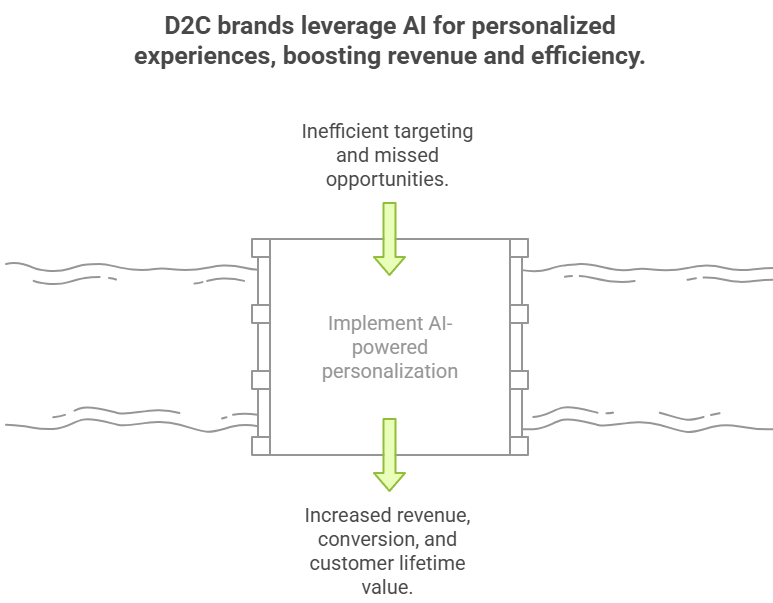
Gartner (2024) indicates that D2C brands adopting AI-powered personalization and segmentation are 2.5 times more likely to exceed revenue targets. A D2C food subscription service, featured by Gartner, used AI to predict next-best offers for individual customers, resulting in a 30% reduction in customer acquisition costs (CAC) and a 5% improvement in customer lifetime value (CLTV) over a year.
How to Apply AI Customer Segmentation for Your D2C Brand
Applying AI customer segmentation effectively involves several key steps:–
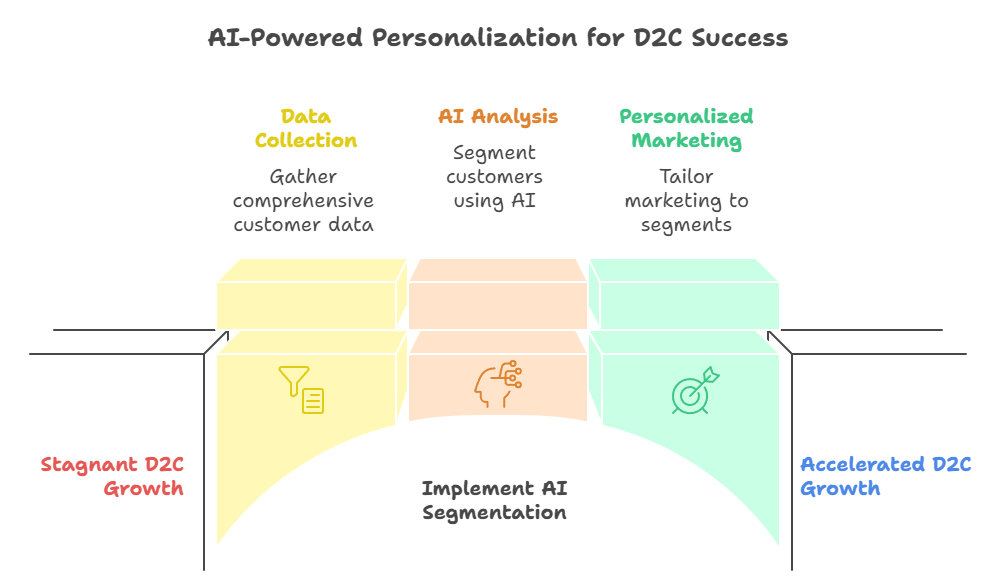
1. Collect Rich Data:– Gather comprehensive customer data, including transactional history, website browsing, social media interactions, and engagement metrics. More data enables AI to build more accurate customer profiles.
2. Utilize Advanced AI Tools: – Adopt unsupervised machine learning algorithms like K-means and DBSCAN. These tools excel at identifying subtle customer patterns that might escape human analysis (Journal of Retailing and Consumer Services, 2023).
3. Focus on Predictive Insights:– Employ AI to forecast future customer behavior, such as identifying churn risks or predicting product preferences. This proactive stance supports better strategic planning (IIM Ahmedabad Research Paper, 2024).
4. Embrace Explainable AI (XAI):– Opt for AI solutions that clarify *why* a customer belongs to a specific segment. This transparency helps your team make informed, strategic marketing decisions (IEEE Transactions on Neural Networks and Learning Systems, 2023).
5. Tailor Your Campaigns:– Develop highly personalized marketing messages, product recommendations, and offers for each identified micro-segment, enhancing relevance and conversion rates.
6. Measure and Optimize: -Continuously track the performance of your segmented campaigns using metrics like conversion rates, repeat purchases, AOV, CAC, and CLTV, refining your approach based on observed outcomes.
Pitfalls and Misconceptions :-
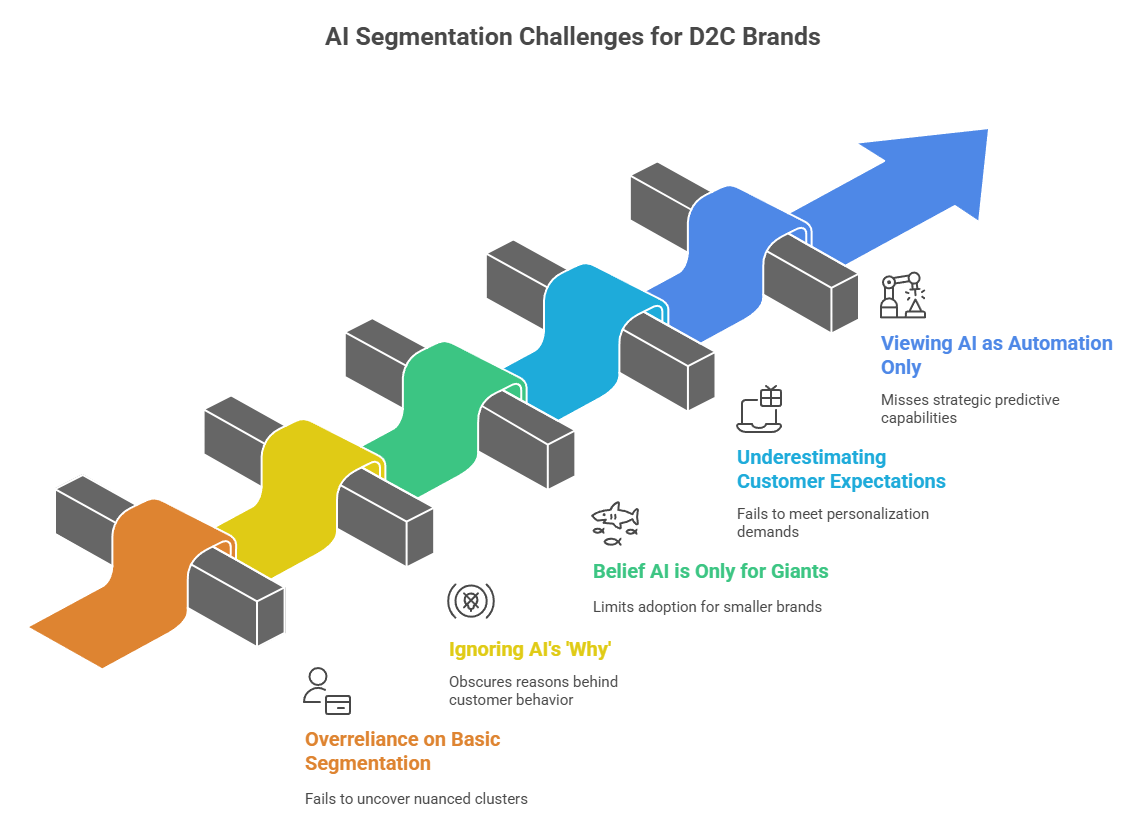
1. Overreliance on Basic Segmentation:– Many D2C brands believe simple demographic or RFM segmentation is sufficient. However, research demonstrates that AI-driven segmentation significantly outperforms these traditional methods by uncovering nuanced customer clusters (Journal of Retailing and Consumer Services, 2023).
2. Ignoring AI’s ‘Why”:– Implementing AI without understanding its outputs can be a mistake. Focusing on Explainable AI (XAI) is crucial for deciphering why a customer is in a particular segment, leading to more strategic decisions (IEEE Transactions on Neural Networks and Learning Systems, 2023).
3. Belief that AI is Only for Large Global Brands:– The success of an Indian D2C beauty brand using AI to boost repeat purchases by 25% and AOV by 15% (NASSCOM, 2024) clearly shows AI’s applicability and benefits for D2C brands in India, regardless of scale.
4. Underestimating Customer Expectations:– Today’s customers expect personalization; 80% are more likely to make a repeat purchase after a personalized experience (Salesforce Research, 2024). Failing to invest in AI for this means falling short of modern consumer demands.
5. Viewing AI as Just an Automation Tool:– AI for segmentation helps identify latent patterns in vast data that human analysts would miss. This leads to truly predictive segments, allowing brands to anticipate customer needs, making it a strategic advantage beyond mere automation (Dr. Anand Srinivasan, IIM Bangalore, 2023).
Quick FAQ:-
1. What is AI customer segmentation for D2C? AI customer segmentation uses Artificial Intelligence to group D2C customers based on their behavior and preferences, enabling highly personalized marketing.
2. Why should Indian D2C brands use AI segmentation? The Indian D2C market is projected to reach US$100 billion by 2025, making AI segmentation essential for standing out, retaining customers, and personalizing experiences in a competitive landscape (Statista / IBEF, 2024).
3. What data does AI segmentation use? AI segmentation leverages diverse data, including transactional history, browsing behavior, social media interactions, and engagement metrics (Dr. Anand Srinivasan, IIM Bangalore, 2023).
4. Can AI segmentation reduce customer churn? Yes, an IIM Ahmedabad study (2024) found AI can identify customers at high risk of churn with 80-85% accuracy, enabling targeted retention strategies.
5. How does AI segmentation improve marketing? It facilitates hyper-personalized campaigns, leading to 15-20% higher conversion rates and 10% lower marketing costs through more efficient targeting (McKinsey & Company, 2023).
6. What is Explainable AI (XAI)? Explainable AI (XAI) helps marketers understand why a customer belongs to a certain segment, fostering strategic rather than just automated marketing decisions (IEEE Transactions on Neural Networks and Learning Systems, 2023).
Conclusion :-
For D2C brands in India, embracing AI customer segmentation is no longer merely an option but a necessity for survival and sustained growth. It empowers brands to move beyond basic customer understanding to deep, predictive insights. By leveraging AI to segment customers, you can deliver personalized experiences that meet high consumer expectations, effectively reduce churn, and drive significant revenue growth.
In the dynamic and rapidly expanding Indian market, investing in AI customer segmentation is a strategic move to secure your brand’s future.