
Discover how AI customer segmentation transforms Indian D2C brands. Learn to use predictive analytics, RFM analysis, and deep learning to boost sales, retention, and ROI.
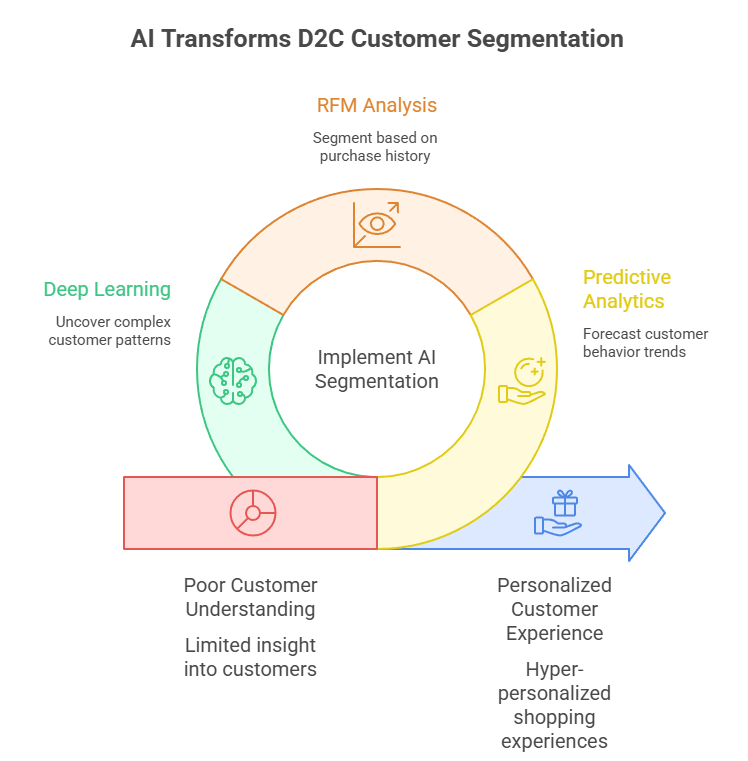
AI customer segmentation uses smart technology to understand your customers better. It breaks down your large customer base into smaller groups based on their behavior, preferences, and needs. This helps D2C (Direct-to-Consumer) brands create highly personal shopping experiences through personalized marketing.
For Indian D2C brands, AI customer segmentation is a game-changer. It uses machine learning and predictive analytics to understand diverse customers, leading to increased sales, better customer retention, and smarter marketing spend by offering hyper-personalized experiences.
Why This Matters Now: India and Global Trends
The way customers shop online is changing quickly, especially in India. The Indian D2C market is growing fast and is expected to reach US$100 billion by 2025, according to Statista & IAMAI (Internet and Mobile Association of India) (2023-2024). This huge growth means more competition. About 60% of online shoppers in India expect personalized experiences, and brands that fail to deliver this risk losing customers (Statista & IAMAI, 2023-2024).
Globally, 71% of consumers expect personalized interactions, and 76% get frustrated when this doesn’t happen (Deloitte Digital, 2023). Gartner predicts that by 2026, 75% of large retail companies will use AI to personalize customer experiences, a significant rise from less than 30% in 2022. Much of this AI adoption will be for advanced AI customer segmentation and predictive analytics (Gartner, 2024). NASSCOM estimates AI could add USD 450-500 billion to India’s GDP by 2025, with retail personalization being a major driver (NASSCOM, 2023).
Key Insights & Proof
Advanced AI customer segmentation goes beyond old ways of grouping customers, offering powerful tools for deep insights.
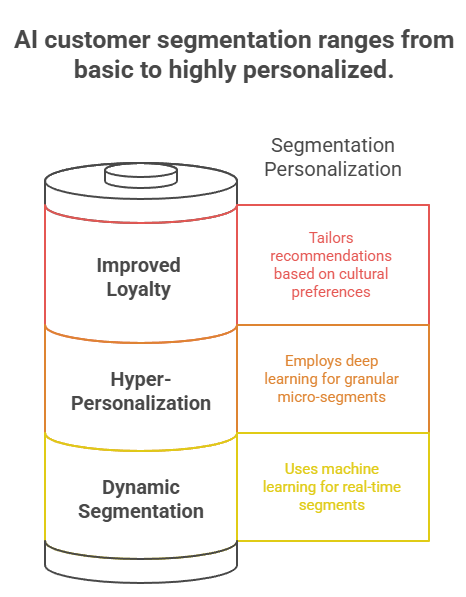
Dynamic Segmentation for Personalization: Machine learning algorithms like Gradient Boosting and Random Forest significantly improve predictive accuracy for purchase behavior. This allows for dynamic, real-time segment creation beyond traditional demographic or RFM analysis models, leading to more effective personalized marketing campaigns (IEEE Transactions on Engineering Management, 2023).
Hyper-Personalization with Deep Learning: Deep learning models can analyze vast, unstructured customer data like social media interactions, clickstream data, and product reviews. This creates granular micro-segments, enabling D2C brands to deliver hyper-personalized product recommendations, pricing, and content, optimizing the entire customer journey from discovery to post-purchase support (Harvard Business Review, 2023).
Improved Customer Loyalty and Retention: Research on the Indian retail sector shows that AI-driven CRM, particularly through enhanced customer segmentation, improves customer satisfaction and retention rates. Indian D2C brands can effectively tailor product recommendations and communication strategies by understanding diverse regional and cultural consumer preferences, thereby boosting customer loyalty (Journal of Marketing Analytics, 2024).
India Focus: Market Reality
India’s market is unique due to its vast diversity in language, culture, and buying habits. For D2C brands, understanding this is critical. Kunal Bahl, Co-founder & CEO of Snapdeal, stated in 2023 that the future of Indian e-commerce, especially D2C, depends on deep individual customer understanding. He noted that AI customer segmentation helps move beyond broad categories to micro-segments, enabling highly targeted campaigns that resonate with India’s specific regional, linguistic, and socio-economic nuances (Kunal Bahl, Snapdeal, 2023).
This deep understanding is not just good for customers; it is good for business. AI-driven customer relationship management in India, powered by segmentation, improves customer satisfaction and retention (Journal of Marketing Analytics, 2024). This is a big deal for D2C brands aiming to grow in a competitive market like India.
Case Study Highlights :-
Real-world examples show how AI customer segmentation delivers clear results for D2C brands.
Bewakoof (India): This Indian D2C apparel brand used an AI-powered segmentation engine. It analyzed purchasing patterns, browsing history, and social media engagement to identify distinct fashion tribes and lifestyle segments. Consequently, Bewakoof reported a 15% increase in conversion rates for segmented campaigns and a 10% reduction in marketing spend by optimizing ad targeting (NASSCOM Report, 2023).
Mamaearth (India): Mamaearth, a prominent Indian D2C beauty and personal care brand, has heavily invested in AI. By segmenting customers based on product preferences, skin concerns, and purchase frequency, they optimized their product recommendation engine and new product launch strategies. This resulted in a reported 20% improvement in customer retention for segmented user groups and a significant uplift in cross-selling (FICCI & Deloitte India Retail Report, 2024).
Global Retail Personalization Study: A McKinsey & Company whitepaper in 2024 showed that global D2C companies mastering AI-driven personalization and segmentation saw a 10-15% increase in revenue and 5-10% in customer lifetime value (CLTV) within 12-18 months. These brands moved from rule-based to AI-driven dynamic segments, leading to more relevant customer interactions and reduced churn (McKinsey & Company Whitepaper, 2024).
How to Apply AI Customer Segmentation:-
Implementing AI customer segmentation does not have to be complex. Here are practical steps:
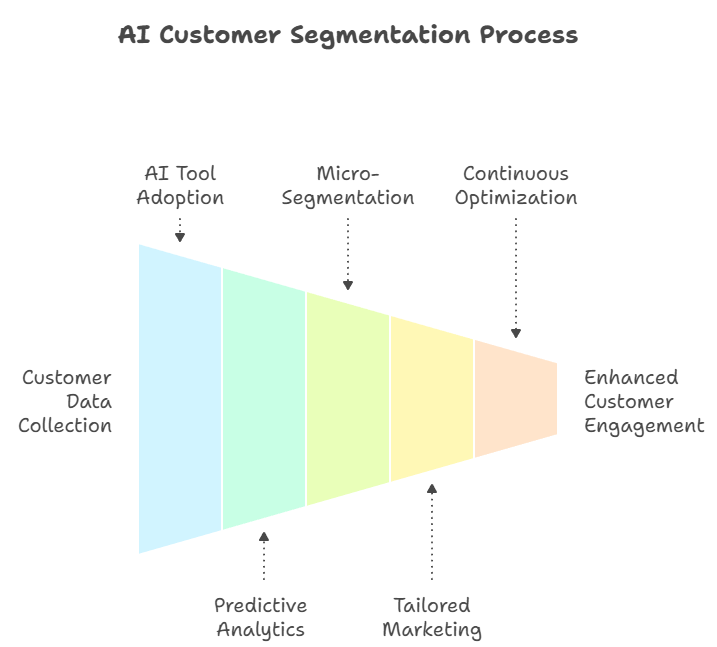
1. Gather Comprehensive Data: Collect all customer data, including purchase history, browsing activity, product reviews, and social media interactions. The more diverse the data, the better AI can learn.
2. Adopt Advanced AI Tools: Look for platforms using machine learning algorithms like Gradient Boosting or Random Forest. These create dynamic segments based on actual customer behavior, moving beyond basic demographics.
3. Prioritise Predictive Analytics: Use AI to predict future customer actions and understand the ‘why’ behind their behaviour. Anjali Singh, Co-founder & CEO of Segmentify, noted in 2024 that this predictive capability is a “game-changer” for personalization in India (Anjali Singh, Segmentify, 2024).
4. Create Granular Micro-Segments: Leverage deep learning to find very specific customer groups. This allows for truly hyper-personalized recommendations, similar to Mamaearth’s success in boosting retention (FICCI & Deloitte India Retail Report, 2024).
5. Tailor Marketing Campaigns: Use these precise segments to customize your marketing messages, product suggestions, and offers. Bewakoof achieved a 15% increase in conversions by optimizing targeting (NASSCOM Report, 2023).
6. Measure and Optimise Continuously: Always track the results of your segmented campaigns. Monitor conversion rates, customer retention, and marketing costs to refine your AI models and strategies.
Pitfalls & Myths ;
Even with great benefits, some myths about AI customer segmentation need to be addressed.
Myth: Traditional RFM analysis is still effective for D2C.
Reality Dr. Ganesh Prasad, Professor of Marketing at IIM Bangalore, stated in 2024 that traditional RFM models are becoming obsolete in a hyper-competitive digital landscape. AI, specifically machine learning and deep learning, offers the agility to identify emerging trends within customer cohorts, significantly boosting ROI (Dr. Ganesh Prasad, IIM Bangalore, 2024).
Myth: AI is too complex for small D2C brands to implement.
Reality While AI is advanced, many user-friendly AI platforms are now available. The focus is on the measurable outcomes – better customer understanding and higher sales – rather than requiring deep technical expertise to get started.
Myth: AI customer segmentation is merely about grouping people.
Reality: Anjali Singh clarified in 2024 that for D2C brands, AI segmentation is about predicting future behavior and understanding the ‘why’ behind every purchase or browse. This predictive power is crucial, especially in India’s diverse market (Anjali Singh, Segmentify, 2024).
Quick FAQ ;
Q1: What is AI customer segmentation for D2C?
A1: It uses AI to divide D2C customers into dynamic groups based on behavior, preferences, and needs, enabling personalized marketing and improved customer experiences.
Q2: How does AI improve customer retention?
A2: By understanding specific customer needs, AI helps D2C brands offer relevant products, similar to Mamaearth’s 20% retention improvement (FICCI & Deloitte India Retail Report, 2024).
Q3: Is AI customer segmentation expensive for startups?
A3: Initial investment varies, but AI reduces marketing spend by optimizing ad targeting, as Bewakoof achieved a 10% reduction (NASSCOM Report, 2023), leading to long-term savings.
Q4: Can AI understand India’s diverse customers?
A4: Yes, AI-driven segmentation analyzes regional, linguistic, and socio-economic nuances, allowing highly targeted campaigns that resonate with India’s varied consumer base (Kunal Bahl, Snapdeal, 2023).
Q5: What are predictive analytics in D2C?
A5: Predictive analytics use AI to forecast future customer actions, like purchases or churn, helping D2C brands proactively tailor strategies for better engagement.
Q6: Why are traditional RFM analysis models becoming obsolete?
A6: Traditional RFM models are static. AI offers agility to spot emerging trends and optimize operations in real-time, providing a much higher ROI in competitive markets (Dr. Ganesh Prasad, IIM Bangalore, 2024).
Conclusion :-
AI customer segmentation is no longer just an option; it’s a strategic necessity for D2C brands, especially in India’s booming and diverse market. By using AI to understand customers at a deep, individual level, D2C brands can unlock significant growth, boost sales, reduce marketing waste, and build lasting customer loyalty. The path to capturing the US$100 billion Indian D2C market by 2025 (Statista & IAMAI, 2023-2024) lies in embracing these smart technologies for a truly personalized customer experience.
Sources :-
* Deloitte Digital, 2023
* FICCI & Deloitte India Retail Report, 2024
* Gartner, 2024
* Harvard Business Review (Research Feature), 2023
* IEEE Transactions on Engineering Management, 2023
* Journal of Marketing Analytics, 2024
* Kunal Bahl, Co-founder & CEO, Snapdeal, 2023
* McKinsey & Company Whitepaper: The AI-Powered Personalization Imperative, 2024ai-customer-segmentation-d2c-india
* NASSCOM, 2023
* NASSCOM Report: AI in Indian E-commerce Retail, 2023
* Dr. Ganesh Prasad, Professor of Marketing, IIM Bangalore, 2024
* Anjali Singh, Co-founder & CEO, Segmentify, 2024
* Statista & IAMAI (Internet and Mobile Association of India), 2023-2024
0 Comments