
AI customer segmentation uses advanced machine learning to group your business clients based on their behaviour, needs, and value. This helps B2B SaaS companies understand their customers deeply, allowing for highly personalised strategies, proactive interventions, and ultimately, better business outcomes. By leveraging AI customer segmentation, businesses can unlock hyper-personalization, reduce churn, and drive significant revenue growth.
Why This Matters Now: India and Global Growth
The business world is undergoing rapid transformation, making deep customer understanding more critical than ever for B2B SaaS companies. Globally, the market for AI in business applications is experiencing explosive growth. It is projected to expand from USD 29.8 billion in 2024 to an impressive USD 149.3 billion by 2029, demonstrating a Compound Annual Growth Rate (CAGR) of 38.0%. This substantial growth is significantly driven by the increasing adoption of AI in Customer Relationship Management (CRM) and customer experience applications (MarketsandMarkets, 2024).
India’s vibrant SaaS sector is also on an incredible growth trajectory, with revenues expected to reach USD 50 billion by 2030, growing at a CAGR of 25-30% (NASSCOM India SaaS Report, 2023). For Indian B2B SaaS companies to achieve global leadership, customer-centricity and hyper-personalization through advanced analytics are identified as crucial growth drivers. As Satya Nadella, CEO of Microsoft, stated in 2024, “The future of every business will be defined by the quality of its data and its ability to extract intelligence from it to better serve customers. AI is the critical ingredient for transforming data into personalized experiences at scale.” This sentiment is echoed by Arvind Krishna, Chairman and CEO of IBM, who noted in 2023 that “Every CEO is looking for ways to use AI to drive better business outcomes. For B2B companies, this often means understanding your customer deeply and anticipating their needs, which is precisely where AI-driven analytics delivers tremendous value.” These insights underscore AI’s fundamental role in leveraging data for customer intelligence and aligning with executive priorities.
Key Insights and Proof of AI Customer Segmentation
AI customer segmentation is far more than a mere buzzword; it delivers tangible results validated by recent research:
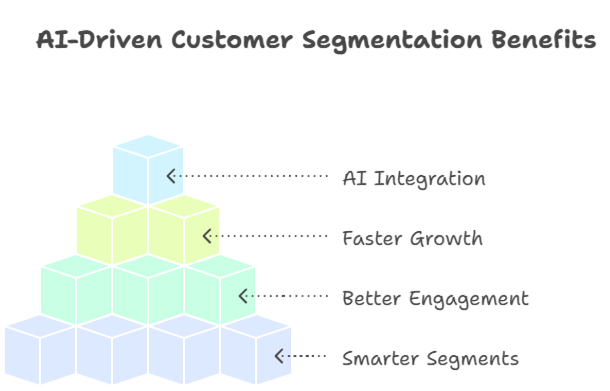
Smarter Segments: Advanced machine learning algorithms, such as K-means clustering and hierarchical clustering with optimal feature selection, can identify more nuanced and actionable customer segments in B2B contexts than traditional methods (Journal of Business Research, 2023). AI can process vast and disparate data sources, including CRM records, ERP data, website behaviour, and support tickets, to uncover hidden patterns indicative of customer lifetime value and churn risk.
Better Engagement and Personalization: B2B Sales companies that leverage AI for predictive analytics in customer segmentation achieve significantly higher customer engagement rates and improved personalization (IEEE Transactions on Engineering Management, 2024). AI models can forecast future customer needs, identify potential upsell and cross-sell opportunities, and predict customer churn, enabling proactive interventions and customized service offerings.
Faster Revenue Growth: Companies that harness AI for personalized customer experiences can experience revenue growth rates 1.7 times faster than those that do not (Forrester, 2024). A significant catalyst for this accelerated growth is AI-powered micro-segmentation, which facilitates precise targeting and customized customer journeys.
AI in CRM and CX: The global shift towards AI integration in business functions is particularly evident in CRM and customer experience applications (MarketsandMarkets, 2024). This overarching trend solidifies the increasing importance and investment in AI-powered customer segmentation for B2B SaaS firms worldwide.
India Focus: Market Reality and Opportunities
India’s digital transformation journey is accelerating, with AI positioned at its core. Nivruti Rai, formerly CEO & MD, Intel Foundry Services and Country Head, Intel India, emphasized in 2023 that Indian businesses, especially within the SaaS space, must harness AI not only for operational efficiency but also for profound customer understanding. This “deep customer understanding” is crucial for unlocking new growth vectors in a competitive landscape.
While the potential for AI-powered customer segmentation in India is immense, certain unique considerations must be addressed (IIM Ahmedabad Working Paper Series, 2023):
Diverse Data: Indian businesses often contend with heterogeneous data sources. AI offers the potential to bridge these data silos, providing a holistic view of the customer.
Localized Models: For optimal performance, AI models frequently require localization to account for the unique characteristics of the Indian market.
Skilled Talent: The availability of skilled AI talent is a key factor for successful adoption and implementation.
Data Privacy: Strict adherence to data privacy regulations is paramount.
Despite these challenges, Indian companies are actively embracing AI. A 2023 survey revealed that 76% of large Indian companies have an AI strategy in place, with customer experience and marketing identified as primary application areas (Analytics India Magazine & Great Learning, 2023). Notably, even Small and Medium-sized Enterprises (SMEs) are increasingly exploring AI solutions to enhance efficiency and fuel growth. Shiv Nadar, Founder of HCL Technologies, articulated in 2022 that “Innovation in customer engagement will define the next decade for technology companies. AI offers the ability to predict needs and personalize interactions in ways previously unimaginable, creating truly sticky customer relationships.” This statement underscores AI’s pivotal role in forging strong, lasting customer bonds within the Indian context.
Case Study Highlights: Real-World Success
Real-world applications powerfully illustrate the substantial benefits of AI customer segmentation:
Global B2B Tech Success: McKinsey & Company detailed a 2023 case where a B2B technology company utilized AI for customer segmentation, moving beyond traditional firmographics.
By analyzing purchase history, website interactions, product usage, and support tickets, AI identified micro-segments with specific pain points and significant growth potential. This led to a 10-15% increase in cross-selling revenue and a 5% reduction in customer churn within 18 months (McKinsey Digital Report, 2023), showcasing a clear financial return.
Mid-sized Sales Boost: Gartner reported in 2024 on a mid-sized B2B SaaS provider that implemented an AI-driven segmentation tool. This tool enabled dynamic customer grouping based on evolving product usage patterns and engagement scores. The outcome was a 20% improvement in marketing campaign conversion rates and a significant reduction in sales cycle time, achieved by focusing sales efforts on high-propensity-to-buy segments (Gartner Report, 2024).
Indian Sales Firms Lead the Way: The NASSCOM India SaaS Report (2023) highlighted that Indian B2B SaaS companies are increasingly integrating AI into their platforms and internal operations to deepen customer understanding. The report cited examples of Indian SaaS firms leveraging AI for predictive lead scoring and personalized onboarding—direct derivatives of sophisticated segmentation—leading to improved customer satisfaction scores and faster feature adoption among target user groups (NASSCOM India SaaS Report, 2023). This demonstrates Indian companies actively seizing the opportunity to gain a competitive edge.
How to Apply AI Customer Segmentation
For your B2B Sales business to effectively implement AI customer segmentation, follow these practical steps:
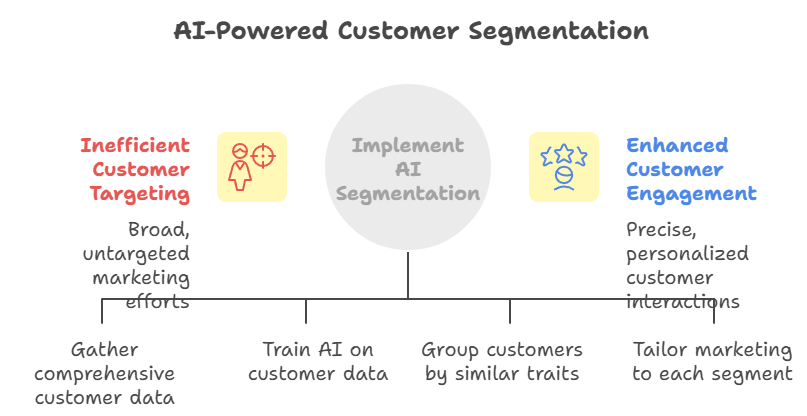
1. Collect All Data: Gather comprehensive data from every available source, including CRM, ERP, website behavior, and support tickets. The breadth of data directly enhances AI’s ability to uncover intricate patterns (Journal of Business Research, 2023).
2. Use Advanced Algorithms: Employ modern machine learning techniques like K-means clustering or hierarchical clustering, incorporating optimal feature selection. These algorithms are crucial for identifying more precise and actionable customer segments (Journal of Business Research, 2023).
3. Predict Customer Needs: Utilize AI models to forecast future customer requirements. This foresight allows you to proactively identify potential upsell or cross-sell opportunities (IEEE Transactions on Engineering Management, 2024).
4. Personalize Interactions: Once segments are identified, craft highly customized service offerings and marketing messages tailored to each group. This approach facilitates proactive customer support and delivers genuinely personalized experiences (IEEE Transactions on Engineering Management, 2024).
5. Monitor and Adapt: Implement dynamic customer grouping based on evolving product usage patterns and engagement scores. Continuous monitoring ensures your segments remain relevant and responsive to changing customer behavior (Gartner Report, 2024).
6. Optimize Sales and Marketing: Direct your sales efforts toward segments that AI predicts have the highest propensity to buy. This strategy significantly boosts marketing campaign conversion rates and shortens the sales cycle (Gartner Report, 2024).

Pitfalls and Myths
While AI customer segmentation offers immense benefits, it’s essential to approach it with realistic expectations:
Myth: AI is a magic bullet for all business problems.
Reality: AI’s effectiveness is heavily dependent on the quality of your data. As Satya Nadella highlighted, the “quality of its data” is paramount for extracting meaningful intelligence (Satya Nadella, 2024). Poor data invariably leads to poor results.
Myth: One-size-fits-all AI solutions work universally.
Reality: In diverse markets like India, AI models often require localization due to heterogeneous data sources and unique market conditions (IIM Ahmedabad Working Paper Series, 2023). Generic models may not yield optimal results.
Myth: Once implemented, AI customer segmentation requires no further attention.
Reality: AI models demand continuous monitoring, tuning, and updates as customer behaviors and market dynamics evolve. Dynamic segmentation is crucial for sustained relevance (Gartner Report, 2024).
Myth: AI completely replaces human insight and strategic thinking.
Reality: While AI provides profound insights, human experts remain indispensable for interpreting these results, developing overarching strategies, and nurturing genuine customer relationships. AI enhances, rather than eradicates, the need for human acumen.
Myth: AI solutions are too complex or costly for smaller businesses.
Reality: Although AI adoption is currently higher in larger enterprises, SMEs are increasingly exploring accessible AI solutions for efficiency and growth (Analytics India Magazine & Great Learning, 2023). The cost and complexity barrier is gradually diminishing.
Quick FAQ
What is AI customer segmentation?
It involves using machine learning to group B2B clients by similar traits, behaviors, and needs, enabling more precise tailoring of marketing, sales, and service efforts.
How does AI segmentation help B2B SaaS companies?
It identifies hidden customer patterns, predicts future needs, and spots upsell opportunities, leading to higher customer engagement and reduced churn (IEEE Transactions on Engineering Management, 2024).
Is AI customer segmentation relevant for Indian businesses?
Absolutely , Indian B2B SaaS firms are already leveraging AI for deeper customer understanding and growth, underscoring its significant local relevance (NASSCOM India Sales Report, 2023).
What are the main benefits for sales and marketing?
Sales teams can focus on high-potential buyers, shortening sales cycles. Marketing campaigns become significantly more effective, with reported improvements of 20% in conversion rates (Gartner Report, 2024).
What challenges should Indian companies consider?
Key challenges include ensuring robust data quality, localizing AI models, sourcing skilled talent, and strictly adhering to data privacy regulations (IIM Ahmedabad Working Paper Series, 2023).
Can AI really boost revenue for B2B Sales ?
Yes, companies utilizing AI for personalization can experience revenue growth 1.7 times faster than those that don’t. AI-powered micro-segmentation is a significant driver of this accelerated growth (Forrester, 2024).
Conclusion :-
AI customer segmentation is no longer an optional luxury but a strategic imperative for B2B SaaS companies striving for robust growth in both India and across global markets. By intelligently leveraging AI to gain profound insights into distinct customer groups, businesses can achieve hyper-personalization, effectively reduce churn, and unlock substantial new revenue streams. The Indian market is particularly fertile for this transformative technology, with local companies already demonstrating its profound impact. Embracing AI customer segmentation now means not only building truly sticky customer relationships but also securing and accelerating your future growth trajectory.