
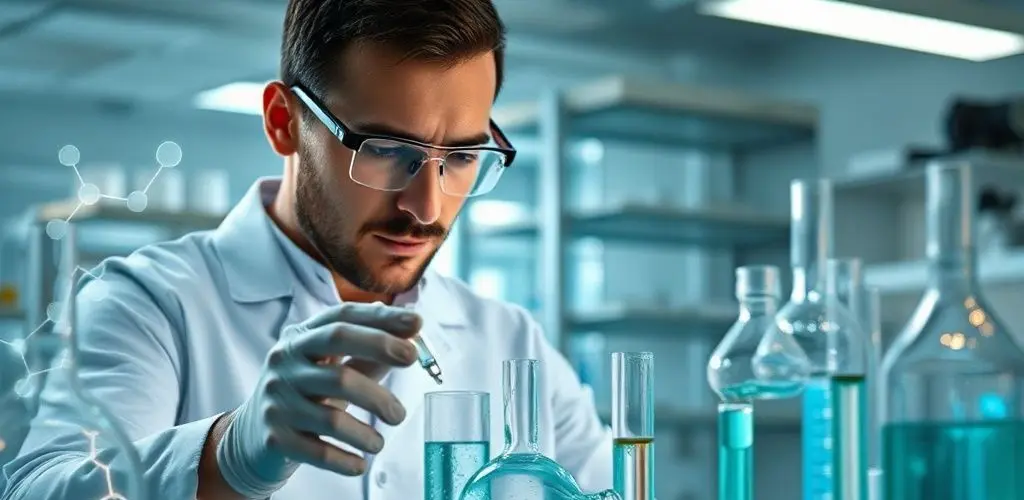
The AI-Powered Quest for Sustainable Hydrogen Peroxide Catalysts
The subtle scent of antiseptic signals a silent guardian: hydrogen peroxide. I remember my grandmother meticulously cleaning a cut with it, teaching me that true care comes from how we bring forth even the simplest things. Yet, the journey of most hydrogen peroxide is burdened by an invisible environmental cost.
Traditional industrial production is notoriously energy-intensive, leaving a heavy carbon shadow. But now, researchers led by Hao Li at Tohoku University have developed an AI-driven computational framework that radically transforms catalyst design. This blueprint combines atomic-level insights with machine learning to identify highly effective, sustainable catalysts.
This is not just about laboratory breakthroughs; it is about reshaping the bedrock of our industrial landscape. By moving from trial-and-error to predictive AI, we are accelerating the shift towards a cleaner, more energy-efficient future for vital everyday chemicals.
A new AI-driven framework has efficiently identified high-performance catalysts like LiScO₂, offering a cleaner path for hydrogen peroxide production and solving a critical industrial bottleneck.
The Invisible Hurdle
The quest for greener hydrogen peroxide relies on electrochemistry. The linchpin? Catalysts. Designing them is like searching for a needle in a haystack because they come in diverse forms—metal alloys, oxides, single atoms—each with unique atomic structures.
Conventional methods were siloed and slow. As Hao Li notes, “Designing catalysts… has been difficult because… each type has different atomic structures, making it challenging to compare.” This complexity created a bottleneck holding back sustainable innovation.
A Blueprint for Breakthrough
How AI sidesteps the trial-and-error trap to revolutionize material discovery.
Breakthrough 01
A Unified LanguageThe framework uses a “weighted atom-centered symmetry function” to describe diverse catalysts. This allows for direct, apples-to-apples comparisons across previously incompatible materials, unifying the research field.
Breakthrough 02
Predictive PowerBy combining these descriptors with machine learning, the model accurately predicts key reaction properties. These predictions closely match detailed quantum-mechanical calculations, reducing costly failures.
Breakthrough 03
Rapid DiscoveryThe framework quickly identified lithium scandium oxide (LiScO₂) as a top candidate. Lab validation confirmed its success: ~90% efficiency and stability for nearly a week, proving the model’s practical value.
Playbook You Can Use Today
For leaders in R&D and clean tech, this is a signal to adapt. Here is your strategy:
Foster deep understanding of AI-driven materials science. Encourage cross-functional teams that blend chemical engineering expertise with data science.
Investigate platforms like the “Digital Catalysis Platform.” Leveraging these tools offers a direct path to reducing trial-and-error in your own development cycles.
Actively fund projects focused on cleaner production methods. This aligns with global decarbonization goals and positions your brand as a leader in green chemistry.
Implement AI/ML models in internal workflows to rapidly screen candidates. This drastically cuts research timelines, as demonstrated by the discovery of LiScO₂.
Recruit talent at the intersection of chemistry and AI. The success of this research highlights the power of bridging traditionally separate domains.
Success relies on high-quality data. Invest in robust collection and management systems to fuel your computational frameworks effectively.
Risks and Ethical Considerations
While immense, the promise of AI requires a clear-eyed view. Models are only as good as their training data; continuous experimental validation is crucial to prevent “in silico” success that fails in practice. Furthermore, we must responsibly manage the rapid discovery of new materials to ensure safety and sustainability.
Tools, Metrics & Cadence
Operationalizing AI-driven R&D requires the right stack and rigorous tracking.
Recommended Tool Stacks
- Quantum Chemistry – VASP or Gaussian for foundational data.
- ML Frameworks – TensorFlow/PyTorch + matminer/pymatgen.
- Digital Platforms – Specialized databases for reaction prediction.
Key KPIs
- Discovery Time – Aim for 30-50% reduction.
- Trial Reduction – Decrease experimental iterations by 25-40%.
- Sustainability Score – Improve energy footprint metric by 15% annually.
Review Cadence
- Weekly: Stand-ups on model performance & data health.
- Monthly: Strategy adjustments based on AI insights.
- Annually: Strategic planning for new AI advancements.
Frequently Asked Questions
Why do we need new catalysts?
Why is design so difficult?
How does AI solve this?
What is LiScO₂?
Conclusion
My grandmother’s simple act of cleaning resonates with this research. It is about taking something essential and rethinking its creation with a new standard of care for our planet.
The breakthrough in AI catalyst design is a testament to human ingenuity empowered by technology. By transforming catalyst discovery into a systematic, intelligent process, we are laying the groundwork for a truly sustainable chemistry revolution. The future of manufacturing is not just smart; it is genuinely green.