

The low hum of the coffee machine filled the kitchen, a familiar morning ritual.
This particular morning, my neighbor, a seasoned graphic designer, leaned against the counter, a faint line of worry etched between his brows.
ChatGPT this, Gemini that, he began, swirling his coffee.
Perplexity the other thing.
My son keeps telling me to use these AI apps on my phone, but frankly, it all feels like a lot of noise.
Just slop.
What exactly is useful, and how do I even start?
His frustration echoed a sentiment heard countless times.
This exciting new technology, promising to revolutionize everything, often delivers unhelpful, generic output for the uninitiated.
The promise of intelligent assistance gets lost in a sea of AI slop, leaving many bewildered.
In our increasingly digital world, understanding and utilizing this powerful technology demands a human-first approach.
For total beginners, navigating AI apps like ChatGPT requires mastering basic prompt engineering to cut through generic AI slop.
Focus on clarity, giving the AI a role, being explicit, and treating interactions as a refining conversation to unlock truly useful outcomes.
Why This Matters Now: Cutting Through the Noise
Artificial intelligence is a present reality, touching everything from customer service to creative endeavors.
New AI apps emerge constantly, promising to simplify or revolutionize our lives.
Mobile AI apps are ubiquitous, yet for many, their practical utility remains elusive.
This rapid proliferation has created a paradox: more access to AI, but often less clarity on how to leverage it effectively.
The challenge lies not in finding an AI tool, but in getting useful output.
We are grappling with a new kind of literacy—AI literacy—that requires understanding how to speak its language, guide it, and extract genuine value.
Without this foundational understanding, the promise of these powerful tools remains overshadowed by uninspired content.
The Core Problem: Drowning in AI Slop
Imagine asking a new intern, Just do something useful for me, and expecting a perfectly polished report.
You would provide context, guidelines, and examples.
Yet, many approach AI with similar vague expectations, then wonder why results are underwhelming.
This is the heart of AI slop—generic, uninspired, or incorrect output from vague or poorly constructed inputs.
While AI aims to reduce our cognitive load, getting truly great results often requires a momentary increase in thoughtful input.
It is not a magic box that reads your mind; it is a powerful, malleable tool that responds to precision and intention.
More thought in your prompt means less time sifting irrelevant material.
A Common Scenario: The Blog Post Dilemma
Consider a client recently frustrated after asking ChatGPT for a blog post about healthy eating for her wellness site.
What she received was fine, but bland and generic, like something from a 2005 health magazine.
It did not sound like her at all, leading her to rewrite most of it.
Her experience is common.
She asked for a generic task, and the AI, an expert at statistical pattern matching, delivered a generic response.
It lacked her brand voice, target audience, or specific angle.
Without critical context, the output was technically correct but unuseful for her unique needs.
The solution was not a better AI, but a better prompt.
What We Are Learning About Effective AI Use
Our practical understanding of effective AI use is built daily through countless user interactions.
We observe clear patterns demystifying the process for beginners.
Generative AI, despite impressive capabilities, thrives on guidance.
It does not inherently know what you want; it predicts what you might want based on patterns.
Without specific instructions, AI defaults to common, lowest-common-denominator responses.
This is why AI slop proliferates: generic inputs lead to generic outputs.
Our input quality directly dictates our output quality.
We must become active participants, not passive recipients, treating AI as a fast, highly capable assistant that still needs clear direction.
Your Playbook for Better AI Conversations: Adrian Weckler’s Four Tips
Adrian Weckler, a keen observer of the tech landscape, distills effective AI interaction into four core tips for beginners.
These are shifts in how we approach conversation with intelligent systems, transforming experience from frustration to genuine utility.
Start Simple, Then Elaborate: The Art of Iteration
Do not feel pressured to craft the perfect prompt on your first try.
Begin with a straightforward request.
For example, instead of a comprehensive marketing plan for a sustainable sneaker brand targeting Gen Z, start with: Draft three unique headline ideas for a new sustainable sneaker brand.
Once you get initial output, layer on complexity.
Ask: Now make those headlines more playful and specifically mention recycled materials.
This iterative approach is crucial for learning AI’s nuances and refining your desired outcome, turning a daunting task into a manageable dialogue.
Give It a Job (and a Persona): Set the Stage
AI models perform best when they understand their assigned role and perspective.
Before asking what you want, tell the AI who it is.
Are you talking to a seasoned journalist, a witty copywriter, a meticulous data analyst, or a friendly customer service agent?
A prompt like: Act as a professional marketing consultant specializing in eco-friendly products.
Your task is to brainstorm unique campaign ideas for a new line of biodegradable packaging will yield superior results than a simple: Give me marketing ideas.
Defining its persona sets the tone and expertise level, directly combating generic AI slop.
Be Explicit, Not Implicit: Clarity is King
Humans infer much from context, but AI thrives on explicit instructions.
What seems obvious to you might be unknown to the model.
Spell out your constraints, desired format, tone, and any specific inclusions or exclusions.
Instead of: Write me something about fitness, try: Write a 300-word upbeat social media post targeting busy parents, focusing on quick 15-minute home workouts.
Use a friendly, encouraging tone.
Include a call to action to visit our blog.
Every specific detail helps the AI narrow its focus and align with your vision.
This is foundational for effective AI prompts.
Test and Refine – It is a Conversation: Dialogue, Not Monologue
Think of interacting with AI as a guided conversation, not just issuing commands.
The first response is rarely the final one.
You have the power to ask for revisions, expansions, summaries, or completely different angles.
If the AI provides something close but not quite right, use follow-up prompts like: Make it shorter and more direct.
Can you expand on point three?
Rewrite this from a more optimistic perspective, or Generate five alternative calls to action.
This continuous feedback loop transforms raw output into tailored, useful content and helps you understand the AI app’s usefulness for your specific needs.

Risks, Trade-offs, and Ethics in AI Use
While AI offers immense potential, recognizing its inherent risks and ethical considerations is crucial for beginners.
A primary trade-off exists between speed and accuracy.
AI generates content rapidly, but this speed does not guarantee factual correctness, originality, or ethical soundness.
One major risk is hallucination, where AI confidently generates false information.
Beginners must always fact-check critical details.
Another concern is algorithmic bias; AI models trained on vast datasets can reflect and amplify societal biases, leading to problematic or exclusionary outputs.
To mitigate these risks, treat AI output as a draft, never a final, verified source.
Always cross-reference facts, statistics, and critical information.
Use AI as an assistant, not a replacement; a human eye should always review and refine AI-generated content for accuracy, tone, and ethical considerations.
Be cautious about inputting proprietary or sensitive information into public AI models, as some models may use this data for future training.
When using AI for content creation, consider disclosing its use, especially in sensitive contexts, to maintain transparency and trust, fostering responsible AI for beginners.
Tools, Metrics, and Cadence
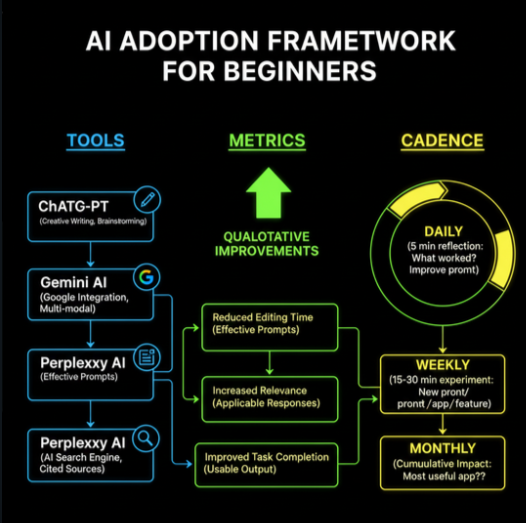
For beginners, accessible AI apps include ChatGPT, Gemini AI, and Perplexity AI.
ChatGPT excels at creative writing, brainstorming, and conversational tasks.
Gemini AI, from Google, is strong for integration with other Google services and often performs well with multi-modal inputs.
Perplexity AI distinguishes itself as an AI-powered search engine, providing concise answers with cited sources, invaluable for initial research.
For beginners, success can be measured by qualitative improvements.
These include reduced editing time, indicating more effective prompts; increased relevance, where AI responses are directly applicable; enhanced creativity or ideation, as AI helps generate novel ideas; and an improved task completion rate, reflecting AI output forming a significant, usable part of the final product.
A simple review cadence is most effective.
Daily, after using an AI tool, reflect for five minutes on what worked well and how to improve your prompt next time.
Weekly, dedicate 15-30 minutes to experiment with a new prompt type, a different AI app, or a new feature to build confidence.
Monthly, consider the cumulative impact: are these AI tools saving time or improving output, and which AI app proved most useful?
Conclusion
My neighbor, still nursing his coffee, listened intently as I shared these four tips.
The worry lines softened.
He realized the problem was not the slop itself, but the lack of a clear path through it.
The AI is not failing; we have not yet learned to speak its language.
It is about moving from simply using a tool to partnering with it, guiding it with intention and human finesse.
The world of AI apps, from ChatGPT to Gemini, is exciting.
But its true power is not in its ability to generate anything; it is in its capacity to generate precisely what you need.
By embracing these simple, human-centric strategies for prompt engineering, you can transform your AI interactions from frustration into a powerful engine of creativity and productivity.
Take a deep breath, start simple, and dive into the conversation.
The future, with all its intelligent assistance, waits for your thoughtful input.