
Discover how AI customer segmentation transforms e-commerce in India and globally. Boost sales, cut costs, and personalize experiences for every buyer.
AI Customer Segmentation: Your Key to E-commerce Success in India
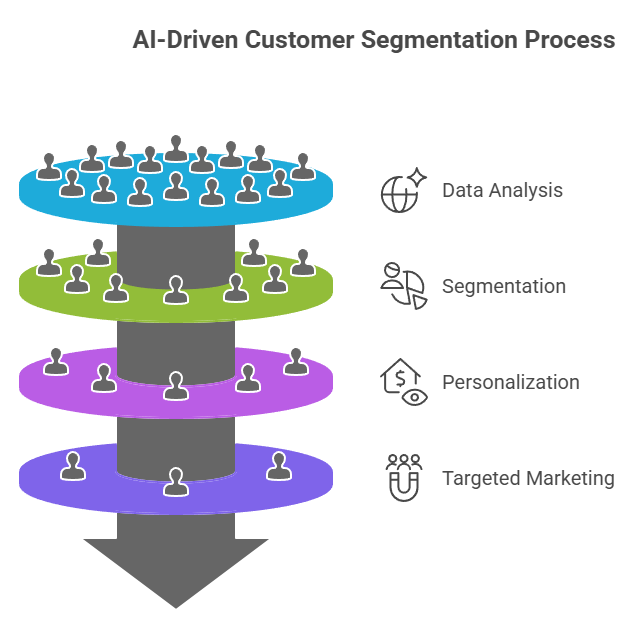
AI customer segmentation is a strategic approach that utilizes artificial intelligence to group customers based on deep behavioral data and patterns. This advanced method helps e-commerce marketplaces understand their shoppers more profoundly than ever before, moving beyond basic demographics to offer truly personalized shopping experiences. By leveraging AI, businesses can create dynamic, intelligent customer groups, leading to targeted marketing efforts and improved customer engagement.
Why This Matters Now: India and Global E-commerce Boom
The landscape of online shopping is undergoing rapid transformation, fueled by significant investment in AI. Global spending on AI is projected to reach over $300 billion by 2026, with customer experience (CX) applications, including segmentation, growing at a compound annual rate of 25% over the next five years (IDC, 2024). This substantial investment underscores the critical role AI plays in competitive business strategies worldwide.
India stands as a pivotal market in this evolution. The Indian AI market is expected to grow at a remarkable 20.2% CAGR from 2023 to 2027, reaching a market size of US$14.8 billion (NITI Aayog / PwC India, 2023). E-commerce and retail are identified as primary drivers for AI adoption within the country. Furthermore, the Indian e-commerce market itself is projected to reach $160 billion by 2026 (Deloitte India, 2024). This growth is particularly pronounced with an anticipated 400 million new online shoppers emerging from smaller Tier 2 and Tier 3 cities. AI customer segmentation is indispensable for effectively reaching and serving this diverse and rapidly expanding customer base.
Key Insights and Proof
Traditional customer segmentation methods often prove inadequate, being static and unable to capture the real-time behavior of shoppers on dynamic e-commerce platforms.
A study in IEEE Transactions on Engineering Management (2024) highlights that AI-driven approaches, particularly those utilizing deep learning and reinforcement learning, enable adaptive segmentation. This means customer groups can evolve in response to immediate browsing patterns, purchase history, and even external factors, resulting in significantly more relevant recommendations and marketing interventions.
Researchers detailed in the Journal of Retailing and Consumer Services (2023) found that AI algorithms, such as K-means and hierarchical clustering, combined with advanced Natural Language Processing (NLP) for analyzing unstructured data like reviews and search queries, are instrumental in uncovering nuanced customer segments. These segments extend beyond mere demographics, revealing psychographic and behavioral distinctions that drive tailored marketing strategies and product development.
Focusing on the Indian context, a research paper from IIM Ahmedabad (2023) investigated the adoption of AI-powered segmentation by leading Indian e-commerce players. It concluded that marketplaces leveraging AI to segment users based on factors like language preferences, payment methods, regional product demand, and festival-driven purchasing behavior achieve higher customer retention rates and average order values. This is a crucial differentiator given India’s unique cultural, linguistic, and economic diversity.
India Focus: Market Reality
India’s market presents a complex mosaic of consumer behaviors due to its vast diversity in languages, festivals, income disparities, and varying digital literacy levels. AI provides e-commerce platforms with the tools to navigate this complexity. Dr. P. K. Singh, Professor of Marketing at IIM Bangalore (2023), emphasized this point, stating, “In India, customer segmentation needs to account for a multitude of factors – income disparity, digital literacy variations, regional festival calendars, and language diversity. AI allows e-commerce platforms to manage this complexity and deliver truly localized experiences at scale, which is a game-changer for market penetration.” This underscores AI’s ability to create deeply personal and relevant experiences across India’s diverse consumer landscape.
NASSCOM’s Strategic Review (2024) further confirmed AI-driven personalization as a key enabler for scaling Indian e-commerce. The review cited examples of Indian marketplaces utilizing AI to segment customers based on purchasing frequency during major festive sales, such as Diwali and Eid, and regional linguistic preferences. These efforts led to a substantial 20-25% increase in conversion rates for personalized campaigns during peak seasons, proving particularly effective in Tier 2 and Tier 3 cities where regional nuances are more pronounced.

Case Study Highlights
Real-world applications powerfully demonstrate the impact of AI customer segmentation.
McKinsey & Company (2023) reported that businesses employing AI for personalization and segmentation have witnessed revenue increases ranging from 5% to 15%. Additionally, these companies experienced a 10% to 30% improvement in marketing spend efficiency. A notable example involved a large e-commerce client that, through AI-driven segmentation of its high-value customers, implemented targeted promotions which resulted in a 12% uplift in repeat purchases within a single quarter. This illustrates the direct correlation between AI segmentation and significant financial gains.
Gartner’s analysis (2024) projects that by 2026, organizations integrating AI across their marketing and sales functions, including customer segmentation, will outperform competitors by 25% in customer acquisition, retention, and cost reduction. An unnamed global e-commerce marketplace was highlighted for its use of AI to identify “at-risk” customer segments, proactively engaging them and thereby reducing churn by 18% over six months. This demonstrates AI’s critical role in enhancing customer loyalty and profitability.
How to Apply AI Customer Segmentation
Applying AI customer segmentation involves a structured approach to transform raw data into actionable insights:
Begin by collecting comprehensive customer data, including browsing history, purchase records, reviews, search queries, language choices, and preferred payment methods. The depth and breadth of this data are foundational for effective AI analysis (Journal of Retailing and Consumer Services, 2023).
Shift focus from static, historical groups to real-time behavioral understanding. Utilize AI to monitor immediate browsing patterns and adapt recommendations dynamically, reflecting the core principle of dynamic segmentation (IEEE Transactions on Engineering Management, 2024).
Employ advanced AI algorithms, such as various clustering techniques, to uncover nuanced customer segments based on psychographic profiles and deep behavioral patterns. This allows businesses to understand the underlying motivations behind customer purchases (Journal of Retailing and Consumer Services, 2023).
For the Indian market, it is essential to leverage AI to account for specific factors like language preferences, regional product demand, festival-driven shopping habits, and diverse payment methods. This approach facilitates the delivery of truly localized experiences at scale across India’s varied consumer base (IIM Ahmedabad, 2023; Dr. P. K. Singh, IIM Bangalore, 2023).
Once segments are clearly defined, implement highly targeted offers and communications. Use AI models to identify customers at risk of churn and engage them proactively, a strategy proven to significantly reduce customer attrition (Gartner, 2024).
Continuously monitor and evaluate the performance of your segmented campaigns. Analyze metrics such as conversion rates, average order value, and customer retention. These insights are vital for refining AI models and optimizing segmentation strategies for ongoing improvement.

Pitfalls and Myths
Despite its transformative power, AI customer segmentation is often misunderstood, leading to common pitfalls.
One myth is that traditional methods like RFM (Recency, Frequency, Monetary) analysis are sufficient. The reality, however, is that traditional segmentation is static and fails to capture the dynamic, real-time customer behavior prevalent on modern e-commerce platforms. AI is essential for adaptive and truly dynamic segmentation (IEEE Transactions on Engineering Management, 2024).
Another misconception is that AI is merely a luxury rather than a necessity. Dr. C. P. Gurnani, CEO & MD of Tech Mahindra (2023), clearly articulated that “AI is no longer a luxury but a necessity for e-commerce. For marketplaces, segmenting customers with AI means not just understanding what they buy, but *why* they buy and what they might need next.” This is critical for fostering customer loyalty and achieving profitable growth in India’s competitive market.
Some believe they can afford to delay AI adoption for segmentation. Conversely, Gartner (2024) predicts that by 2026, companies that embed AI across their marketing and sales functions will outperform competitors by 25% in customer acquisition, retention, and cost reduction. Waiting to adopt AI risks falling significantly behind competitors.
There is also a myth that AI is exclusively for large enterprises like Amazon or Flipkart. In truth, the Indian AI market is experiencing rapid growth, with personalization being a key driver. Small to medium-sized Indian e-commerce marketplaces can also effectively implement and benefit from these technologies (NITI Aayog / PwC India, 2023).
Finally, the idea that AI segmentation, once configured, operates autonomously is incorrect. Rajesh Aggarwal, Senior Partner at McKinsey & Company (2024), highlighted that the future relies on “dynamic, real-time AI segmentation” that adapts in milliseconds. This necessitates robust data infrastructure and sophisticated machine learning models, implying continuous management and refinement.
Quick FAQ
What is AI customer segmentation?
It involves using Artificial Intelligence to group e-commerce customers based on intricate behavioral data, enabling highly personalized experiences and targeted marketing efforts.
Why is it particularly important for Indian e-commerce?
India’s highly diverse market necessitates AI to effectively manage numerous factors like varied languages, diverse festivals, and regional product demands, which allows for truly localized customer experiences and boosts sales across the country.
What tangible benefits can be expected from AI segmentation?
Businesses can anticipate revenue increases of 5% to 15%, an improvement in marketing spend efficiency by 10% to 30%, and a significant reduction in customer churn (McKinsey, 2023; Gartner, 2024).
Can small businesses successfully implement AI customer segmentation?
Yes, with the increasing accessibility of AI solutions, small to medium-sized e-commerce businesses can leverage AI for enhanced customer understanding and growth, particularly supported by India’s expanding AI market.
What types of data does AI utilize for segmentation?
AI employs a wide array of data, including browsing history, purchase data, customer reviews, search queries, language preferences, payment methods, and even external market factors, to create dynamic and highly nuanced customer segments.
Is AI segmentation a future trend or a present necessity?
It is unequivocally a present necessity. Experts like Dr. C. P. Gurnani of Tech Mahindra (2023) emphasize that AI is no longer a luxury but is crucial for competitive growth in the e-commerce sector.
Conclusion :-
AI customer segmentation is fundamentally reshaping how e-commerce marketplaces operate, both globally and specifically within India. By fostering a deep, real-time understanding of customer behavior, businesses are empowered to deliver personalized experiences that directly translate into higher sales, increased customer loyalty, and improved efficiency. With the Indian e-commerce market poised for exponential growth, embracing AI customer segmentation is not merely an advantage; it is a critical imperative for sustained growth and success. Begin exploring how AI can transform your customer understanding and propel your marketplace forward today.