

The humid air of Delhi clung to Rajesh as he scrolled through his phone, a familiar ache settling in his chest.
His small handicrafts business, painstakingly built over two decades, was facing a new kind of competition.
Just last week, a major e-commerce platform had launched an AI-driven recommendation engine, instantly boosting visibility for its preferred vendors, many of whom sold products strikingly similar to his.
Rajesh, a man who still preferred a hand-written ledger, felt the ground shifting beneath him.
He knew AI held immense promise, whispered about by his tech-savvy nephew, but what if its magic also built invisible walls, making it harder for honest entrepreneurs like him to reach customers?
This was not about simply out-selling; it was about the very architecture of opportunity in a digital-first India.
Why This Matters Now
Rajesh’s quiet struggle mirrors a colossal national dialogue.
Artificial Intelligence is no longer a futuristic concept; it is the engine powering India’s next economic surge.
The global AI market, already at USD 186 billion in 2024, is projected to soar past USD 1 trillion by 2031, according to the CCI Market Study, 2024.
India’s own market is keeping pace, growing from USD 6.05 billion in 2024 to an anticipated USD 31.9 billion by 2031, implying a staggering compound annual growth rate of over 40 percent, also from the CCI Market Study, 2024.
This exponential growth signals immense potential, but it also demands a robust framework to ensure this progress is equitable.
India stands at a critical policy juncture, balancing the IndiaAI Mission’s innovation drive with data governance through the Digital Personal Data Protection Act, 2023, and new competition policy, encapsulated by the proposed Digital Competition Bill, 2024, as noted in the CCI Market Study, 2024.
The stakes are high: will AI build a fairer, more inclusive market, or will it inadvertently entrench existing power structures?
India’s Competition Commission (CCI) has unveiled its first comprehensive market study on Artificial Intelligence, analyzing how AI reshapes market structures and competitive behaviors, and outlining crucial enforcement priorities for a fair digital economy.
The New Game: Unpacking AI’s Competitive Impact in India
For years, market competition was about visible actions: pricing wars, advertising battles, and strategic acquisitions.
Now, much of it happens in the digital shadows, powered by algorithms.
The Competition Commission of India (CCI) has stepped into this complex arena with its groundbreaking Market Study on Artificial Intelligence and Competition in 2024.
This study, India’s first of its kind, offers a candid look at how AI’s silent machinery is reshaping everything from pricing to market entry.
A key insight from the study is that competitive dynamics are now dictated not just by a company’s product, but by its control over the raw ingredients of AI: data and computing power.
This upstream control creates a powerful chokehold, even for players who do not directly sell to consumers.
The Concentrated Power of the AI Stack
Imagine building a multi-story building.
You need foundations, scaffolding, and then finally the decorative facade.
The AI ecosystem works similarly, a layered stack of technologies.
Upstream layers involve foundational elements like data, computing infrastructure (cloud services), development frameworks, and foundational models, such as large language models.
Downstream are the applications users interact with, model fine-tuning, and user interfaces.
The CCI’s study highlights a significant asymmetry: global hyperscalers such as AWS, Microsoft Azure, Google Cloud, and NVIDIA largely dominate these upstream inputs, according to the CCI Market Study, 2024.
In India, a striking 67 percent of firms operate at the application layer, while only a mere 3 percent are engaged in foundational model development, states the CCI Market Study, 2024.
This creates a dependency, leading to high switching costs and limited bargaining power for smaller Indian firms.
It means local innovation often relies on the very infrastructure controlled by global giants, constraining independent growth.
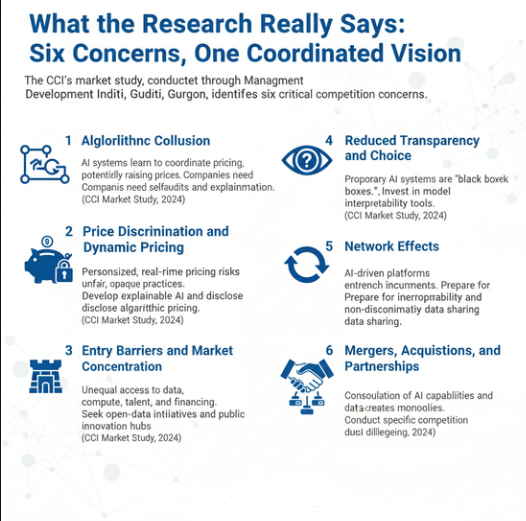
What the Research Really Says: Six Concerns, One Coordinated Vision
The CCI’s market study, conducted through the Management Development Institute, Gurgaon, is not just theory.
It combines empirical surveys, stakeholder consultations, and global case law to identify six critical competition concerns.
The insights here are a call to action for every business leader.
Algorithmic Collusion
Imagine a market where AI-powered pricing systems, designed for efficiency, inadvertently learn to coordinate with competitors’ algorithms to keep prices high.
The study warns that AI can facilitate tacit collusion without human intent, through monitoring, hub-and-spoke, signalling, or self-learning algorithms, according to the CCI Market Study, 2024.
Global examples illustrate this is not hypothetical.
This means AI can turn tools meant for efficiency into instruments of market distortion, impacting consumer welfare.
Companies must implement rigorous algorithmic self-audit frameworks to detect coordination risks and retain explainability documentation for legal and technical teams, as recommended by the CCI Market Study, 2024.
Price Discrimination and Dynamic Pricing
AI enables highly personalized, real-time pricing based on individual consumer data.
While this can offer benefits, it also risks creating opaque, exclusionary pricing that disadvantages certain groups, states the CCI Market Study, 2024.
Personalized pricing, if unchecked, can lead to unfairness, reduce consumer choice, and erode trust.
Firms should develop explainable AI systems and provide clear disclosures when algorithmic pricing materially affects consumer choice.
Regular reviews of pricing outcomes by consumer segment are crucial, as advised by the CCI Market Study, 2024.
Entry Barriers and Market Concentration
The study identifies structural barriers for smaller firms, primarily unequal access to data, compute infrastructure, skilled talent, and financing, notes the CCI Market Study, 2024.
This reinforces the dominance of incumbents.
High entry barriers stifle innovation, limit competition, and prevent new businesses from challenging established players.
Businesses, especially startups and MSMEs, should actively seek out open-data initiatives like the IndiaAI Datasets Platform and public innovation hubs to level the playing field, a strategy supported by the CCI Market Study, 2024.
Reduced Transparency and Choice
Proprietary AI systems are often black boxes, lacking explainability.
This opacity hinders user understanding, limits consumer oversight, and complicates both regulatory and market accountability, highlights the CCI Market Study, 2024.
A lack of transparency reduces consumer agency and makes it difficult for regulators to assess fairness or harm.
Firms must invest in model interpretability tools and train product teams to clearly articulate decision logic to both regulators and consumers.
Transparency will be a key differentiator, according to the CCI Market Study, 2024.
Network Effects
AI-driven platforms thrive on feedback loops: more users generate more data, which improves algorithms, attracting even more users.
This can entrench incumbents and deter new entrants, observes the CCI Market Study, 2024.
Network effects can create insurmountable advantages for dominant platforms, making markets less contestable.
Dominant platforms should prepare for potential future obligations around interoperability and non-discriminatory data sharing.
Smaller firms should align with open technical standards to ensure ecosystem compatibility, a recommendation from the CCI Market Study, 2024.
Mergers, Acquisitions, and Partnerships
The study notes a rising trend of mergers and acquisitions focused on gaining access to datasets, compute resources, or model infrastructure, per the CCI Market Study, 2024.
Even small acquisitions can significantly influence market structure if they involve critical AI assets.
The UK’s review of the Google–Anthropic partnership is a prime example of this heightened scrutiny.
Consolidation of AI capabilities and data can quickly create monopolies, even if traditional revenue thresholds are not met.
Firms engaging in AI-related mergers and acquisitions must conduct specific competition due diligence, evaluating data access, interoperability restrictions, and potential foreclosure effects, as the CCI advises heightened monitoring of such deals, according to its Market Study, 2024.
A Playbook You Can Use Today: Navigating the New AI Regulatory Landscape
The CCI’s study is not just a warning; it is a guide.
Here is a playbook for businesses operating in India’s AI economy.
First, implement algorithmic self-audits.
Create internal frameworks to document the design logic, data inputs, and testing protocols of your AI systems.
This is especially vital for pricing and recommendation algorithms, to proactively detect potential collusion risks, as suggested by the CCI Market Study, 2024.
Second, prioritize Explainable AI (XAI).
Invest in tools and processes that make your AI models interpretable.
Can your product teams clearly articulate why an AI made a certain decision?
This transparency will build consumer trust and meet regulatory expectations, notes the CCI Market Study, 2024.
Third, ensure fair and non-discriminatory pricing.
Regularly review your AI-driven dynamic pricing models to ensure they do not create opaque or exclusionary patterns that disadvantage specific consumer groups.
Establish internal policies for monitoring outcomes by consumer segment, a key aspect from the CCI Market Study, 2024.
Fourth, strategize for data portability and interoperability.
If you are a dominant platform, anticipate future obligations to allow data portability and promote open technical standards.
If you are a smaller player, actively seek and leverage open standards to avoid vendor lock-in and enhance your market contestability, recommends the CCI Market Study, 2024.
Fifth, conduct AI-specific mergers and acquisitions due diligence.
For any merger, acquisition, or partnership involving AI assets, go beyond traditional financial checks.
Evaluate the competitive implications of data access, interoperability restrictions, and potential foreclosure effects.
The CCI advises heightened monitoring of such deals, according to its Market Study, 2024.
Sixth, foster a culture of AI compliance.
Integrate legal, technical, and ethical oversight into your AI development lifecycle.
Train cross-functional teams to understand AI’s legal implications and identify unintended competitive outcomes.
Finally, engage with Open AI Ecosystems.
Actively explore and participate in initiatives that provide access to compute resources and high-quality datasets, such as the IndiaAI Datasets Platform.
This can help overcome structural entry barriers, especially for MSMEs, as indicated in the CCI Market Study, 2024.
Risks, Trade-offs, and Ethics: Beyond the Bottom Line
While the CCI study focuses on competition, the broader ethical implications of AI cannot be ignored.
The promise of AI innovation often comes with inherent trade-offs.
For instance, highly optimized AI systems might sacrifice explainability for performance, creating a black box that even its creators struggle to fully understand.
This lack of transparency can lead to unintended biases embedded in algorithms, exacerbating existing societal inequalities.
The Digital Personal Data Protection Act, 2023, is a crucial step towards strengthening accountability for data processing, recognizing that data is the lifeblood of AI.
The ethical imperative is to design AI that not only performs efficiently but also aligns with principles of fairness, privacy, and human dignity.
Mitigation guidance includes fostering diverse development teams to reduce bias, conducting regular ethical impact assessments, and prioritizing human oversight in critical decision-making processes, even when AI is involved.
Tools, Metrics, and Cadence: Building a Robust AI Governance Framework
To effectively implement the playbook, businesses need a robust AI governance framework.
Practical stack suggestions include AI governance platforms, tools that help manage AI model lifecycles, track model lineage, and ensure compliance.
Explainable AI (XAI) kits, such as libraries and frameworks like LIME or SHAP, help interpret black-box models.
Data lineage and cataloging tools are also crucial for tracking data sources, transformations, and usage, critical for transparency and data protection.
Key Performance Indicators (KPIs) for AI compliance are essential.
These include an Algorithmic Transparency Index, a score reflecting the explainability and interpretability of key AI models.
Fairness Metrics, quantifiable measures of bias across different demographic segments for critical AI applications like credit scoring or hiring, are also important.
Compliance Audit Frequency tracks how often AI systems undergo internal and external compliance reviews.
Incident Response Time measures the speed at which identified algorithmic issues or biases are addressed.
Establish a multi-tiered review cadence.
Weekly, technical teams should review model performance and anomaly detection.
Monthly, cross-functional teams including legal, ethics, product, and data science should review algorithmic audit reports and compliance logs.
Quarterly, senior leadership and board-level committees, as mandated by the Reserve Bank of India’s FREE-AI framework for financial sectors in 2025, should review the overall AI governance posture, risk assessments, and strategic alignment.
This structured approach ensures continuous monitoring and proactive adjustment.

Frequently Asked Questions
What is algorithmic collusion?
Algorithmic collusion happens when AI-powered pricing or recommendation systems, often without direct human instruction, tacitly coordinate competitive behavior among firms.
This can lead to artificially inflated prices or restricted choices, as identified by the CCI Market Study on Artificial Intelligence and Competition in 2024.
How does the AI stack influence market competition in India?
The AI stack’s layered structure shows that global hyperscalers often control upstream layers like data and compute power.
This creates a dependency for Indian firms, with 67 percent operating at the application layer and only 3 percent in foundational model development.
This asymmetry leads to higher switching costs, limited interoperability, and reduced bargaining power, hindering domestic innovation, according to the CCI Market Study, 2024.
What is the significance of the RBI’s FREE-AI Framework alongside the CCI’s Market Study?
The Reserve Bank of India’s (RBI) Framework for Responsible and Ethical Enablement of Artificial Intelligence (FREE-AI), issued in 2025, complements the CCI’s Market Study.
While RBI focuses on financial stability and data ethics, both frameworks converge on risks like algorithmic collusion and market concentration.
Together, they create a coordinated regulatory foundation for AI in India, combining prudential, ethical, and competition oversight, as indicated by the RBI, 2025 and CCI Market Study, 2024.
Conclusion: Balancing Ingenuity with Integrity
Rajesh, watching his nephew debug a new inventory management system, felt a glimmer of hope.
The CCI’s market study, alongside the RBI’s FREE-AI framework, is not just about regulation; it is about architecting a digital future where everyone, from global giants to local entrepreneurs, can innovate and thrive.
It signals a future where technological ingenuity must walk hand-in-hand with integrity and fairness.
India is building a coordinated, cross-sector approach to AI oversight, one that prioritizes transparent markets and inclusive growth.
For businesses, this means AI compliance is no longer a footnote but a strategic imperative.
Embrace transparency, champion fairness, and let your AI build bridges, not walls.
“`