

The coffee was cooling, forgotten, beside Priya’s monitor.
Her eyes, usually sparkling with the morning’s energy, were now shadowed with a familiar weariness.
Another quarter-end was looming, and the same old dance with their venerable Dynamics GP system had begun.
Rows of figures, compiled from countless manual exports, stretched across a dozen spreadsheets.
Priya would often sigh, wishing for a simpler way to ask the system for quarterly revenue trends by region, accounting for recent returns.
Instead, she’d dive into the digital labyrinth, a dedicated explorer but one often exhausted by the journey.
This was not just about numbers; it was about the human energy consumed, the strategic insights delayed, and the quiet frustration of knowing there was a faster, smarter way to understand their business.
Priya, like many leaders, understood that technology was not just a tool; it was an extension of their team’s potential, and sometimes, that extension felt like it was still living in a bygone era.
This week’s Microsoft Dynamics Partner Roundup highlights Enavate’s new AI companion for Dynamics GP, Nexer’s strategic CRM cloud transformation with Øresundsbron, a resilient partnership between Innoware and EPSA Ukraine, and Queue Associates celebrating a new Microsoft MVP, showcasing innovation and collaboration.
Why This Matters Now: Beyond the Spreadsheet Struggle
Priya’s daily challenge is not unique; it is a microcosm of a larger imperative sweeping across businesses globally.
Organizations are grappling with the need for enhanced agility, deeper insights, and more fluid operations, particularly as digital transformation accelerates.
The sheer volume of data, coupled with legacy systems, often creates bottlenecks that stifle growth and innovation.
In this landscape, the evolution of Microsoft Dynamics Partner solutions—especially those incorporating artificial intelligence and robust cloud capabilities—becomes not just an upgrade, but a lifeline for modern enterprises seeking to unlock true potential.
The partner ecosystem is not just selling software; it is orchestrating a fundamental shift in how businesses operate, communicate, and thrive.
The Core Problem: Unlocking Insights from Enterprise Goldmines
At its heart, the challenge many businesses face is akin to owning a vast goldmine, their enterprise data, but having only a shovel and a sieve.
The value is there, buried deep within Enterprise Resource Planning (ERP) systems like Dynamics GP or Customer Relationship Management (CRM) platforms, but accessing and refining it into actionable insights is often cumbersome, slow, and resource-intensive.
This is not just about data entry; it is about querying, analyzing, and synthesizing information in a way that fuels real-time decision-making.
The counterintuitive insight here is that the problem is not a lack of data, but often an overabundance of uncontextualized, hard-to-access data, creating paralysis rather than clarity.
A New Voice for Legacy ERP: Enavate AI
Consider the scenario of a long-standing business that relies heavily on Microsoft Dynamics GP for its financial and operational backbone.
This system, a workhorse for decades, holds historical data, yet extracting quick, nuanced answers often requires specialized IT knowledge or laborious report generation.
This is precisely the pain point Enavate addresses with its new AI for Dynamics GP companion app, Enavate AI.
Enavate AI, as unveiled by Microsoft Dynamics partner and cloud solutions provider Enavate, is designed to modernize and simplify interaction with Dynamics GP data.
By linking GP data directly into Microsoft’s Fabric ecosystem, it enables users to ask conversational questions about their ERP data using natural language.
Imagine Priya, instead of wrestling with spreadsheets, simply asking for top-selling products in the last quarter across specific regions and receiving an instant, context-rich response.
This transforms data access from a technical task into an intuitive conversation, democratizing insights across the organization.
This is ERP modernization in action, bringing the power of modern AI to established systems.
What These Partner Stories Reveal: Agility, Partnership, and Human Ingenuity
The recent announcements from the Microsoft Dynamics partner ecosystem are more than just product launches; they are signposts pointing to the evolving landscape of enterprise technology.
These stories are not just about features; they are about the implications for businesses seeking greater agility, deeper connections, and sustained resilience.
First, AI is breathing new life into established platforms.
Enavate AI’s focus on Dynamics GP illustrates a crucial trend: the intelligent augmentation of existing, robust ERP systems rather than a forced, rip-and-replace approach.
The practical implication for businesses is the opportunity to unlock latent value from their historical data investments without massive, disruptive migrations.
It is about making ERP data actively work for users, answering questions proactively rather than passively storing information.
Second, cloud transformation is paramount for critical infrastructure.
Nexer Enterprise Applications’ partnership with Øresundsbron for its CRM cloud transformation of Microsoft Dynamics 365 CRM speaks volumes.
Øresundsbron, a vital link between Denmark and Sweden, requires rock-solid, continuously available systems.
The practical implication is that businesses, regardless of their operational complexity, must prioritize moving their CRM systems to the cloud to ensure business continuity, enhance accessibility, and benefit from ongoing innovation that only a cloud environment can provide.
This is a clear signal for cloud computing in ERP/CRM.
Third, strategic partnerships fuel resilience and growth.
The announcement of a strategic IT partnership between Innoware and EPSA Ukraine, even in challenging geopolitical circumstances, highlights the enduring power of collaboration.
The practical implication for businesses is to seek out partners with not only technical prowess but also a demonstrated commitment to long-term collaboration and client success, recognizing that resilience is a shared endeavor.
Finally, individual excellence continues to drive the ecosystem.
Queue Associates celebrating a new Microsoft MVP underscores the vital role of individual expertise and community contribution.
The practical implication for businesses is the assurance that a deep bench of recognized talent exists to support their complex deployments and leverage the platforms to their fullest potential.
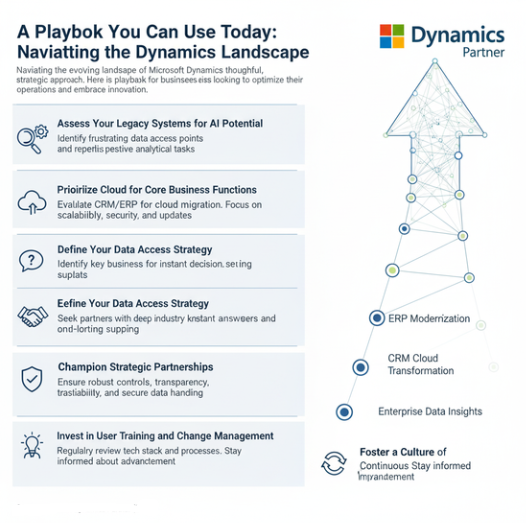
A Playbook You Can Use Today: Navigating the Dynamics Landscape
Navigating the evolving landscape of Microsoft Dynamics requires a thoughtful, strategic approach.
Here is a playbook for businesses looking to optimize their operations and embrace innovation.
Assess Your Legacy Systems for AI Potential.
Do not assume older systems are digital dinosaurs.
As Enavate AI demonstrates with Dynamics GP, existing ERP platforms can be powerfully augmented with modern AI capabilities.
Start by identifying your team’s most frustrating data access points and repetitive analytical tasks.
Prioritize Cloud for Core Business Functions.
Follow Øresundsbron’s lead and evaluate your CRM and ERP systems for cloud migration.
Focus on the benefits of scalability, security, and continuous updates.
A phased CRM cloud transformation can minimize disruption while maximizing long-term gains.
Define Your Data Access Strategy.
With conversational AI, the emphasis shifts from how to extract data to what questions you need answered.
Work with your teams to identify key business questions that, if answered instantly, would dramatically improve decision-making.
Embrace Strategic Partnerships.
Seek out Microsoft Dynamics Partner firms that offer more than just technical implementation.
Look for those, like Innoware and EPSA Ukraine, who offer deep industry knowledge, a commitment to long-term support, and a proven track record of helping clients adapt to evolving challenges.
This includes considering their IT consulting and services capabilities.
Champion Data Governance and Security.
When introducing AI in enterprise software, ensure robust controls are in place.
Prioritize solutions that offer transparency, traceability, and secure data handling.
Invest in User Training and Change Management.
New technologies, especially those that change interaction paradigms like conversational AI, require thoughtful onboarding.
Prepare your teams for new ways of working to ensure high adoption and maximize the return on your ERP modernization efforts.
Foster a Culture of Continuous Improvement.
The digital landscape is always shifting.
Regularly review your technology stack and processes.
Lean on your Microsoft Dynamics Partner to stay informed about new features and advancements, like business process automation tools, that can further enhance your operations.
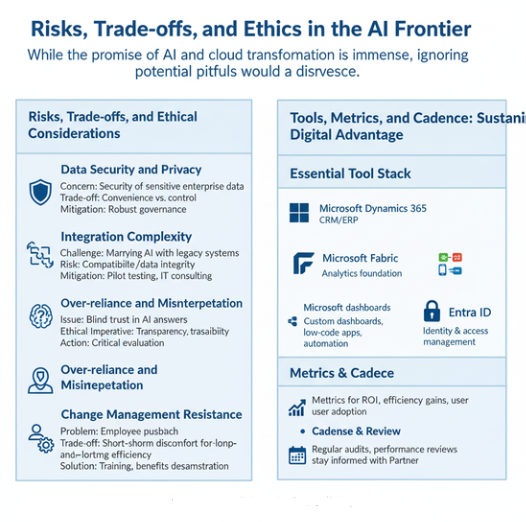
Risks, Trade-offs, and Ethics in the AI Frontier
While the promise of AI and cloud transformation is immense, ignoring potential pitfalls would be a disservice.
Data Security and Privacy.
The most significant concern for many is the security of sensitive enterprise data, especially when integrating AI.
Businesses must verify claims and understand the full data lifecycle.
The trade-off is often between convenience and absolute control; robust governance frameworks are non-negotiable.
Integration Complexity.
Marrying new AI components with legacy ERP systems can be complex.
While the goal is simplification, the initial integration phase might require significant technical expertise and careful planning to avoid disruption.
The risk is unforeseen compatibility issues or data integrity challenges.
Mitigation involves thorough pilot testing and expert IT consulting and services.
Over-reliance and Misinterpretation.
Conversational AI is powerful, but it is not infallible.
Users might over-rely on instant answers without understanding the underlying data sources or potential biases.
The ethical imperative is to ensure transparency, so users can trace responses to their origins and critically evaluate the information provided.
Change Management Resistance.
Introducing new ways of interacting with data can meet resistance from employees accustomed to older methods.
The trade-off is often short-term discomfort for long-term efficiency.
Mitigation requires clear communication, comprehensive training, and demonstrating the tangible benefits to individual workflows.
Tools, Metrics, and Cadence: Sustaining Digital Advantage
To truly harness the power of a modern Dynamics ecosystem, you need the right tools, a way to measure success, and a consistent review cadence.
Essential Tool Stack.
- Microsoft Dynamics 365 serves as a central hub for CRM cloud transformation and ERP capabilities, providing a unified platform.
- Microsoft Fabric provides the analytics foundation for integrating and leveraging data from various sources.
- Microsoft Power Platform, including Power BI, Power Apps, and Power Automate, supports custom analytics dashboards, low-code application development, and business process automation to extend Dynamics functionality.
- Microsoft Entra ID, formerly Azure Active Directory, offers robust identity and access management, critical for securing AI-enabled data access.
Key Performance Indicators (KPIs) for Success.
Measuring success is vital.
- Data Query Response Time, the average time to retrieve specific data insights.
- User Adoption Rate, the percentage of target users actively engaging with new AI or cloud features.
- Operational Efficiency, the time saved on routine data analysis tasks.
- Customer Satisfaction, noting improvement in CRM-driven service or sales interactions.
- Data Accuracy Score, a measure of data consistency and reliability across integrated systems.
Review Cadence.
- Establish a consistent review schedule.Weekly team stand-ups can discuss immediate challenges and quick wins with new tools.
- Monthly, conduct a deep dive into KPI reports, review user feedback, and identify areas for optimization and further ERP modernization.
- Quarterly, hold a strategic review with Microsoft Dynamics Partner leadership to assess project progress, discuss emerging technologies, and plan future enhancements.
- Annually, perform a comprehensive audit of system performance, security protocols, and alignment with overarching business goals, including the impact of AI in enterprise software.
Conclusion: The Unfolding Human Story of Technology
Priya, coffee now reheated, finds herself looking at her monitor with a new sense of possibility.
The idea of conversing with her ERP system, getting instant, contextual answers without the usual struggle, feels less like a futuristic dream and more like an imminent reality.
It is not just about the bytes and algorithms; it is about the human ingenuity that builds these bridges, the partnerships that endure challenges, and the continuous effort to make technology serve us better, more intuitively.
The week’s Microsoft Dynamics Partner news is not just a collection of announcements; it is a testament to the fact that at the heart of every technological advancement lies a human story of aspiration, problem-solving, and the relentless pursuit of a more efficient, insightful, and resilient future.
Embrace the journey of digital transformation; your partners are ready to help you write its next chapter.