
 Maya, proprietor of The Daily Grind, sighed as she watched her new barista, fresh from college, wrestle with the clunky coffee machine.
It was a good kid, eager to learn, but the repetitive tasks – grinding beans, frothing milk, cleaning spills – chipped away at his focus and her bottom line.
She often mused about a different kind of assistant, one that never tired, never complained, and could handle the monotonous yet essential rhythms of a busy café.
Not a soulless automaton, she thought, but a seamless partner, freeing up her human team for the creative, connection-building work that truly defined her brand.
This wasnt a futuristic fantasy, not anymore.
This was the quiet ambition bubbling beneath the surface of todays robotics industry, an ambition now embodied by something called Figure 03.
Figure AIs Figure 03 robot is seen as the potential Model T of robotics.
Its innovative design prioritizes mass production and general-purpose work, aiming to democratize humanoid robotics.
Like Henry Fords revolutionary automobile made personal transport widely accessible, Figure 03 seeks to move these advanced machines from specialized labs into everyday environments like homes and workplaces.
Why This Matters Now: Beyond the Lab and Onto the Floor
For decades, the idea of a truly general-purpose robot has been the stuff of science fiction.
Weve seen industrial arms in factories and specialized bots in research labs, but the concept of a machine that could navigate our nuanced human environments, perform diverse tasks, and work safely alongside us remained elusive.
It was complex, prohibitively expensive, and rarely designed for the everyday.
However, a significant shift is underway.
The humanoid robot field today resembles the early automobile industry, a playground for engineers and hobbyists, poised for a disruptive breakthrough (Figure AI, 2023).
This is precisely the moment Figure AI is targeting with its third-generation bipedal machine, Figure 03.
By explicitly designing for mass production, Figure AI aims to move humanoid robotics from a niche curiosity to a practical, widespread tool.
The company estimates an initial annual production rate of 12,000 units, with a target of 100,000 units over four years, leveraging a new supply chain at its San Jose, California facility (Figure AI, 2023).
This isnt just about building robots; it is about building a future where these machines are as common as the robotic vacuum or, perhaps, even the venerable Ford Model T.
The Core Problem: Bridging the Human-Robot Gap
The fundamental challenge with general-purpose robots has always been their inability to adapt.
Human environments are messy, unpredictable, and filled with objects designed for human hands and minds.
Previous generations of robots, while impressive in controlled settings, often stumbled when faced with the real worlds inherent variability.
They struggled with tasks requiring dexterity, perception, or common sense – the very things humans do effortlessly.
The problem wasnt just technical; it was also psychological.
No one wants a machine that feels cold, dangerous, or triggers Terminator vibes, as the company itself acknowledges (Figure AI, 2023).
Consider a scenario many of our clients face: a small-to-medium enterprise (SME) looking to automate repetitive tasks in a warehouse or hospitality setting.
They see the potential for increased efficiency and reduced labor strain, but theyre daunted by the cost, the complexity of integration, and, crucially, the fear of having a rigid, unadaptable machine that requires constant reprogramming for minor changes.
The counterintuitive insight here is that the breakthrough isnt necessarily about building the smartest robot, but the safest and most adaptable one, a machine that simplifies, rather than complicates, human operations.
A Clients Dilemma: The Cost of Rigidity
Recently, a hotel chain approached us, eager to explore automation for room service delivery and laundry collection.
Their existing robotic solutions were expensive, required dedicated pathways, and couldnt handle unexpected guest requests or items misplaced outside designated drop-off points.
The cost of retrofitting their historic buildings for these machines was astronomical, and the robots themselves were too bulky and stiff for safe interaction in crowded lobbies.
They needed something that could move gracefully through human spaces, understand spoken commands, and even hand a fresh towel directly to a guest without causing alarm.
Their dilemma highlighted the gap between industrial automation and truly human-centric, general-purpose robotics.
What the Research Really Says: Design for a Human Future
Figure AIs approach with Figure 03 addresses these very challenges head-on, drawing clear parallels with the Model Ts revolutionary impact.
- First, the Model T analogy isnt just marketing hype; it is a design philosophy.
The Ford Model T wasnt the first car, but it was the first explicitly designed for mass production by assembly line, aiming directly at the heart of the mass market (Figure AI, 2023).
This focus on manufacturability made it accessible.
Figure 03 mirrors this, with projected initial production rates of 12,000 units annually, scaling to 100,000 units over four years (Figure AI, 2023).
This focus moves beyond one-off prototypes towards democratizing access to advanced robotics.
For businesses, the practical implication is a significant decrease in the cost barrier for humanoid robots, making automation feasible across a wider range of applications, from logistics to hospitality.
- Second, safety and human interaction are paramount.
Figure 03 incorporates washable soft external materials and eliminates exposed machined parts, along with a 9% weight reduction and smaller volume compared to its predecessor, Figure 02 (Figure AI, 2023).
This deliberate design choice mitigates safety concerns when these machines inevitably work alongside people.
The practical implication for operations is reduced risk, increased human comfort, and smoother integration into environments where human-robot collaboration is essential, helping to avoid those Terminator vibes (Figure AI, 2023).
- Third, advanced AI and sensory capabilities drive versatility.
Figure 03 uses Figure AIs proprietary Helix vision-language-action AI system, enabling it to learn and carry out tasks through direct interaction (Figure AI, 2023).
It boasts a new sensor suite with a 60% wider field of view per camera and hands capable of sensing pressures of only a few grams (Figure AI, 2023).
This machine is designed not just to execute programmed commands but to perceive, understand, and adapt to complex real-world surroundings.
The practical implication for businesses is a robot that can perform tasks normally done by humans, acquiring knowledge on the fly, making it genuinely general-purpose for settings ranging from homes to warehouses and hotels (Figure AI, 2023).

Playbook You Can Use Today: Integrating General-Purpose Robotics
The potential of Figure 03 and similar general-purpose robots is immense, but successful integration requires a strategic, human-first approach.
Here is a playbook for businesses and innovators.
- Define your human problem: Instead of looking for a robot to solve an abstract problem, identify specific, repetitive, or strenuous tasks that currently occupy human workers and could benefit from automation.
Consider where a humanoid form factor genuinely adds value over, say, a static robotic arm.
- Prioritize Human-Robot Collaboration (HRC): Design workflows where robots augment, rather than replace, human capabilities.
Focus on safety features, like Figure 03s soft materials and reduced weight (Figure AI, 2023), to ensure seamless, fear-free interaction.
- Embrace Design for Manufacturability Thinking: Understand that a robots widespread utility isnt just about its intelligence, but its accessibility.
Look for solutions built with mass production in mind, mirroring the Model Ts cost-effectiveness, to ensure scalability and long-term viability (Figure AI, 2023).
- Pilot in Controlled, Yet Realistic, Environments: Before full deployment, test robots like Figure 03 in a specific section of your facility or a single hotel floor.
Use these pilots to understand real-world limitations and gather feedback from human co-workers.
- Invest in Teachability: Given robots like Figure 03 can learn through direct interaction via vision-language-action AI (Figure AI, 2023), prioritize systems that allow your teams to teach the robot new tasks rather than requiring complex reprogramming, which reduces dependence on external specialists.
- Develop Clear Safety Protocols and Training: Even with advanced safety features, clear guidelines for human interaction, emergency stops, and designated workspaces are essential.
Train your human workforce thoroughly to build trust and competence.
- Finally, plan for data-driven iteration: Continuously monitor performance, identify bottlenecks, and inform software updates and operational adjustments.
Risks, Trade-offs, and Ethics: Beyond the Hype Reel
While videos of Figure 03 gracefully doing dishes or serving drinks are compelling, it is crucial to approach these demonstrations with a grain of salt.
As the source wisely notes, Weve seen many videos in recent years of robots doing spectacular things, but they can be deceptive when one learns that an impressive back flip is the extent of a robots parkour routine (Figure AI, 2023).
A robot performing flawlessly in a controlled demo may stumble if a glass isnt where it is expected or a human doesnt follow a precise script.
Key Risks
The primary risks include the performance gap, which is the difference between impressive demos and real-world robustness, as robots might struggle with unexpected variability or subtle human cues.
There is also the ethical dilemma of job displacement versus augmentation, concerning automations impact on human employment.
Data privacy and security become critical as robots interact and learn, gathering vast amounts of data about environments and people.
Finally, there is the risk of over-reliance, becoming overly dependent on robotic systems, potentially degrading human skills or creating single points of failure.
Mitigation Guidance
To mitigate these risks, set realistic expectations: Understand that general-purpose doesnt mean perfect and plan for ongoing human oversight and intervention.
Develop clear ethical guidelines for robot deployment, focusing on human dignity, transparency, and accountability, and consider societal impact, including re-skilling initiatives for human workers.
Implement robust data governance with strict data privacy protocols, ensuring data collected by robots is secure, anonymized where necessary, and used ethically.
Finally, use phased rollouts: Begin with pilots, rigorously testing in varied conditions before scaling to help identify limitations and refine processes.
Tools, Metrics, and Cadence: Measuring Success in a Robotic Era
To ensure successful integration of bipedal machines like Figure 03, a robust framework for monitoring and iteration is crucial.
Essential Tools
- AI Robotics Management Platforms, which are software dashboards to monitor robot status, task completion, battery life, and error logs.
- Simulation Software provides virtual environments to test new tasks and optimize robot pathways before deployment in the physical world.
- Human-Robot Interaction (HRI) Feedback Systems offer mechanisms for human workers to provide direct feedback on robot performance, safety concerns, and suggestions for improvement.
- Computer Vision and Sensor Analytics tools process the vast visual and sensory data streams from the robots, like Figure 03s 60% wider field of view per camera (Figure AI, 2023), to identify patterns, anomalies, and learning opportunities.
Key Performance Indicators
- Task Completion Rate, which is the percentage of assigned tasks successfully completed by the robot, with a target of over 95%.
- Error Rate, the frequency of operational errors requiring human intervention, aiming for under 2%.
- Uptime / Availability, the percentage of time the robot is operational and ready for tasks, should ideally be over 98%.
- The Human Collaboration Index, a subjective score from human co-workers on ease and safety of interaction, should target over 4 out of 5.
- The Safety Incident Rate, the number of unexpected contact or near-misses with humans or objects, should ideally be zero.
- Finally, measure Cost Savings / ROI, the tangible savings from reduced labor, increased efficiency, or new services, targeting a positive return on investment.
Review Cadence
A structured review cadence is vital.
- Conduct daily check-ins where the technical team monitors robot health, battery status, and immediate task performance.
- Hold weekly performance reviews for operational leaders to review KPI dashboards, address minor issues, and plan for upcoming tasks.
- Organize monthly HRI feedback sessions to gather input from human workers on their experiences and areas for improvement.
- Schedule quarterly strategic reviews for leadership to assess overall progress, evaluate ROI, and refine the long-term automation roadmap.
- Finally, conduct annual ethical audits to review the broader societal and ethical implications of robot deployment, ensuring alignment with organizational values and community impact.
FAQ: Your Questions on the Future of Humanoid Robots
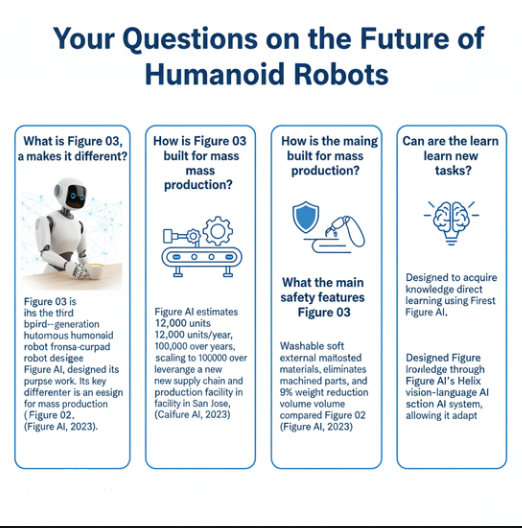
- What is Figure 03, and what makes it different?
Figure 03 is the third-generation bipedal autonomous humanoid robot from Figure AI, designed for general-purpose work across various sectors like homes, warehouses, and hotels.
Its key differentiator is an explicit design for mass production, aiming to make advanced robotics more accessible (Figure AI, 2023).
- How is Figure 03 being built for mass production?
Figure AI estimates an initial production rate of 12,000 units per year, with a target of 100,000 units over four years, leveraging a new supply chain and production facility in San Jose, California (Figure AI, 2023).
- What are the main safety features of Figure 03?
To enhance safety when working alongside humans, Figure 03 incorporates washable soft external materials, eliminates exposed machined parts, and features a 9% weight reduction and smaller volume compared to its predecessor, Figure 02 (Figure AI, 2023).
- Can Figure 03 learn new tasks, or is it pre-programmed?
Figure 03 is designed to acquire knowledge through direct learning and interaction, utilizing Figure AIs proprietary Helix vision-language-action artificial intelligence system.
This allows it to adapt and execute new tasks alongside humans (Figure AI, 2023).
Glossary
- A Humanoid Robot: is a robot with a body shape built to resemble the human body, designed for operating in human environments.
- AI (Artificial Intelligence): is the simulation of human intelligence processes by machines, especially computer systems, with Figure 03 using a Vision-Language-Action AI system.
- Mass Production: is the manufacturing of large quantities of standardized products, often using assembly lines, to achieve economies of scale.
- The Model T: was an automobile produced by Henry Fords Ford Motor Company from 1908 to 1927, widely regarded as the first affordable automobile for the mass market.
- Automation: is the use of largely automatic equipment in a system of manufacturing or other production process.
- A Bipedal Machine: is a machine capable of locomotion using two legs.
- Vision-Language-Action AI: is an artificial intelligence system that combines computer vision for perception, natural language understanding for communication, and action planning for physical interaction.
Conclusion
The journey from a complex, experimental technology to a widespread, accessible tool is rarely linear, but it is a path Figure AI seems intent on forging with Figure 03.
Just as the Model T wasnt the first automobile but rather the one that put America on wheels, Figure 03 might not be the first humanoid robot, but its explicit design for mass production, coupled with a keen eye on safety and versatile AI, positions it as a genuine contender to democratize the robotics industry.
For Maya at The Daily Grind, and countless others wrestling with the daily grind of repetitive tasks, the prospect of a capable, safe, and truly general-purpose robotic assistant is no longer a distant dream.
It is an evolving reality that demands our careful consideration, our strategic planning, and our commitment to a human-first future.
The proof, as always, will be in the pudding – or perhaps, in the perfectly frothed latte served by a Figure 03.
It is time to watch, learn, and prepare for a future where intelligent machines become integral to our daily lives.
References
Figure AI.
(2023).
Figure 03 – The Model T of robots?.