
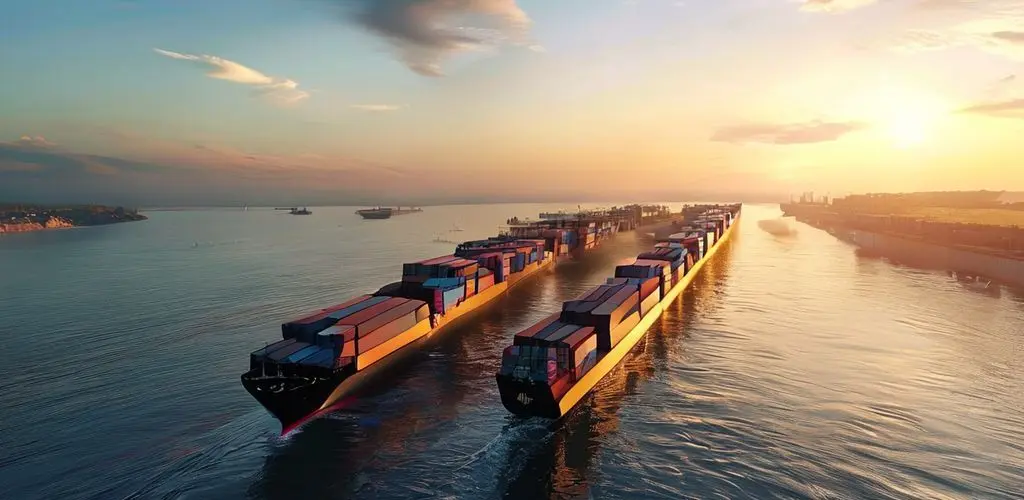
How the 2026 U.S. National Defense Strategy Reframes Maritime Access
The email arrived late, a sterile subject line about logistics adjustments, but my mind immediately drifted back to a blustery morning in a coastal town.
I was watching containers being hoisted onto a massive vessel, a symphony of steel and crane wires, each box a testament to a global dance of goods.
It felt like the heartbeat of the world, predictable, unstoppable.
A small child, bundled in a bright red coat, pointed excitedly at a ship vanishing over the horizon, utterly unaware of the invisible, intricate threads that connect that vessel to a factory across the ocean, to her grandmother’s medicine, or to the microchip in her father’s phone.
We often assume this flow, this maritime access, is a given.
That the seas will always be open, the routes clear, and the chokepoints free.
Yet, the quiet hum of commerce across these vast waterways is under a new kind of scrutiny.
That innocuous email hinted at a shifting tide, one the 2026 U.S. National Defense Strategy now brings into sharp focus: maritime access is no longer a backdrop, but a main character in our strategic narrative.
This shift impacts global supply chains, economic security, and overall strategic competition.
In short: The 2026 U.S. National Defense Strategy dramatically shifts how we view maritime access, moving it from a crisis-only concern to a continuous strategic condition.
This reframing highlights its daily impact on economic security and global deterrence, demanding proactive monitoring and management from all stakeholders.
Why This Matters Now: The Fragility of Assumed Passage
For decades, predictable maritime access was treated as a fundamental assumption.
Shipping lanes, chokepoints, and vital infrastructure were largely considered stable, with disruptions relegated to exceptional circumstances like conflict or severe weather.
However, recent events have painted a starkly different picture.
The sheer fragility of this assumption was laid bare in March 2021 when the grounding of the Ever Given in the Suez Canal halted nearly 12 percent of global trade for six days.
There was no hostile intent, no escalation of conflict, just an unexpected impediment.
Yet, the economic reverberations were immediate: global supply chain delays, price volatility, and a worldwide re-evaluation of risk.
This incident, widely reported in 2021, demonstrated that strategic impact does not require a military confrontation.
It can emerge from the mere absence of reliable access.
This new defense strategy, published by the U.S. Department of Defense, challenges our comfortable assumptions, declaring that the control of access at sea is not a contingency but a continuous strategic condition.
This marks a profound shift in naval strategy and geopolitical thought.
The Problem of Assumed Passage
Historically, maritime access was viewed through a reactive lens.
We braced for disruptions during declared conflicts or major crises, but in peacetime, the sea was largely considered open and free for passage.
The 2026 U.S. National Defense Strategy now dismantles this outdated perspective.
It posits that maritime routes, critical chokepoints, and supporting infrastructure are not just benign background conditions.
Instead, they are strategic variables, constantly shaping economic security and deterrence, even without overt conflict.
This is a counterintuitive shift: disruption does not always wear a uniform.
It can manifest as administrative friction, ambiguous incidents, or persistent pressure that operates subtly below the threshold of traditional warfare.
The Ever Given incident in the Suez Canal, for example, revealed how easily critical infrastructure vulnerabilities could be disrupted with significant global consequences without triggering a conventional conflict.
The core problem, then, is our historical tendency to frame access as a default, rather than a continuously managed strategic asset central to global supply chain resilience and maritime domain awareness.
What the Research Really Says: Pillars of the New Strategy
-
Maritime Access is a Foundation of Economic Security: The 2026 National Defense Strategy, according to the U.S. Department of Defense, explicitly links predictable sea lines of communication, port connectivity, and transit corridor integrity to underpinning global trade, energy flows, and industrial supply chains.
This means economic stability and national prosperity are intrinsically tied to the uninterrupted flow of goods across the oceans.
Consequently, businesses must integrate maritime risk scenarios into their economic forecasting and global supply chain resilience planning, recognizing that even temporary unreliability can cascade rapidly.
-
Chokepoints and Infrastructure are Leverage, Not Just Vulnerabilities: While traditionally seen as weak points, the strategy highlights how ports, canals, straits, and undersea cables can be leveraged to shape who moves, when, and under what conditions, even without physical damage, as emphasized by the U.S. Department of Defense.
Routine activities near these critical assets thus carry strategic weight, revealing where access can be subtly influenced or constrained.
This is crucial for understanding geopolitics of trade, requiring organizations to implement enhanced, continuous monitoring of operational patterns and anomalous activities around key chokepoints and infrastructure, not just in times of declared crisis.
-
Risk Management Shifts from Episodic to Continuous: The strategy mandates that maritime risk management move beyond responding to singular events towards continuous monitoring and interpretation of cumulative pressure, notes the U.S. Department of Defense.
This implies that small, sustained disruptions or repeated anomalies can produce strategic effects without ever escalating into an obvious crisis.
Implementing sophisticated, always-on risk assessment frameworks that focus on patterns and trends across vast amounts of maritime data is therefore essential for distinguishing normal congestion from emerging strategic risk, a key aspect of modern deterrence.
Playbook You Can Use Today: Proactive Maritime Stakeholder Measures
-
Enhance Real-time Maritime Domain Awareness: Invest in technologies that provide continuous, multi-source visibility into vessel movements, ownership networks, and environmental factors.
This aligns with the strategy’s emphasis on continuous monitoring from the U.S. Department of Defense.
-
Map Critical Maritime Dependencies: Identify every chokepoint, port, and sea lane crucial to your supply chain, energy flows, or operations.
Understand where pressure on maritime access could create vulnerability.
This is vital for global supply chain resilience.
-
Integrate Maritime Intelligence into Strategic Planning: Move beyond operational logistics.
Bring insights from vessel behavior and access reliability into executive-level strategic discussions, recognizing its role as a strategic signal, as outlined by the U.S. Department of Defense.
-
Develop Scenario-Based Resilience Plans: Do not just plan for outright conflict.
Stress-test your supply chains against scenarios involving persistent congestion, administrative delays, or selective access pressure, a recommendation consistent with the U.S. Department of Defense’s perspective.
-
Cultivate Maritime Data Literacy: Ensure your teams, from logistics to finance to risk management, understand how to interpret maritime activity data and distinguish routine anomalies from potential strategic threats.
-
Establish Rapid Response Protocols for Access Disruption: Beyond rerouting, consider diplomatic engagement strategies, alternative sourcing, or strategic stockpiling for key goods if access becomes unreliable.
This is crucial for effective risk management.
Risks, Trade-offs, and Ethics in Maritime Domain Awareness
While a proactive stance on maritime access is vital, it is not without its challenges.
Over-interpretation of routine maritime activity could lead to unnecessary alarm or misallocation of resources.
The sheer volume of data might obscure true threats in a sea of false positives, risking alert fatigue.
Furthermore, increased surveillance and data collection raise questions about privacy and the potential for miscalculation if data is misinterpreted or used for unintended purposes, touching on aspects of naval strategy.
Mitigation requires a nuanced approach: prioritize multi-source verification and data validation to reduce false positives.
Establish clear thresholds and contextual frameworks for interpreting anomalies, ensuring that human intelligence complements AI analysis.
Develop robust ethical guidelines for data collection and usage, balancing national and economic security needs with international norms and privacy concerns.
This proactive management demands not just advanced tools, but also sound judgment and a commitment to responsible oversight.
Tools, Metrics, and Cadence for Continuous Access Management
Recommended Tool Stacks:
-
AI-powered Maritime Analytics Platforms: For real-time vessel tracking, behavior analysis, and anomaly detection, essential for maritime domain awareness.
-
Satellite Imagery and Remote Sensing Intelligence: To provide independent verification and broader contextual awareness of maritime infrastructure and activity.
-
Global Supply Chain Mapping Platforms: To visualize dependencies on specific chokepoints and routes, crucial for supply chain resilience.
-
Geopolitical Intelligence Feeds: To integrate political, economic, and security developments affecting maritime access.
Key Performance Indicators (KPIs) for Access Reliability:
-
Access Reliability Index: Percentage of on-time deliveries through critical chokepoints and routes.
-
Anomalous Activity Alerts: Frequency and severity of unusual vessel behavior or infrastructure incidents near key maritime assets.
-
Supply Chain Resilience Score: Measures diversification of routes, lead times for alternative sourcing, and capacity for rerouting.
-
Economic Impact of Disruptions: Quantifies the financial consequences of any access disruptions, however minor.
Review Cadence for Strategic Maritime Planning:
-
Daily: Operational dashboards for real-time alerts and immediate tactical adjustments.
-
Weekly: Strategic reviews to assess emerging patterns, geopolitical shifts, and short-term access reliability forecasts.
-
Quarterly: Comprehensive scenario planning, stress-testing resilience plans, and updating long-term strategies based on evolving maritime security landscapes.
FAQ: Understanding the 2026 NDS on Maritime Access
What is the core shift in the 2026 U.S. National Defense Strategy regarding maritime access?
The core shift is redefining maritime access from an episodic crisis concern to a continuous strategic condition, integral to daily economic security and deterrence, according to the U.S. Department of Defense.
How does the strategy link maritime access to economic security?
The strategy links maritime access to economic security by recognizing that reliable sea lines of communication, port connectivity, and transit corridors underpin global trade, energy, and supply chains.
Disruptions, even minor, can have rapid economic cascade effects.
What are the practical implications for organizations operating at sea?
Organizations must now view access reliability as a strategic signal, interpret routine activity near chokepoints carefully, shift risk assessment to continuous monitoring, and prioritize visibility and verification even in normal conditions.
Conclusion: The Future of Global Commerce Sails on Foresight
The child on the shore, pointing at the ship disappearing into the vastness, saw adventure.
We, as guardians of global commerce and security, must now see something more complex: a delicate, continuously managed condition.
The 2026 U.S. National Defense Strategy is not just a military document; it is a profound re-reading of our interconnected world, one where the seemingly mundane acts of maritime transit hold immense strategic weight for economic security and strategic competition.
We can no longer afford to treat the freedom of the seas as a default.
It is an active, ongoing endeavor, demanding vigilance, intelligence, and a human-centered approach to risk management.
By embracing this new understanding, we ensure not just the flow of goods, but the stability and prosperity that depend on it.
The future of global trade and security sails on the currents of our collective foresight, not just our reaction to crisis.
References
-
The Ever Given Suez Canal Grounding Incident, N/A (Article’s Example), 2021.
-
2026 U.S. National Defense Strategy (Interpretation by article), U.S. Department of Defense.