
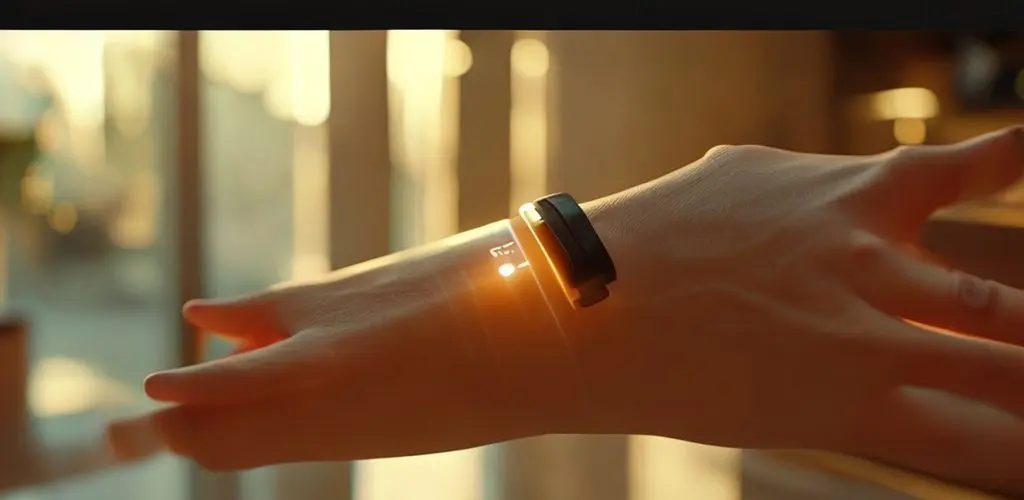
The Next Leap OpenAI’s Human-First AI Device for a Post-Screen World
The morning sun, a gentle whisper against the windowpane, cast long shadows across my kitchen.
I was stirring chai, when my phone buzzed, demanding attention.
Another alert, another notification, pulling me away from the quiet rhythm of the moment.
This is a scene replayed daily: technology, ostensibly designed to connect, often creates new barriers, demanding our gaze, our taps, our constant interaction with a glowing rectangle.
We crave presence, simplicity, a return to the natural flow of thought, yet our devices frequently pull us away.
This longing for a more intuitive, less intrusive technological embrace is not just a personal yearning; it is a profound market signal.
It points to a future where AI is not just software on a screen, but a seamless extension of our lives.
This sentiment underpins the ambition reportedly brewing at OpenAI: a strategic shift toward AI hardware.
Chris Lehane, OpenAI’s Chief Global Affairs Officer, announced at Axios House Davos in 2024 that the company aims to unveil its first OpenAI AI device in the latter half of 2026.
This is not merely another gadget; it is a bold step, poised to redefine how we interact with artificial intelligence.
In short: OpenAI is reportedly launching its first AI hardware device by late 2026, signaling a major shift from software to integrated physical products.
With Jony Ive’s design expertise and a growing AI wearables market, this OpenAI AI device targets simpler, more seamless human-computer interaction.
The Dawn of Ambient AI Beyond the Screen
For years, our interaction with AI has largely been confined to screens: keyboards, mice, touch interfaces.
But what if AI could disappear into the fabric of our lives, offering assistance without demanding visual attention?
This is the core problem OpenAI aims to address with its new AI hardware strategy.
The company’s vision, supported by the acquisition of Jony Ive’s design company, io, in May 2023, hints at an OpenAI AI device designed for simplicity and seamless integration, distinct from current smartphones.
This is not just about making AI smaller; it is about making it gentler.
True innovation might lie not in adding more features, but in subtracting complexity, allowing technology to serve us without constantly asserting its presence.
Imagine a world where insight flows as naturally as thought, where context is understood without explicit command.
We are moving towards a paradigm where AI anticipates needs rather than merely responding to prompts, driving the future of human-computer interaction.
A New Interface The Whisper of an Idea
Consider a marketing leader, Sarah, overwhelmed by digital data.
Her current AI tools require endless prompts and screen time.
She dreams of an AI gadget that could intuitively surface key market shifts or customer sentiment as she is thinking about them, perhaps through a subtle audio cue or gentle haptic feedback, without ever needing a phone.
This is the human-centered design ethos OpenAI, with Jony Ive’s team, is likely pursuing—a shift from command-and-control to ambient, context-aware intelligence, transforming consumer electronics innovation.
What the Research Really Says About AI’s Next Wave
The 2026 launch into hardware by OpenAI is not happening in a vacuum; it is a response to clear market signals and strategic foresight.
Here is what verifiable data tells us:
OpenAI’s Strategic Pivot
Chris Lehane’s announcement confirms OpenAI’s intention to expand beyond software into AI hardware by late 2026.
This signifies a major strategic shift for OpenAI, moving from purely software solutions to integrated physical products.
For businesses and marketers, this implies a need to rethink AI adoption strategies, preparing for AI that lives not just on servers, but in our hands or on our bodies, marking a significant tech industry disruption.
Jony Ive’s Design Influence
The involvement of Jony Ive’s company, io, acquired by OpenAI in May 2023, underscores a commitment to design and user experience.
If OpenAI’s device follows the Jony Ive design philosophy, it will set a new standard for human-AI interaction.
For companies considering AI integrations, this means prioritizing intuitive design and user-centricity over computational power.
User experience will be paramount for any future AI gadgets.
A Burgeoning AI Hardware Market
Qualcomm CEO Cristiano Amon highlighted in 2024 that around 10 million AI-equipped glasses ship annually, with projections of that number reaching 100 million within one to two years.
This tenfold increase signals a burgeoning AI wearables market ready for expansion.
OpenAI’s 2026 launch positions it to ride this wave of growing demand, provided it can offer a competitive and innovative product.
Businesses should explore how their services can integrate with new wearable AI platforms.
Strategic Collaborations
Cristiano Amon also confirmed in 2024 that Qualcomm has been collaborating with OpenAI on hardware development.
This suggests a sophisticated technical foundation for the device.
Cross-industry partnerships will be critical for success in the complex AI hardware landscape, leveraging specialized expertise in both AI and chip design for personal AI assistants.
A Playbook for the Future of Interaction
As AI-enabled consumer electronics redefine our interface with the digital world, businesses can prepare by investing in ambient AI research and development, exploring how AI delivers value without direct screen interaction through voice, haptics, and contextual awareness.
This will be key for future devices and human-computer interaction.
They should foster design-led thinking, prioritizing simplicity, intuition, and seamless integration into daily life, focusing on feeling over features.
Businesses must prepare for new interaction paradigms beyond voice, considering gesture, subtle biometrics, and predictive assistance to understand what new AI gadgets their customers might adopt.
They should also pilot context-aware solutions, experimenting with AI that understands user intent and environment, delivering relevant information proactively.
Building ethical AI frameworks is crucial; with devices intimately integrated into users’ lives, privacy, data security, and bias mitigation become non-negotiable, requiring transparent data practices and evolving ethical AI development strategies.
Finally, forming strategic partnerships, like OpenAI’s collaboration with Qualcomm, will accelerate tech innovation by leveraging expertise in hardware, chip design, and user experience.
Risks, Trade-offs, and the Moral Core
The promise of seamlessly integrated AI also carries inherent risks.
Privacy concerns top the list: a device constantly listening or observing raises critical questions about data ownership and potential misuse.
There is also the trade-off of dependency; what happens if we become too reliant on invisible AI?
The AI wearables market itself might see failures if compelling use cases are not found.
Mitigation demands transparency in design and function.
Users must have clear control over their data and privacy settings, perhaps even visual indicators of when the device is active.
Strong ethical guidelines, developed in collaboration with users and privacy advocates, are essential from day one.
Companies must prioritize user agency and dignity, ensuring the technology serves humanity, not the other way around.
This is not just good business; it is a moral imperative in the age of pervasive AI and consumer electronics innovation.
Tools, Metrics, and Cadence for the Ambient Age
Navigating this tech industry disruption requires a tailored approach to measurement and development.
For a recommended tool stack, businesses should utilize frameworks like Google Cloud AI or Azure AI for robust model training and deployment.
Advanced user testing suites involving eye-tracking, haptic feedback analysis, and qualitative user interviews will be crucial for understanding nuanced interactions with wearable AI.
Ethical AI governance tools will also monitor for bias, ensure data privacy compliance, and manage AI transparency.
Key performance indicators include User Adoption Rate, targeting 25% within the first six months post-launch, and Interaction Efficiency, aiming for a 20% improvement in task completion.
User satisfaction, reflected in Sentiment Scores, should target above 8.0 out of 10, while Privacy Compliance Incidents should be zero.
Contextual Relevance, the AI’s ability to provide timely and useful information, should be highly relevant in over 75% of interactions.
For review cadence, implement an agile development cycle with weekly sprint reviews and monthly strategic deep-dives.
Conduct quarterly user sentiment analysis and bi-annual ethical audits.
This iterative approach ensures products evolve responsively to technical advancements and human needs for personal AI assistants.
FAQ
- When is OpenAI expected to launch its first AI device?
OpenAI is reportedly targeting the second half of 2026 for the unveiling of its first hardware device, according to Chief Global Affairs Officer Chris Lehane, as reported by Axios House Davos in 2024.
This marks a significant 2026 launch in the AI hardware space.
- Is OpenAI collaborating with other companies on this hardware?
Yes, Qualcomm CEO Cristiano Amon confirmed in 2024 that Qualcomm has been collaborating with OpenAI on hardware development.
Additionally, OpenAI acquired Jony Ive’s design company, io, in May 2023, integrating significant design expertise to influence the OpenAI AI device.
- What kind of AI devices are expected to grow in the market?
The AI wearables market is expected to see a surge, with AI-equipped glasses potentially reaching 100 million shipments within one to two years, up from 10 million annually, according to Qualcomm’s CEO in 2024.
This highlights the growing potential for new AI gadgets.
- How will OpenAI’s device be different from current smartphones?
While few specifics have been released, the device is expected to be distinct from smartphones, designed for simplicity, and will aim to expand AI beyond traditional software interfaces.
It represents a potential new interface for users beyond traditional screens and keyboards, embodying a new future of human-computer interaction.
The Human Heart of AI’s Future
Returning to that kitchen scene, the lingering scent of cardamom, the desire for an undistracted moment – this is the landscape OpenAI is entering.
Their 2026 launch is not just about a new product; it is about a new promise.
A promise that technology can be a gentle partner, not a demanding master.
That it can enhance our human experience without eroding our presence.
As we stand on the cusp of this new wave of AI hardware, the real opportunity is not just in building smarter machines, but in building more humane ones.
Ones that understand the subtle hum of daily life, that enrich our moments rather than interrupt them.
The future of personal AI assistants will be defined by how well they serve the human spirit.
The time is now to embrace this human-first vision, to co-create a future where technology truly elevates us.
References
- Axios House Davos (reportage). OpenAI’s Upcoming Hardware Plans (Chris Lehane statement). 2024.
- OpenAI. OpenAI’s Acquisition of Jony Ive’s Company ‘io’. 2023.
- Qualcomm. Qualcomm CEO Comments on AI Hardware (Cristiano Amon statement). 2024.