
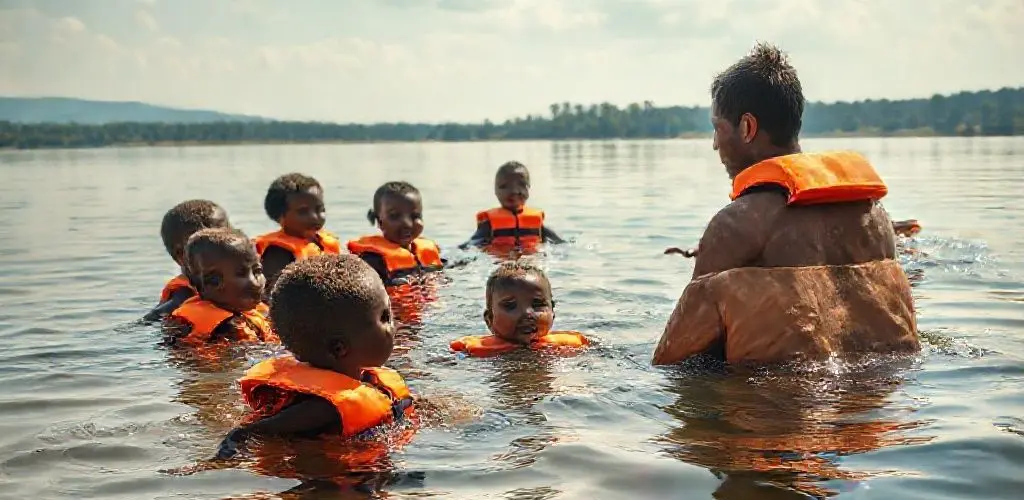
Sauti Plus’s Award-Winning Omanyi Okuwuga Campaign: Turning the Tide on Drowning in Uganda
The early morning mist still clung to the fishing boats on Lake Victoria, a silvery shroud hinting at the cool depths below.
For Mama Rose, every ripple was a reminder, a soft whisper of the water’s power.
She had seen too many families touched by its unforgiving embrace, the sudden, silent loss that leaves an aching void.
It is a truth etched into the very fabric of life in lakeside villages: water gives, and water can take.
But what if it did not have to be this way?
What if a simple skill, a conscious choice, could turn the tide against such sorrow?
This is the silent question that drives transformative work across Uganda.
Sauti Plus has been honored with a prestigious PRAU Award for its Omanyi Okuwuga campaign in Uganda.
This two-year initiative effectively addresses the country’s high drowning rates through a holistic approach encompassing community education, practical survival-swimming training, and advocacy for stronger national water-safety policies, proving communication can genuinely save lives.
Why This Matters Now: Turning the Tide on a Silent Crisis
Mama Rose’s quiet worry echoes a critical public health challenge across Uganda.
Drowning is not just an unfortunate accident; it remains the leading water-related cause of death in the nation, despite a slight decline in cases recorded by the Uganda Police in 2024.
This is a pervasive issue demanding urgent, sustained attention for Uganda public health.
The sheer scale of the challenge is stark.
A 2018 study by the Makerere University School of Public Health documented more than 1,435 fatal and non-fatal drowning cases across over 60 districts between January 2016 and June 2018.
These numbers underscore the vital need for robust, impactful water safety initiatives.
This is precisely where the work of organizations like Sauti Plus becomes not just commendable, but life-saving.
The Unseen Threat: Uganda’s Persistent Killer
Many might assume that with greater awareness, drowning rates would naturally fall.
Yet, the persistent statistics tell a different story.
Often, drowning is a swift, silent tragedy linked to limited awareness, unsafe practices around water bodies, and a critical gap in basic survival skills.
It is a public health crisis often hiding in plain sight, demanding proactive intervention.
The counterintuitive insight here is that while many communities live alongside water, that proximity can foster a false sense of security rather than informed caution.
Familiarity can breed complacency, making targeted drowning prevention Uganda initiatives even more crucial.
The problem is not just a lack of information, but often a lack of accessible, actionable solutions tailored to local contexts and behaviors.
A Family’s Newfound Hope
Imagine a young boy, perhaps 10 years old, growing up beside a busy river crossing.
His family navigates it daily for work, sometimes with overloaded boats, often without life jackets.
The boy might swim in shallow areas, but without formal instruction, he is ill-equipped for real emergencies.
This vulnerability is a lived reality for countless families in high-risk districts.
Through campaigns like Omanyi Okuwuga, children like him learn basic survival swimming training and critical water-safety rules, transforming potential tragedy into newfound confidence.
These practical skills are literally a lifeline, changing generational patterns of risk and fostering community resilience.
What the Research Really Says: A Blueprint for Impact
The success of the Omanyi Okuwuga campaign, recognized by the Public Relations Association of Uganda (PRAU) in 2025, is not accidental.
It is built on a foundation of deeply understanding the problem and strategically addressing it.
Drowning continues as Uganda’s primary water-related fatality, according to the Uganda Police in 2024.
Despite a reported slight decline, this signifies a persistent crisis needing sustained, robust prevention campaigns.
Effective public health and safety efforts require long-term commitment and adaptive strategies.
The problem’s pervasive nature is evident from the Makerere University School of Public Health’s 2018 study, which documented over 1,435 fatal and non-fatal drowning cases across more than 60 districts.
This widespread impact means interventions require broad reach, utilizing a mix of traditional and digital media, coupled with targeted community outreach Uganda.
The Public Relations Association of Uganda (PRAU) recognized the Omanyi Okuwuga campaign in 2025 as an award-winning effort for effectively using communication and marketing to address socio-economic challenges.
This highlights the power of strategic social marketing campaign principles in public health, emphasizing that investing in professional communication, clear messaging, and multi-channel distribution is paramount for tangible results and influencing behavior.
A Playbook You Can Use Today: Driving Real-World Impact
To replicate the success of campaigns like Omanyi Okuwuga, consider this actionable playbook for your own social marketing or public health initiatives:
- Understand Your Audience Deeply: Go beyond demographics to understand beliefs, routines, and barriers.
In-depth qualitative research is crucial here.
- Multichannel Communication is Non-Negotiable: Leverage both traditional media (radio, community meetings) and digital platforms for widespread reach, particularly as drowning incidents are geographically widespread, as the Makerere University School of Public Health found in 2018.
- Prioritize Practical Skills Over Pure Awareness: Awareness is only a start.
Provide access to tangible, life-saving skills like survival swimming training.
This transforms abstract knowledge into concrete action.
- Engage Communities Authentically: Conduct regular community and school outreaches.
These direct interactions build trust and provide tailored water-safety information, fostering local ownership of the message.
- Champion Policy Advocacy: Do not just inform; advocate for systemic change.
Push for integrating essential skills like swimming into national school curricula and for stronger enforcement of safety regulations.
This addresses root causes, impacting generations and strengthening water transport safety.
- Measure Beyond Impressions: Track changes in behavior, skill adoption rates, and policy shifts, not just media mentions.
True impact lies in observable, sustained change.
Risks, Trade-offs, and Ethical Considerations in Social Change
Even the most well-intentioned campaigns face hurdles.
One significant risk is sustainability: a two-year initiative is fantastic, but maintaining momentum requires ongoing funding and consistent political will.
Public health crises are long-term battles.
Another trade-off lies in balancing broad awareness with deep behavioral change.
It is easier to shout a message than to embed a new habit.
Ethically, it is crucial to empower communities without inadvertently placing the sole burden of safety on individuals when systemic issues also play a role.
Campaigns must champion dignity, ensuring messages are culturally sensitive and never shame those at risk.
Authenticity means acknowledging the complexities of local life, from economic pressures that lead to unsafe practices to the cultural significance of water bodies.
Grounded empathy guides the entire process, ensuring the human element remains at the forefront.
Tools, Metrics, and Cadence for Sustained Impact
To effectively manage and measure the success of such vital campaigns, a robust framework is essential.
Recommended Tool Stack:
For communication and reach, consider social media management platforms, local radio advertising tools, and community SMS services.
For engagement and learning, survey tools for pre and post-campaign knowledge assessment, interactive learning apps, and community event management software are valuable.
For advocacy, policy tracking databases and stakeholder mapping tools are useful.
Key Performance Indicators (KPIs):
Awareness can be tracked by the percentage increase in self-reported water safety knowledge and reach and engagement rates on digital and traditional platforms.
Behavioral change can be measured by the percentage increase in life jacket usage, the percentage of children enrolled in survival swimming lessons, and the percentage reduction in observed unsafe practices.
Policy and infrastructure improvements are indicated by the number of policy proposals advanced, improvements in emergency response times, and the number of water transport infrastructure upgrades.
Review Cadence:
Monthly, review digital campaign performance, community feedback, and immediate outreach results.
Quarterly, assess progress against behavioral change KPIs, conduct mini-surveys, and adjust strategies.
Annually, perform a comprehensive impact assessment, stakeholder review, and strategic planning for the next phase.
This consistent monitoring is crucial for Omanyi Okuwuga campaign success and other PRAU Excellence Awards contenders.
Your Questions on Water Safety Initiatives Answered
What is the Omanyi Okuwuga campaign?
The Omanyi Okuwuga campaign is a two-year social marketing and behavioural-change initiative by Sauti Plus, recognized by the Public Relations Association of Uganda (PRAU) in 2025.
It focuses on preventing drowning in high-risk districts of Uganda through awareness, training, and policy advocacy.
Why is drowning prevention so important in Uganda?
Drowning remains the leading water-related cause of death in Uganda, according to the Uganda Police in 2024, highlighting a significant public health challenge.
The campaign addresses this by promoting core life skills and safer practices around water.
How does the campaign reach communities and promote water safety?
The Omanyi Okuwuga initiative employs both traditional and digital media platforms, conducts community and school outreaches, and provides practical survival swimming lessons.
This multi-faceted approach ensures comprehensive reach and engagement, as recognized by Sauti Plus and PRAU in 2025.
Conclusion: A Ripple Effect of Hope
As Mama Rose watched the sun climb higher, chasing away the morning mist, she saw children playing by the shore, now, a few wore bright orange life jackets.
The fear was not entirely gone, but a new current of hope was flowing through her community.
The recognition for Sauti Plus’s Omanyi Okuwuga campaign is not just an award; it is a testament to the profound impact of strategic, human-centered communication.
It proves that with thoughtful planning, authentic engagement, and a relentless focus on saving lives, we can indeed turn the tide on silent tragedies.
Every stroke learned, every safety precaution adopted, creates a ripple effect, building a safer Uganda for all.
References
- Public Relations Association of Uganda (PRAU). 9th PRAU Excellence Awards 2025. 2025.
- Uganda Police. Uganda Police annual crime report. 2024.
- Makerere University School of Public Health. Study by the Makerere University School of Public Health. 2018.