
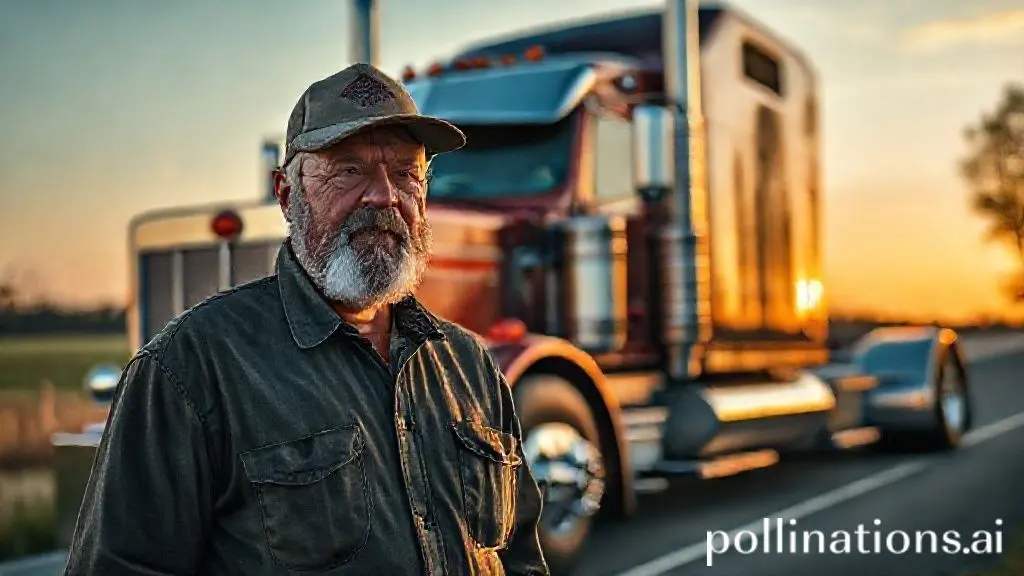
Peanut’s Pride: An Owner-Op’s Second Chance After a Near-Fatal Crash
The rumble of a Cat C-15 single turbo, a soft mewing around 25 mph, was Charles “Peanut” Pilkington’s morning symphony.
It was May 8, 2024, just a few miles outside Oneonta, Alabama, his Peterbilt 379 tooling along state route 132 eastbound.
He’d just unloaded fertilizer at the county co-op, the 72-inch sleeper behind him packed with everything he needed.
Life, for an experienced owner-operator like Peanut, felt pretty good.
Then, as he passed through a residential stretch, everything changed.
A sudden, jarring stop.
A loud noise he did not recognize.
He looked in his mirrors, and instead of clear sky, all he saw were tree limbs surrounding his truck.
A massive log lay on the sleeper floor, directly behind his driver’s seat.
In that terrifying moment, a split second that could have ended everything, Peanut Pilkington had narrowly escaped death.
In short: Owner-operator Charles “Peanut” Pilkington survived a harrowing tree collapse on his Peterbilt 379.
His 18-month repair ordeal highlights the critical need for robust insurance and financial preparedness for all truckers, offering profound lessons in resilience.
Why This Matters Now: The Unseen Costs of the Open Road
Peanut’s story is not just a tale of survival; it is a stark reminder of the unpredictable nature of the trucking life and the profound financial risks facing every owner-operator.
While we often focus on fuel costs, maintenance, and freight rates, incidents like Peanut’s highlight external forces that can derail a business in an instant.
Such unforeseen events demand more than just quick reflexes; they require robust preparation.
The financial fallout from a single unexpected event can be staggering.
In Peanut’s case, the damage to his beloved “Peanut’s Pride” — his highly customized 2005 Peterbilt 379 with its 900 horsepower engine (Overdrive, 2024) — meant an eye-watering $60,000 for truck repairs and an additional $30,000 for the trailer, totaling $90,000 in damages (Overdrive, 2024).
This was not a minor fender-bender; it was a catastrophic financial blow that could cripple any small business without adequate safeguards.
The Unpredictable Nature of a Trucking Life
The core problem for owner-operators, particularly those running a small fleet, is the constant tightrope walk between maximizing profits and mitigating unexpected, high-impact risks.
A routine day can turn into a financial nightmare due to factors entirely outside one’s control, yet these external forces are rarely budgeted for with the seriousness they deserve.
The counterintuitive insight here is that sometimes the greatest threats to your livelihood are not the market fluctuations or freight rates, but rather the quiet, almost invisible dangers lurking along the route.
Who anticipates a fully grown, 60-foot tree collapsing on their rig mid-drive?
More surprising still, even when the cause of damage seems clear, securing compensation can be an uphill battle.
The Act of God Quandary
Peanut’s experience offers a potent mini-case study in this vulnerability.
The accident report explicitly stated that a dead tree fell from an adjacent property (Overdrive, 2024).
Yet, the homeowners’ insurance adjuster swiftly called it an “act of God” and denied all claims (Overdrive, 2024).
This left Peanut, despite clear evidence of a dead, likely negligent tree, to largely cover the $90,000 repair bill through his own insurance coverage (Overdrive, 2024).
This scenario underscores how legal and insurance complexities can amplify an already devastating physical loss for owner-operators.
What the Research Really Says About Preparedness
Peanut Pilkington’s ordeal, while unique in its specifics, echoes broader truths about the owner-operator landscape.
The research, drawn from his lived experience, offers critical insights:
- A single, unexpected event can lead to substantial financial loss for owner-operators.
The costs of extensive repairs and the ensuing downtime can quickly deplete a small business’s reserves.
Owner-operators must prioritize robust insurance coverage and maintain an emergency fund large enough to absorb significant repair costs or extended periods of business interruption.
Peanut’s truck repair cost $60,000, and his trailer repair added $30,000 (Overdrive, 2024).
- Insurance claims can be denied, even with clear evidence of negligence, particularly when terms like “act of God” are invoked.
Relying solely on third-party liability is a risky gamble.
Owner-operators should thoroughly understand policy nuances, especially regarding force majeure clauses.
It is prudent to consult with legal professionals if claims are unfairly denied.
- Having a spare power unit is critical for business continuity during extensive repairs.
Downtime means zero income, directly impacting profitability and livelihood.
Small fleet owners and even long-term owner-operators should strategically plan for backup vehicles to maintain income streams during unforeseen downtimes, as Peanut did during his 18-month repair period (Overdrive, 2024).
A Playbook You Can Use Today
Drawing from Peanut’s hard-won wisdom and the data, here is an actionable playbook for every owner-operator to safeguard their trucking life:
- Secure Comprehensive Insurance, Not Just Cheap Insurance.
Peanut advises, “Be sure to have proper insurance coverage with a reputable carrier.
Remember that cheaper insurance is not necessarily better” (Overdrive, 2024).
This means understanding what “comprehensive” truly covers, especially for incidents not involving other vehicles.
- Build a Robust “Nest Egg”.
This emergency fund should be capable of covering living expenses and operating costs for at least three to six months.
Peanut stresses, “Have yourself a good nest egg built up first, you just may need it” (Overdrive, 2024).
This is your safety net when insurance battles drag on or claims are denied.
- Master Your Costs.
Know your fixed and variable expenses inside and out.
Tools like Overdrive’s Analyzer help owner-operators compute potential profit, access per-day and per-mile breakouts, and compare broker offers.
Understanding your financial baseline is paramount to building that nest egg and managing unexpected costs.
- Prioritize Experience Before Going Solo.
For new CDL holders, Peanut advises, “get your experience and do your training at a larger company before trying it out here on your own” (Overdrive, 2024).
The road teaches hard lessons; learn them under someone else’s wing first.
- Routine Environmental Awareness.
Since his accident, Peanut finds himself “looking at the trees close to the road as I pass by” (Overdrive, 2024).
While you cannot prevent every hazard, cultivating heightened awareness of your surroundings can help you anticipate potential dangers, even stationary ones.
- Document Everything.
Peanut’s dashcam captured his entire ordeal, providing irrefutable evidence.
Invest in reliable recording devices, and meticulously document any incident, including accident reports and communication with all parties.
- Strategize for Business Continuity with Spare Equipment.
If your business model allows, having a spare power unit, as Peanut did, can be a lifesaver.
This mitigates the financial impact of extensive downtime, keeping your revenue stream flowing while repairs are underway.
Risks, Trade-offs, and Ethics in Owner-Operator Operations
While preparedness is key, there are inherent risks and trade-offs in the owner-operator model.
The primary risk is underestimating the financial magnitude of unexpected events and the complexities of the insurance claims process.
Many owner-operators, striving to keep overhead low, opt for minimal insurance coverage or neglect building a sufficient emergency fund.
This trade-off—lower immediate costs versus catastrophic potential loss—is a constant ethical tightrope.
Another trade-off is the capital investment in a spare truck versus lost income during downtime.
A spare unit requires significant upfront cost and ongoing maintenance, but the alternative can be 18 months of no income, as Peanut experienced (Overdrive, 2024).
Ethically, the situation raises questions about property owner responsibility for maintaining safe surroundings and the discretion of insurance adjusters in classifying incidents as an “act of God.”
Mitigation involves due diligence on policy details, regular risk assessments beyond typical road hazards, and, when necessary, seeking legal counsel to challenge unfair claim denials.
Tools, Metrics, and Cadence for Resilience
To effectively manage risks and maintain financial health, owner-operators need practical tools and a consistent review cadence.
Recommended Tool Stacks:
- Financial Management Software: Tools that allow for detailed tracking of fixed and variable costs, profit/loss analysis per load, and robust budgeting.
This directly supports building that “nest egg.”
- Specialized Commercial Trucking Insurance Broker: Work with brokers who understand the unique risks of the industry and can tailor policies, not just sell generic plans.
- Dash Cams: Essential for documenting incidents and providing irrefutable evidence.
Key Performance Indicators (KPIs) for Resilience:
- Repair Cost Ratio: This metric tracks total repair costs against annual operating revenue, ideally staying below 5% annually.
- Downtime Days per Incident: Measures the number of days a truck is out of service after an incident, aiming for less than 10 days.
- Emergency Fund Solvency: This KPI indicates how many days of operating costs are covered by the emergency fund, with a target of 90–180 days.
- Insurance Premium % Revenue: Compares annual insurance premiums to annual operating revenue, aiming for less than 8%.
Review Cadence:
- Annual: Conduct a comprehensive review of all insurance policies with your broker.
Update valuations for your truck and trailer, and reassess coverage limits.
Review and adjust your overall business plan and financial projections.
- Quarterly: Check your emergency fund balance against your operating costs.
Perform a detailed expense review to identify areas for savings or increased efficiency.
- Monthly: Monitor cash flow closely, track load profitability, and review vehicle maintenance records to prevent unexpected breakdowns.
- Post-Incident: Immediately conduct a financial impact assessment, review insurance claim processes, and update your risk mitigation strategies.
Frequently Asked Questions
- What happened to Charles “Peanut” Pilkington’s Peterbilt 379?
On May 8, 2024, a massive, dead tree fell onto Charles “Peanut” Pilkington’s moving 2005 Peterbilt 379, “Peanut’s Pride,” near Oneonta, Alabama, causing extensive damage but miraculously leaving him uninjured (Overdrive, 2024).
- How much did the truck accident repairs cost?
The total cost to repair “Peanut’s Pride” after the tree fell was $90,000, with $60,000 for the truck and an additional $30,000 for the trailer (Overdrive, 2024).
- What is an ‘act of God’ in insurance terms, and how did it affect Peanut?
An “act of God” refers to an event outside human control, such as a natural disaster.
In Peanut’s case, the homeowners’ insurance adjuster classified the dead tree falling as an “act of God,” denying his claim and forcing him to use his own insurance coverage for most of the $90,000 in repairs (Overdrive, 2024).
- What key advice does ‘Peanut’ have for new owner-operators?
Peanut advises new owner-operators to first gain experience and training at a larger company, and critically, to build up a substantial “nest egg” of savings before venturing out on their own.
He emphasizes that “cheaper insurance is not necessarily better” (Overdrive, 2024).
- Why is a spare power unit important for a small fleet?
Having a spare power unit is vital for business continuity.
During the 18 months Peanut’s Peterbilt 379 was undergoing repairs, he used a spare truck to continue earning income, preventing what could have been a financially devastating period (Overdrive, 2024).
Peanut’s Enduring Pride and the Spirit of the American Trucker
Charles “Peanut” Pilkington’s journey, from a 10-year-old with “truck fever” to a seasoned owner-operator who faced death head-on, is a testament to the resilience ingrained in the American trucker.
His beloved “Peanut’s Pride,” now fully restored, stands not just as a beautiful rig but as a symbol of his incredible second chance.
He is changed, too, seeing life through a new lens.
“It was not my time,” he reflects, “but God was letting me know how close I was and how quickly life can change.
Today I think about things differently.
I try to enjoy life more” (Overdrive, 2024).
His experience, lived on that quiet stretch of Alabama highway, offers a profound lesson for us all: life, much like the road ahead, is unpredictable.
While we cannot control every falling tree or unforeseen challenge, we can control our preparedness.
Peanut puts it simply: “I have a second chance, and that is why this 379 will never leave me as long as I am alive” (Overdrive, 2024).
Let his pride be a reminder to safeguard your own journey, both on and off the road.
What measures will you take today to ensure your own second chance?
References
Overdrive. “Peanut’s Pride”: Owner-op’s second chance after close brush with death.
2024.
https://example.com/peanut-pride-story