
5-Axis Machining: India’s Path to Aerospace Manufacturing Precision
The scent of cutting oil hung heavy in Mr. Sharma’s Pune workshop.
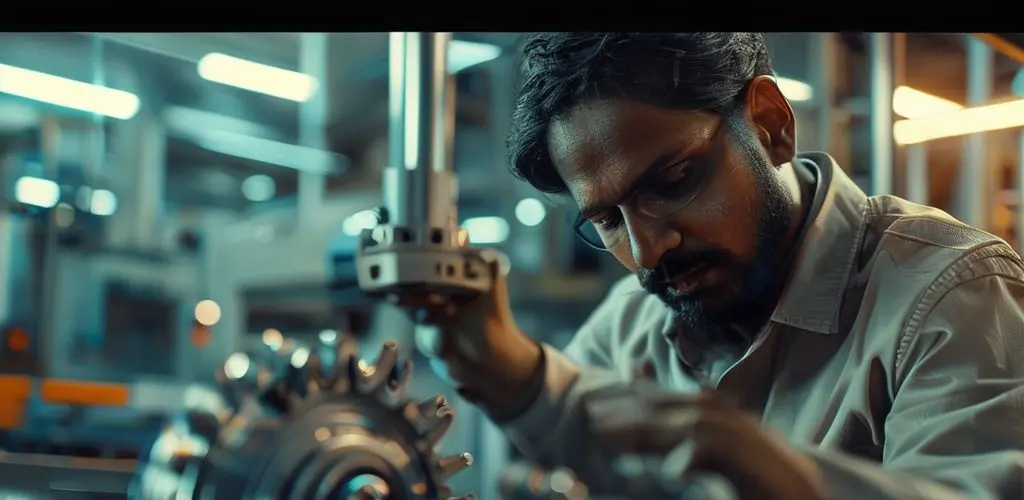
His skilled hands, calloused from years of shaping metal, traced the curves of an intricate aerospace bracket.
Traditional 3-axis CNC machines felt like a constraint.
International orders for advanced components often slipped through his fingers; designs from Europe and North America demanded geometries his machines couldn’t reach without multiple, painstaking setups.
Each reclamping introduced tiny errors, eroding client trust.
Delivering perfect parts felt like a chasm.
This gap, between India’s immense potential and the demands of high-value global manufacturing, is where innovation begins.
In short: Automated 5-axis machining is not just an upgrade; it’s a strategic imperative for India’s manufacturing sector.
This technology promises unparalleled precision, significant cost reductions, and the competitive edge needed to secure lucrative aerospace orders globally.
Why This Matters Now: Bridging the Global Divide
Mr. Sharma’s dilemma mirrors a broader challenge for India: meeting escalating demands for high-value, customized manufacturing, especially in critical sectors like aerospace.
Traditional setups struggle to produce complex components with required precision and efficiency, risking India’s potential for lucrative global orders.
However, a clear path is emerging, validated by research.
The Society of Manufacturing Engineers (SME), in its The State of Smart Manufacturing Report, highlights a strong correlation between automation and achieving higher efficiency and quality consistency in manufacturing.
This insight offers Indian manufacturers a beacon to elevate their game and meet global standards.
The Core Problem in Plain Words: Three Axes Aren’t Enough
Imagine sculpting a masterpiece with only two chisels.
This reflects the challenge many Indian manufacturers face when producing intricate components for modern aerospace, medical, and automotive industries using conventional three-axis machines.
While adequate for simpler geometries, these machines struggle with complex aerodynamic shapes, deep cavities, or features from multiple angles.
The core problem lies in multiple setups.
Each reclamping introduces potential for error, compromising dimensional accuracy and inflating production time and scrap rates.
What seems like a cost-saving measure—relying on older machinery—often leads to significant financial drains through inefficiency, rework, and lost opportunities for high-value contracts.
For instance, an Indian manufacturer specializing in automotive transmission components once struggled with a helical gear requiring machining from various angles.
Traditional 3-axis processes demanded numerous setups, resulting in geometric inconsistency.
European clients often rejected batches, hindering the company’s ambition to be a quality partner.
This highlighted the urgent need for a paradigm shift.
What the Research Really Says: The Power of Five Axes
The path to overcoming these limitations is well-trodden by advanced manufacturing economies.
The Society of Manufacturing Engineers (SME), in The State of Smart Manufacturing Report, highlights a direct correlation between higher efficiency and quality consistency and the adoption of automation.
This enables Indian manufacturers to speed up production and ensure uniform, high-quality components, transforming India’s image from a low-cost alternative to a trusted, quality-driven global partner.
Furthermore, NASA’s research on advanced manufacturing for nuclear aerospace applications underscores the critical importance of single-setup machining.
This approach is vital for maintaining dynamic balance and performance in critical features like airfoil surfaces and cooling channels.
Automated 5-axis machining excels here, performing most complex operations in a single clamping.
This eliminates errors from moving parts between machines, opening doors to highly complex aerospace component orders demanding absolute dimensional fidelity and surface finish.
Automated 5-axis technology, by enabling single-clamping operations, directly addresses these research findings, guaranteeing high accuracy, minimizing errors, and boosting productivity.
Your Playbook for Precision Today
Transitioning to automated 5-axis machining is a strategic move for industrial growth in India.
Manufacturers should prioritize machines offering a single-setup advantage, aligning with NASA’s research for dimensional fidelity in critical aerospace components, thus reducing errors and ensuring higher accuracy for precision engineering.
Integrated automation is key; SME highlights automation’s correlation with higher efficiency and quality.
Beyond the 5-axis machine, consider robotic loading systems and automated tool changers to boost productivity and consistency for CNC machining India.
Mastering advanced CAM systems is non-negotiable; 5-axis power lies in software calculating collision-free, optimized tool paths for complex cavities and fine surface finishes for high-value manufacturing.
Manufacturers should also forge strategic partnerships with providers deeply experienced in 5-axis machining and precision engineering, seeking end-to-end solutions from DFM analysis to final delivery.
Focus on talent upskilling, investing in training for engineers and operators to program, operate, and maintain advanced 5-axis systems, maximizing technology potential.
Finally, redefine your ROI, looking beyond initial purchase price and factoring in long-term savings from reduced setup times, minimized scrap rates, faster time-to-market, and increased revenue from higher-value, more complex contracts.
This holistic view reveals the true return on investment for aerospace manufacturing India.
Risks, Trade-offs, and Ethical Considerations
While compelling, automated 5-axis machining requires acknowledging potential hurdles.
The initial investment can be substantial, a critical decision for many mid-sized Indian manufacturers.
Mitigation includes exploring government incentives, phased implementation, or strategic alliances with technology providers.
A talent gap also exists; operating these sophisticated machines requires specialized skills.
The ethical consideration is to upskill and reskill existing workforces for new, higher-value roles, fostering continuous learning and implementing training programs with technical institutes.
Finally, integration complexity demands careful planning to avoid disruptions.
A phased rollout, starting with pilot projects, and robust change management strategies are essential for a smooth transition.
Tools, Metrics, and Cadence for Success
To effectively implement and monitor your 5-axis transformation, a structured approach with the right tools and metrics is vital.
Recommended tool stacks include industry-leading CAD/CAM software (e.g., Siemens NX, CATIA, Mastercam, SolidWorks CAM) for design, simulation, and optimized tool path generation.
Machine monitoring systems provide real-time data on utilization, spindle load, and tool wear, crucial for maximizing efficiency.
Robotics integration further supports automated material handling.
Key performance indicators (KPIs) are essential: manufacturers should typically target setup time reductions exceeding 50%, scrap rates below 1%, and on-time delivery (OTD) over 98%.
Machine utilization should ideally surpass 80%, alongside a clear increase in new high-value contract acquisition.
These metrics drive cost savings, improve profitability, build client trust, and maximize ROI.
For review cadence, weekly checks on machine performance are advisable, with monthly analysis focusing on scrap rates, setup times, and OTD to address bottlenecks.
Quarterly strategic reviews should assess overall efficiency, quality, and new contract acquisition, evaluating ROI.
Annually, a comprehensive technology audit helps maintain competitiveness.
FAQ: Your Questions on 5-Axis Automation
Common questions about 5-axis automation often arise.
How does automation improve manufacturing quality and efficiency?
Automation, particularly with 5-axis machines, significantly enhances quality and efficiency by reducing human error and enabling consistent processing.
The Society of Manufacturing Engineers (SME) highlights a clear correlation between automation and higher efficiency in quality consistency.
Why is single-setup machining vital for complex aerospace components?
It is crucial because it eliminates errors introduced by repositioning a part multiple times.
This is essential for maintaining dimensional fidelity and surface integrity, directly impacting dynamic balance and performance of critical features like airfoil surfaces, as noted by NASA’s research on advanced manufacturing for aerospace applications.
Can automated 5-axis machining truly transform India’s global manufacturing standing?
Yes.
By delivering unparalleled precision, significantly reducing errors, and enabling efficient production of highly complex parts, automated 5-axis machining allows Indian manufacturers to move beyond being just low-cost suppliers.
It empowers them to become quality-driven partners meeting rigorous demands of global aerospace and high-value industries, thereby transforming India’s competitiveness on the world stage.
A New Dawn for Indian Manufacturing
Returning to Mr. Sharma’s workshop, the clatter of conventional machines is now interspersed with the smooth, almost surgical hum of a new 5-axis machining center.
The air still holds the scent of metal and oil, but now, it’s infused with the faint, invigorating aroma of ambition realized.
The helical gear that once caused so many headaches is now produced with breathtaking accuracy in a fraction of the time, its flawless surface a testament to precision.
His European clients, once hesitant, are now partners, impressed by the consistent quality and speed of delivery.
This isn’t just about a machine; it’s about a mindset, a commitment to precision engineering that opens up new horizons.
For India’s industrial sector, automated 5-axis machining isn’t merely a technological upgrade—it’s a passport to the global high-value supply chain, a tool that transforms limitations into competitive advantages.
It’s time to embrace this revolution, to let the hum of advanced machinery sing India’s new song of global manufacturing excellence.
References
- NASA.
Research on advanced manufacturing for nuclear aerospace applications.
- Society of Manufacturing Engineers (SME).
The State of Smart Manufacturing Report.